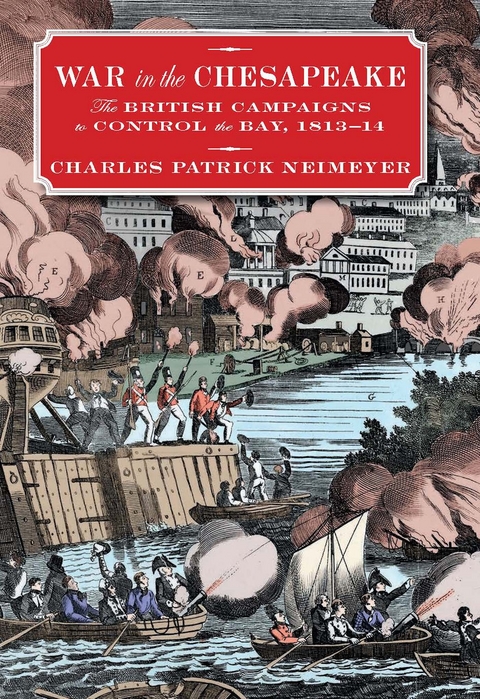
War in the Chesapeake (eBook)
256 Seiten
Naval Institute Press (Verlag)
978-1-61251-866-4 (ISBN)

Dr. Charles P. Neimeyer is currently the Director of Marine Corps History and the Gray Research Center at Marine Corps University, Quantico, Virginia. Prior to coming to Quantico, Dr. Neimeyer was the former Dean of Academics at the Naval War College and Forrest Sherman Chair of Public Diplomacy in Newport, Rhode Island and a former Vice President of Academic Affairs at Valley Forge Military Academy and College. He also previously served as a history professor at the U.S. Naval Academy and the University of Central Oklahoma. During his 20 year career as a military officer, Dr. Neimeyer served in a variety of posts and stations in the Marine Corps, including tours in all three active Marine Divisions and service at the White House. He is the author of America Goes to War: A Social History of the Continental Army, 1775 1783 (New York University Press, 1996) and The Revolutionary War (Greenwood Press, 2007). He edited a volume published by the U.S. Naval Institute in 2008 titled, On the Corps: USMC Wisdom from the pages of Leatherneck, Marine Corps Gazette, and Proceedings.
| Erscheint lt. Verlag | 15.6.2015 |
|---|---|
| Zusatzinfo | 27 b-w photos, 4 maps |
| Sprache | englisch |
| Themenwelt | Sachbuch/Ratgeber ► Geschichte / Politik ► Allgemeines / Lexika |
| Geschichte ► Allgemeine Geschichte ► Neuzeit (bis 1918) | |
| Geisteswissenschaften ► Geschichte ► Regional- / Ländergeschichte | |
| Geschichte ► Teilgebiete der Geschichte ► Militärgeschichte | |
| Sozialwissenschaften ► Politik / Verwaltung | |
| Sozialwissenschaften ► Soziologie | |
| ISBN-10 | 1-61251-866-4 / 1612518664 |
| ISBN-13 | 978-1-61251-866-4 / 9781612518664 |
| Informationen gemäß Produktsicherheitsverordnung (GPSR) | |
| Haben Sie eine Frage zum Produkt? |
 EPUB (Adobe DRM)
Kopierschutz: Adobe-DRM
Adobe-DRM ist ein Kopierschutz, der das eBook vor Mißbrauch schützen soll. Dabei wird das eBook bereits beim Download auf Ihre persönliche Adobe-ID autorisiert. Lesen können Sie das eBook dann nur auf den Geräten, welche ebenfalls auf Ihre Adobe-ID registriert sind.
Details zum Adobe-DRM
Dateiformat: EPUB (Electronic Publication)
EPUB ist ein offener Standard für eBooks und eignet sich besonders zur Darstellung von Belletristik und Sachbüchern. Der Fließtext wird dynamisch an die Display- und Schriftgröße angepasst. Auch für mobile Lesegeräte ist EPUB daher gut geeignet.
Systemvoraussetzungen:
PC/Mac: Mit einem PC oder Mac können Sie dieses eBook lesen. Sie benötigen eine
eReader: Dieses eBook kann mit (fast) allen eBook-Readern gelesen werden. Mit dem amazon-Kindle ist es aber nicht kompatibel.
Smartphone/Tablet: Egal ob Apple oder Android, dieses eBook können Sie lesen. Sie benötigen eine
Geräteliste und zusätzliche Hinweise
Buying eBooks from abroad
For tax law reasons we can sell eBooks just within Germany and Switzerland. Regrettably we cannot fulfill eBook-orders from other countries.
aus dem Bereich