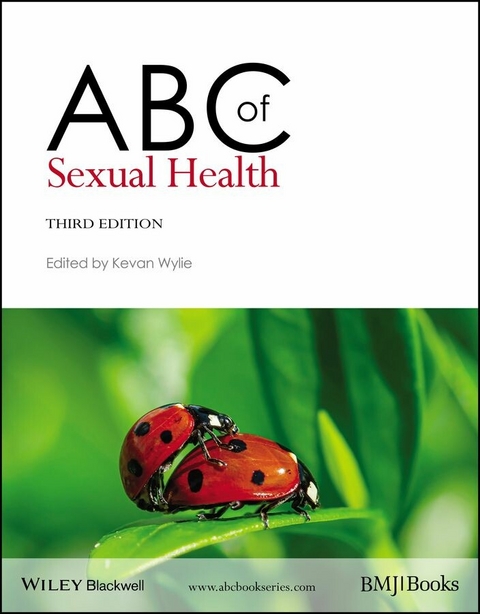
ABC of Sexual Health (eBook)
John Wiley & Sons (Verlag)
978-1-118-66561-9 (ISBN)
Fully revised and expanded to cover a range of new content and topics including psychological, urological, gynaecological, endocrinological and psychiatric aspects of sexual health, the effects of medication, sexual dysfunction, sexual orientation, gender identity, paraphilias, forensic sexology, dermatoses, and psychosexual therapy and education,
ABC of Sexual Health is a practical guide for all general practitioners, family physicians, trainees and medical students wanting to improve communicating, examining and managing patients with sexual health problems,
Kevan R, Wylie, Consultant in Sexual Medicine, NHS, Sheffield, UK; Honorary Professor, University of Sheffield and Visiting Professor, Sheffield Hallam University, UK; President, World Association for Sexual Health
ABC of Sexual Health ABC of Sexual Health provides a comprehensive overview of this important, but difficult subject and includes reading resources as well as information on professional societies, patient groups and online resources. Fully revised and expanded to cover a range of new content and topics including psychological, urological, gynaecological, endocrinological and psychiatric aspects of sexual health, the effects of medication, sexual dysfunction, sexual orientation, gender identity, paraphilias, forensic sexology, dermatoses, and psychosexual therapy and education. ABC of Sexual Health is a practical guide for all general practitioners, family physicians, trainees and medical students wanting to improve communicating, examining and managing patients with sexual health problems. About the ABC series The new ABC series has been thoroughly updated, offering a fresh look, layout and features throughout, helping you to access information and deliver the best patient care.The newly designed books remain an essential reference tool for GPs, GP registrars, junior doctors and those in primary care, designed to address the concerns of general practitioners and provide effective study aids for doctors in training. Now offering over 70 titles, this extensive series provides you with a quick and dependable reference on a range of topics in all the major specialities. Each book in the new series now offers links to further information and articles, and a new dedicated website provides you with even more support. The ABC series is the essential and dependable source of up-to-date information for all practitioners and students in general practice. To receive automatic updates on books and journals in your specialty, join our email list. Sign up today at www.wiley.com/email
Kevan Wylie, Consultant in Sexual Medicine, NHS , Sheffield, UK; Honorary Professor, University of Sheffield and Visiting Professor, Sheffield Hallam University, UK; President, World Association for Sexual Health
Series Foreword, vii
Contributors, ix
1 Psychosexual Development, 1
Brian Daines
2 Physical Aspects of Sexual Development, 4
Woet L. Gianotten
3 Anatomy and Physiology in the Male, 7
Roy J. Levin
4 Anatomy and Physiology in the Female, 12
Roy J. Levin
5 The Sexual History and Formulation, 16
Julie A. Fitter
6 The Clinical Examination of Men and Women, 21
David Goldmeier
7 Male Dermatoses, 24
Manu Shah and Chris Bunker
8 Female Dermatoses, 30
Ruth Murphy
9 Investigation and Management of Endocrine Disorders Affecting Sexuality, 34
T. Hugh Jones
10 Investigations in Sexual Medicine for Women and Men with Sexual Health Problems, 38
Irwin Goldstein and Kevan Wylie
11 Definition and Diagnosis of Sexual Problems, 43
Johannes Bitzer
12 Psychiatric Disorders and Sexuality (Including Trauma and Abuse), 47
Richard Balon
13 Medication and Sexual Dysfunction, 51
John Dean
14 Problems of Sexual Desire in Men, 55
Yacov Reisman and Francesca Tripodi
15 Problems of Sexual Desire and Arousal in Women, 59
Lori A. Brotto and Ellen T.M. Laan
16 Erectile Dysfunction, 68
Geoffrey Hackett
17 Problems of Ejaculation and Orgasm in the Male, 73
Marcel D. Waldinger
18 Problems of Orgasm in the Female, 77
Sharon J. Parish
19 Sexual Pain Disorders-Male and Female, 81
Melissa A. Farmer, Seth Davis and Yitzchak M. Binik
20 Ageing and Sexuality, 86
Alison K. Wood and Ross Runciman
21 Paraphilia Behaviour and Disorders, 90
Kevan Wylie
22 Impulsive/Compulsive Sexual Behaviour, 93
Eli Coleman
23 Forensic Sexology, 96
Don Grubin
24 Ethnic and Cultural Aspects of Sexuality, 101
Sara Nasserzadeh
25 Concerns Arising from Sexual Orientation, Practices and Behaviours, 104
Dominic Davies
26 Gender Dysphoria and Transgender Health, 108
Lin Fraser and Gail A. Knudson
27 Psychosexual Therapy and Couples Therapy, 112
Trudy Hannington
28 Bibliotherapy and Internet-based Programmes for Sexual Problems, 118
Jacques van Lankveld and Fraukje E.F. Mevissen
29 Sexual Pleasure, 121
Sue Newsome
Index, 125
Chapter 1
Psychosexual Development
Brian Daines
University of Sheffield, Sheffield, UK
Overview
- Psychosexual development is not limited to childhood and adolescence but extends through adult life
- Early psychoanalytic views of the process are still influential but more recent ideas such as consumerist and feminist perspectives offer a more societal emphasis
- It is important to consider the impact of the aspects of law and culture that relate to psychosexual development
- Clinicians need to be aware of the implications of these issues and the various factors impacting on development in their consultations with patients.
Introduction
Interest in psychosexual development has tended to focus around managing problems, particularly those associated with risks and their management. These areas include sexual abuse in childhood and early adolescence, unwanted pregnancy and sexually transmitted diseases (STDs) in adolescence and early adulthood and functional sexual difficulties in adults. In contrast, the interest, for example of adolescents has been shown to be more in the rite of passage and recreational aspects of sexual activity. There has also been a concentration on childhood and adolescence, with adult psychosexual development being a poor relation and any emphasis for older people being on dysfunctions and disorders rather than the expected course of development. Development through the life cycle involves important areas such as sexual identity, couple relationship issues, fertility and ageing.
Psychoanalytic views
Probably, the most familiar schema of sexual development in childhood and adolescence is that proposed by Freud (Table 1.1). This still has currency in many modern textbooks despite having long been superseded, not only outside of the world of psychoanalysis, but also generally among psychotherapists. A primary criticism is that it pathologizes variations in sexual development, in particular gay and lesbian relationships. With the passage of time, Freud's emphasis on instinct and drive was replaced by highlighting the importance of relating and relationship and then broadened to recognize the importance of learning and culture. Freud's theories assume that children are caught in hidden conflicts between their fears and their desires, whereas the environmental learning view is of identification through observation and imitation. Modern psychoanalytic views include a wide range of innovative ideas such as that the various dynamics in childhood produce a psychosexual core which is unstable, elusive and never felt to be really owned.
Table 1.1 Freud on psychosexual development
| Oral stage 0–2 years Desires are focussed on the lips and mouth. The mother becomes the first love-object, a displacement from the earliest object of desire, the breast |
| Anal stage 2–4 years of age In this stage, the anus is the new auto-erotic object with pleasure being obtained from controlling bladder and bowel movement |
| Phallic stage 4–7 years of age In this third stage, awareness of and touching the genitals is the primary source of pleasure |
| Latency period 7–12 years of age During this time, sexual development is more or less suspended and sexual urges are repressed |
| Genital phase 13 years + (or from puberty on) In this final phase, sexual urges are direct onto opposite sex peers with the primary focus of pleasure of the genitals |
Consumerist view
At the other end of the spectrum are ideas that take a societal perspective, such as consumer culture bringing sexuality into the world of commerce. Sex is used to sell products through sexiness and physical attractiveness being closely connected with the goods we buy and are seen to own. This aspect of sex and consumerism is particularly directed towards girls and women. A further development is when sex itself is marketed as pleasure or the idea of sexual self-expression is promoted. The world is sexualized, and there is a seduction into the world of responding to sexual impulse. On the Internet in particular, representations of the body become products to buy. This becomes the world into which children and adolescents are socialized and encouraged to participate. As we grow up, sexuality becomes increasingly focussed on technique and performance with a tendency for it to come to resemble work risking the loss of much of its intimate and caring qualities.
Feminist views
The feminist perspective is that gender shapes our personality and social life and that our sexual desires, feelings and preferences are deeply rooted by our gender status. The identification between mothers and daughters leads girls to become very relationship-orientated. This promotes the connection of sex with intimacy and the valuing of its caring and sharing aspects. It develops as a means of communication and intimacy rather than a source of erotic pleasure. In contrast, boys develop a more detached relationship with their mothers and do not have the same kind of identification with their fathers and this leads them to be more goal-orientated around sexuality. There is more of an emphasis on pleasure and on performance. It is also argued that girls' identification with their mothers makes their heterosexual identification weaker than that of boys.
Definition of childhood and adolescence
The nature of childhood and adolescence has been subject to debate and controversy. Whilst all acknowledge that the nature of both has changed in Western culture over the centuries, there is some dispute about when the idea of childhood as a distinctive phase began, and it has been suggested that the idea we have currently of adolescence did not exist before the beginning of the twentieth century. It has also been argued that the concept of childhood makes children more vulnerable including to sexual exploitation and abuse. The idealization of childhood may also contribute to the sexual attraction of children to certain adults.
The impact of law and culture
Aspects of the definitions of childhood and adolescent become enshrined in law particularly in defining the age of consent for sex and what kinds of sexual practices are legal. It also defines a framework for marriage, and alongside this are cultural issues about the acceptability of sexual relationships outside of this. In different countries, the age of consent varies from 12 to 21 for heterosexual, gay and lesbian relationships, but in many countries same-sex relationships are still illegal. The position is complicated by the fact that these arrangements are often subject to review and potential change.
Although it is clearly interwoven, law is only one of the forces at work here as family, religion, culture and mass media also influence teenage attitudes and behaviour. All these forces work together in ways that overlap, support and sometimes contradict one another in the emergence of a normative version of teenage sexuality.
Childhood development
Young children show behaviours that indicate awareness of sexual organs and pleasuring very early and preschoolers are often puzzled by sexual anatomical differences. By the age of 2 or 3, they become aware of their gender and aspects of gender role. Children often have a need for the validation and correction of their sexual learning, but adults often do not feel well-informed about childhood sexuality and, as a consequence, are not confident about how to respond in their care of children. Play such as doctors and nurses and looking at genitals are all common during the preschool and early school years and as many as half of all adults remember this kind of childhood sexual play. The discovery of such activities can give parents and caregivers an opportunity to educate and share values. An example of this would be that another person should not touch them in a way that makes them feel afraid, confused or uncomfortable. Activities between children such as those involving pain, simulated or real penetration or oral–genital contact should raise concerns and may be related to exposure to inappropriate adult entertainment or indicate sexual abuse. School-age children are usually able to understand basic information about sexuality and sexual development and may look to various sources for information, such as friends and the Internet.
Adolescent development
Early teenage development can be characterized by concerns about normality, appearance and attractiveness. As girls' physical development is usually more advanced than that of boys of the same age, they may experience sexual feelings earlier and be attracted to older, more physically mature boys. Those who have early intercourse have been found to have lower self-esteem than virgins, unlike boys for whom intercourse is more socially acceptable. For boys, there is evidence that both peers and families can potentially either support or undermine sexual development and that health care providers may have more influence than they presume. The middle phase sees the exploration of gender roles and an awareness of sexual orientation. Fantasies are idealistic and romanticized, and sexual experimentation and activity often begin in relationships that are often brief and self-serving. Online...
| Erscheint lt. Verlag | 27.4.2015 |
|---|---|
| Reihe/Serie | ABC Series |
| ABC Series | ABC Series |
| Sprache | englisch |
| Themenwelt | Sachbuch/Ratgeber ► Gesundheit / Leben / Psychologie ► Partnerschaft / Sexualität |
| Medizin / Pharmazie ► Medizinische Fachgebiete ► Urologie | |
| Schlagworte | Allgemeine u. Innere Medizin • General & Internal Medicine • Medical Science • Medizin • Sexual Medicine • Sexualmedizin • Sexuelle Gesundheit |
| ISBN-10 | 1-118-66561-9 / 1118665619 |
| ISBN-13 | 978-1-118-66561-9 / 9781118665619 |
| Informationen gemäß Produktsicherheitsverordnung (GPSR) | |
| Haben Sie eine Frage zum Produkt? |
 EPUB (Adobe DRM)
Kopierschutz: Adobe-DRM
Adobe-DRM ist ein Kopierschutz, der das eBook vor Mißbrauch schützen soll. Dabei wird das eBook bereits beim Download auf Ihre persönliche Adobe-ID autorisiert. Lesen können Sie das eBook dann nur auf den Geräten, welche ebenfalls auf Ihre Adobe-ID registriert sind.
Details zum Adobe-DRM
Dateiformat: EPUB (Electronic Publication)
EPUB ist ein offener Standard für eBooks und eignet sich besonders zur Darstellung von Belletristik und Sachbüchern. Der Fließtext wird dynamisch an die Display- und Schriftgröße angepasst. Auch für mobile Lesegeräte ist EPUB daher gut geeignet.
Systemvoraussetzungen:
PC/Mac: Mit einem PC oder Mac können Sie dieses eBook lesen. Sie benötigen eine
eReader: Dieses eBook kann mit (fast) allen eBook-Readern gelesen werden. Mit dem amazon-Kindle ist es aber nicht kompatibel.
Smartphone/Tablet: Egal ob Apple oder Android, dieses eBook können Sie lesen. Sie benötigen eine
Geräteliste und zusätzliche Hinweise
Buying eBooks from abroad
For tax law reasons we can sell eBooks just within Germany and Switzerland. Regrettably we cannot fulfill eBook-orders from other countries.
aus dem Bereich