


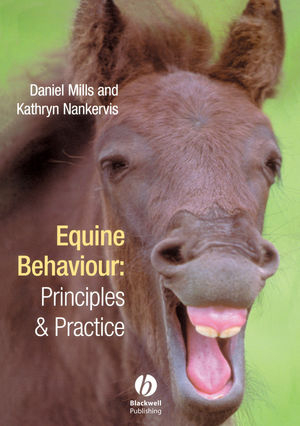
Equine Behaviour (eBook)
John Wiley & Sons (Verlag)
978-1-118-70806-4 (ISBN)
Daniel Mills BVSc, MRCVS is a Veterinary Surgeon and Senior Lecturer in Behavioural Studies at De Montfort University, Lincoln, from where he also runs a referral behaviour clinic, and Kathryn Nankervis BSC (Hons), MSc is a Lecturer in Equine Physiology at De Montfort University, Lincoln. She is also the founder of the Equi-Tutor Learning Programme.
Understanding the flexibility and limits of behaviour is essential to improving both the horse's welfare and its performance. This book tackles the fundamental principles which will enable owners, riders, trainers and students to understand scientific principles and apply them in practice. Subjects covered include the analysis of influences on equine behaviour, the perceptual world of the horse, learning and training techniques including the latest developments in "e;join-up"e; and "e;imprint training"e;.
Daniel Mills BVSc, MRCVS is a Veterinary Surgeon and Senior Lecturer in Behavioural Studies at De Montfort University, Lincoln, from where he also runs a referral behaviour clinic, and Kathryn Nankervis BSC (Hons), MSc is a Lecturer in Equine Physiology at De Montfort University, Lincoln. She is also the founder of the Equi-Tutor Learning Programme.
Preface vii
Acknowledgements viii
Part One: Understanding Behaviour Concepts 1
1 Approaches to the Study of Behaviour 3
What is behavior 3
Ethology versus psychology 6
A brief guide to conducting a behaviour study 9
Conclusion 15
Topics for discussion 16
References and further reading 16
2 Origins of Behaviour 18
An evolutionary approach to understanding behavior 18
Lamarck versus Darwin 19
Genes not individuals 22
Evolutionary throwbacks and genetic jumps 26
Adaptation and apparent stupidity in domestic horses 27
Evolution and the variety of behavior 29
Conclusion 31
Topics for discussion 31
References and further reading 32
3 The Evolutionary History of the Horse 33
Introduction 33
Early evolution of the horse 38
The arrival of Equus 43
The origins of the modern breeds 45
Domestication and its consequences 47
Topics for discussion 52
References and further reading 52
4 The Lifetime Development of Behaviour 53
Instinctive and learned behaviour, what is the difference? 53
Sensitive phases for specia1 times specific associations 56
Using play for better management 58
Using natural biases in development to improve management 60
Conclusion 65
Topics for discussion 65
References and further reading 66
Part Two: Mechanisms of Behaviour 67
5 The Processing, of Information 69
Introduction 69
The nervous system 69
Neural transmission 72
Central processing 80
Behavioural motivation 84
Autonomic and somatic nervous system 88
Topics·for discussion 89
References and further reading 90
6 The Special Senses 91
Sight 91
Hearing 99
Chemoreception 102
Cutaneous sensation 107
Topics for discussion 108
References and further reading 108
7 Communication and Social Organisation 110
Communication 110
Social organisation 125
The composition of the group 129
The social structure of the group 129
The dynamics of the group 133
How horses defend their resources 134
Conclusion 136
Topics for discussion 137
References and further reading 137
8 Sexual and Reproductive Behaviour of Horses 139
Basic genetic foundation of the individual's sexuality 139
Normal mare specific behavior 140
Normal sexual specific behaviour l49
Modifiers of the genetic blueprint 153
Conclusion 160
Topics for discussion 160
References and further reading l60
Part Three: The flexibility of Behaviour and its Management 163
9 Learning and Training 165
Psychological processes 165
A few basic procedures 167
App1ying reinforcement to train new behaviours 176
Punishment and its problems 180
General guidelines to training new behaviours 182
Learning beyond a change in behaviour 183
Training techniques for problem behaviours 186
Conclusion 193
Topics for discussion 164
References and further reading 194
10 Welfare 196
Understanding welfare 196
What is right is not always the same as what is good 196
Measuring welfare 197
ls the domestic horse a fish out of water? 205
Stereotypies 210
Principles of treatment for stereotypies and other behaviour problems 220
Conclusion 224
Topics for discussion 224
References and further reading 225
Appendix 226
Index 227
1
Approaches to the Study of Behaviour
We may be motivated in our study of behaviour by the hope that we can improve the performance of our own horse in some particular way, seeking to make it do what we want, but in studying horse behaviour and its origins and management in general terms, we should not forget that not all horses are winners. You may be disappointed that the horse you had high hopes for turns out to be completely talentless, despite your strenuous efforts to ‘understand’ him. The problem may not lie with the method used, but with the potential of the horse. In other words, the horse’s behaviour is a product of both its biology and its environment or ‘nature and nurture’, as many people call it. We should not get so wrapped up in our role in ‘nurturing’, that we forget about the ‘nature’ of horses in general and that horse in particular.
What is behaviour?
Behaviour is what living animals do, and what dead animals don’t do. Behaviour is an expression of physiology. There are two broad ways in which we tend to describe behaviour:
A horse dozing in a field is performing just as much behaviour as a horse that is fighting, riding a bike, or turning somersaults! These are all complex actions which involve the integration of several behavioural acts. The mechanism that allows a horse to sleep standing up is, in itself, a really neat piece of engineering. Contrary to popular belief, however, horses still need to spend a certain amount of time lying down in order to sleep properly. Management can have an effect on even this. Houpt (1991) reports that horses which are usually stabled sleep less for the first month after turn out, and do not even get down to sleep on the first night. Since sleep is essential for the normal functioning of an animal during its waking hours we should not be surprised if the performance of the horse is affected by such a management change. This simple example highlights an important theme: we cannot understand an animal’s behaviour without referring to its environment. Horses do certain things in certain environments.
Why do horses gallop?
Niko Tinbergen pointed out that if we wanted to know why an animal performs a certain behaviour, there are always four very different, but equally correct answers. For example, if we ask the question, ‘why do horses gallop?’ the answer could be:
We could go even further by saying that the nerve impulses and muscle contractions occurred because of certain physiological and biochemical changes, and give a string of chemical equations in order to explain why the horse was galloping. This is the most basic answer, looking at the horse as though it were a piece of machinery. This answer, where the idea is to try and explain the behaviour in terms of its immediate cause and control, explains the causation of behaviour.
This approach is to explain the behaviour in terms of the developmental history (the ontogeny) of the behaviour within an individual.
This explains the behaviour in terms of its development not within an animal’s lifetime history but within the history of the species. The evolutionary history of a behaviour explains how it is adapted to its environment and is often referred to as its phylogeny.
This offers an explanation as to the function of the behaviour. The function of the behaviour tells us its survival value.
The first two answers explain how a horse manages to gallop, whilst answers three and four consider the purpose of galloping, but they are all correct. When asking ourselves ‘why does...?’, we must appreciate that there are several different approaches and several answers. In order to understand behaviour fully we need to recognise and understand these four different approaches.
Fig. 1.1 Answers to Tinbergen’s four questions.
Ethology versus psychology
The study of behaviour therefore requires the application of several biological sciences. Traditionally these have been focussed into two broad overlapping disciplines, each with a different emphasis: ethology and psychology.
The early ethologists were mainly involved with the study of wild animals in their natural environment, believing that the forces of evolution had adapted the behaviour of animals. Ethologists, therefore, tended to concentrate on those aspects of behaviour which were inherited from one generation to the next, especially the genetic aspects of behaviour. Niko Tinbergen (1952) wrote: ‘Learning and many other higher processes are secondary modifications of innate mechanisms’. To him and other early ethologists the nature of inherited behaviour was its most important feature.
Early psychologists, on the other hand, were more interested in the development of behaviour within the individual, and concentrated on trying to establish general and universal laws affecting behaviour and how it changes with learning. In this case one species of animal was often considered as good as another for modelling the general behaviour mechanisms of animals. They tended to emphasise the importance of the environment and nurturing. This is typified by the words of one of the most famous early psychologists, John Watson:
’Give me a dozen healthy infants, well formed, and my own specified world to bring them up in and I’ll guarantee to take any one of them at random and train him to become any specialist I might select: doctor, lawyer, merchant, chief and yes, even beggar man and thief, regardless of his talents, peculiarities, tendencies, abilities, vocations and race of his ancestors.’ (Watson 1913).
Because they were interested in different aspects of behaviour ethologists and psychologists had very different ways of studying it.
In the first half of the twentieth century furious arguments raged on the nature–nurture debate: psychologists demonstrated how flexible and changeable ‘instinctive’ behaviours were, and ethologists showed how animals would inherently respond to certain stimuli without learning. It is only as recently as the 1970s that the two sides really accepted that they were both making valid contributions, and that most progress would be made if they put their heads together.
Fig. 1.2 Different approaches to the study of animal behaviour.
The modern synthesis
The disciplines of psychology and ethology not only complement each other well but are inextricably linked. You cannot have behaviour without both nature and nurture. Behaviour is the consequence of the constant interaction of genetic factors with the environment; a process called epigenesis. Indeed, we could describe behaviour as a phenotypic characteristic, just like size or coat colour. Unlike other phenotypic characteristics, however, behaviour is variable on a day-to-day, or even a minute-by-minute basis.
McFarland (1993) suggests that the environment and genetics are to behaviour what length and breadth are to a field. You cannot have a field without both of these dimensions. We should resist the temptation to talk about behaviour patterns being either genetic or learned, as if only one of these factors were important in determining behaviour. The combination of genetics and the environment sets the limits for the behaviour, just as length and breadth determine the boundaries of the field. They set the limits of an individual’s ability and suggest certain predispositions. You would not go out and buy a Shetland pony from a children’s farm if you had set your sights on getting round Badminton.
The constant remoulding of an animal’s inherent behavioural tendencies by its environment is important from a training aspect. Horses do not just ‘behave’ because ‘that’s the way they are’, they respond to their environment according to their abilities. In attempting to train the horse, we become part of its environment. This is a big responsibility, which we must be prepared to accept if we hope to be able to tap the horse’s ability. We must make an effort to understand why a horse behaves in a particular way, and not just try to manipulate the results of the behaviour we see.
Techniques developed for studying behaviour in one discipline have also been borrowed by the other and resulted in great advances in our scientific understanding of...
| Erscheint lt. Verlag | 20.5.2013 |
|---|---|
| Sprache | englisch |
| Themenwelt | Sachbuch/Ratgeber ► Natur / Technik ► Tiere / Tierhaltung |
| Naturwissenschaften ► Biologie | |
| Technik | |
| Veterinärmedizin ► Großtier | |
| Schlagworte | Behavior • Behaviour • Book • certain • constraints • Equine • Essential • every • Evolutionary • extent • flexibility • fundamental • History • horse • Horses • Limits • Modern • Nature • Owners • Part • Performance • Person • Pferd • Pferdeforschung • Principles • students |
| ISBN-10 | 1-118-70806-7 / 1118708067 |
| ISBN-13 | 978-1-118-70806-4 / 9781118708064 |
| Informationen gemäß Produktsicherheitsverordnung (GPSR) | |
| Haben Sie eine Frage zum Produkt? |
 EPUB (Adobe DRM)
Kopierschutz: Adobe-DRM
Adobe-DRM ist ein Kopierschutz, der das eBook vor Mißbrauch schützen soll. Dabei wird das eBook bereits beim Download auf Ihre persönliche Adobe-ID autorisiert. Lesen können Sie das eBook dann nur auf den Geräten, welche ebenfalls auf Ihre Adobe-ID registriert sind.
Details zum Adobe-DRM
Dateiformat: EPUB (Electronic Publication)
EPUB ist ein offener Standard für eBooks und eignet sich besonders zur Darstellung von Belletristik und Sachbüchern. Der Fließtext wird dynamisch an die Display- und Schriftgröße angepasst. Auch für mobile Lesegeräte ist EPUB daher gut geeignet.
Systemvoraussetzungen:
PC/Mac: Mit einem PC oder Mac können Sie dieses eBook lesen. Sie benötigen eine
eReader: Dieses eBook kann mit (fast) allen eBook-Readern gelesen werden. Mit dem amazon-Kindle ist es aber nicht kompatibel.
Smartphone/Tablet: Egal ob Apple oder Android, dieses eBook können Sie lesen. Sie benötigen eine
Geräteliste und zusätzliche Hinweise
Buying eBooks from abroad
For tax law reasons we can sell eBooks just within Germany and Switzerland. Regrettably we cannot fulfill eBook-orders from other countries.


