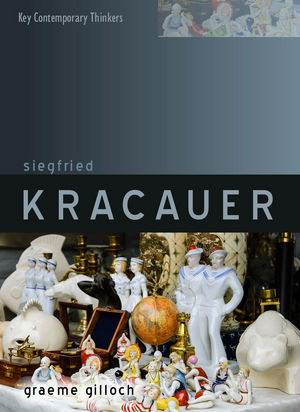
Siegfried Kracauer (eBook)
John Wiley & Sons (Verlag)
978-0-7456-8949-4 (ISBN)
Graeme Gilloch is Reader in Sociology at the University of Lancaster
This major new book offers a much-needed introduction to the work of Siegfried Kracauer, one of the main intellectual figures in the orbit of the Frankfurt School of Critical Theory. It is part of a timely revival and reappraisal of his unique contribution to our critical understanding of modernity, the interrogation of mass culture, and the recognition of both the dynamism and diminution of human experience in the hustle and bustle of the contemporary metropolis. In stressing the extraordinary variety of Kracauer s writings (from scholarly philosophical treatises to journalistic fragments, from comic novels to classified reports) and the dazzling diversity of his themes (from science and urban architectural visions to slapstick and dancing girls), this insightful book reveals his fundamental and formative influence upon Critical Theory and argues for his vital relevance for cultural analysis today.Kracauer s work is distinguished by an acute sensitivity to the surface manifestations of popular culture and a witty, eminently readable literary style. In exploring and making accessible the work of this remarkable thinker, this book will be indispensable for scholars and students working in many disciplines and interdisciplinary fields: sociology and social theory; film, media and cultural studies; urban studies, cultural geography and architectural theory; philosophy and Critical Theory.
Graeme Gilloch is Reader in Sociology at the University of Lancaster
Our Companion Introduced: An Intellectual Schwejk
Part I From Inner Life: Sociological Expressionism
Chapter 1 Small Mercies: The Spirit of our Times
Chapter 2 Portraits of the Age
Part II From Our Weimar Correspondent: The "Newest
Germany" and Elsewhere
Chapter 3 On the Surface: The Dialectics of Ornament
Chapter 4 Berlin Impromptus
Part III From the Boulevards: Paris of the Second Empire in
Kracauer
Chapter 5 Offenbach in Paris
Chapter 6 Orpheus in Hollywood
Part IV From the New World: Monstrous States, Mental Images
Chapter 7 The Caligari Complex
Chapter 8 Re-Surfacing Work
Part V From the Screen: Redeeming Images, Remembered Things
Chapter 9 Film, Improvisation and "The Flow of
Life"
Chapter 10 Film, Phantasmagoria and the Street
Inconclusive: Penultimate Things
"Our Companion in Misfortune is an evocative and engaging
portrait with much fresh insight into Kracauer's wide-ranging
and imaginative work as theorist and critic of media and
metropolitan experience. Gilloch successfully captures
Kracauer's distinctive voice in its mix of melancholy and
sharp wit. Much more than an introduction, this book gives its due
to Kracauer as a major figure in the orbit of Frankfurt School
Critical Theory."
Andreas Huyssen, Columbia University
"Kracauer may "rest a while in peace", but only for a
while. Gilloch's magisterial study, forces a return to
Kracauer. Music, film, the city and his own literary attempts tie
Kracauer to the modern. The book reveals a thinker who, in
responding to the demands of his own time, writes and thinks in a
way that addresses the contemporary. There is an acuity of thought
that allows Kracauer to engage our modernity. Gilloch's own
power as a writer and a thinker is to stage that engagement. This
is an invaluable book whose presence should be both welcomed and
celebrated."
Andrew Benjamin, Monash University
Our Companion Introduced: An Intellectual Schwejk
1 The Path to Be Followed
I imagine the critical theorist Siegfried Kracauer standing at a crossroads, the kind of junction envisaged by the French sociologist Henri Lefebvre in his study Everyday Life in the Modern World when he reflects:
We have now reached a junction, a kind of crossroads, and we could do worse than to examine the lie of the land before we proceed any further. Behind us, as we stand at their point of intersection, are the way of philosophy and the road of everyday life. They are divided by a mountain range, but the path of philosophy keeps to the heights, thus overlooking that of everyday life; ahead the track winds, barely visible, through thickets, thorn bushes and swamps. (2000: 17)
There would be those among us who, fearful of the meandering path ahead and what might be lurking unseen in its undergrowth, would turn tail and head for the security and prospects of the high ground. Others, wrinkling their noses in distaste, would seek to preserve their dignity and distance by treading with disdain as they seek to circumnavigate the difficult terrain ahead, all the while bemoaning their lot and the foolishness of their guide.
There are those rare talents who have come thus far by old smugglers' routes, and who have the arcane wisdom to find yet more long forgotten and forbidden tracks through the mire (Walter Benjamin is one such perhaps). And there are those, like Kracauer, for whom, with pipe clenched between the teeth, nothing could be more intriguing, enticing and, indeed, important than the overgrown wilderness ahead.
The concrete world of the everyday was his terrain of choice. This is not to say that he was unfamiliar with the high ground of philosophy – after all, he was Theodor W. Adorno's first unofficial tutor in Kantian thought1 – or that his works lacked philosophical themes, insights and profundity. Far from it – these are all present and correct though often in curious guise. But he was drawn unerringly to those uninviting ‘thickets, thorn bushes and swamps’ of everyday life. This is the true landscape, not only of his own thinking, but of film, his most beloved medium and the dominant motif of his later writings. ‘Landscape’, though, is perhaps not the right word here: cityscape is more appropriate. For Kracauer remains one of the most sensitive and subtle analysts of the experience and culture of metropolitan modernity – its teeming crowds and noisy traffic; its brilliant lights and sparkling surfaces; its streets and architecture; its manifold distractions and diversions; its dismal leavings and left-overs. He had an acute eye for all those seemingly insignificant and ephemeral phenomena of the city that others blithely overlook and undervalue.2 As a radical ‘ragpicker at daybreak’3 he recognized their profound potential for the critical unmasking and debunking of prevailing capitalist power and its central mythology of rational technological progress. All such myriad and momentary figures and forms of quotidian life fascinated Kracauer and found exquisite expression in writings penned in five great cities – Frankfurt am Main, Berlin, Paris, Marseilles and New York – and spanning the calamitous events and catastrophes of the first half of the twentieth century.
For me, three things distinguish Kracauer's works and make them so enjoyable and exciting for the reader today, nearly fifty years after his death. Firstly, there is the sheer variety of his writings in terms of their form, let alone their thematic and conceptual range: long unpublished treatises dating from the years of the Great War, steeped in the tenets and traditions of Lebensphilosophie;4 feuilleton fragments of all kinds written as journalist, reviewer and editor for the Frankfurter Zeitung and attesting to the daily life of Frankfurt and Berlin during the Weimar years; assorted fictional writings, including a novella, a short story or two, and two full-length quasi-autobiographical novels; ‘biographical’ studies of a peculiar and pioneering kind; sketches of screenplays and film ‘treatments’; scripts and questionnaires for a psychological experiment; articles for both academic journals and popular magazines; confidential reports for government agencies; essay collections; three books written in his adopted English language in ‘permanent exile’ in post-war New York; and even a few adolescent poems. Kracauer was a prolific and hugely adaptable writer who managed to live through the most turbulent and traumatic of times by means of his typewriter.
Secondly, despite this heterogeneity of textual production and the most varied of circumstances across many years, Kracauer's works exhibit a characteristic style and exude a particular tone. Doubtless because they were so often intended to appeal to a wide public, his writings tend to eschew the technical language and tropes of scholarly writing in favour of the vernacular and the everyday. Unlike so much scholarship, then and now, Kracauer's texts are both accessible and readable.5 And this is true in some measure even of his earliest philosophical texts where the most intricate of ideas are presented with an enviable clarity of expression and precision in phrasing. This is complexity of thought without convolution, sophistication of argument without showiness. For me, the very ease and directness of his writing belies the skill of his textual strategies. It would be easy to underestimate the powerful work of his prose, especially when it might seem a touch pedestrian. Time and again it winds its way through seemingly commonplace examples and turns of phrase to arrive suddenly at an extraordinary and unexpected insight. Looking back at the pages already turned, one realizes that what had hitherto seemed detours and digressions were in fact the only paths to this point. Not a word has been wasted en route: this is what one might term writing recaptured.
And then there is Kracauer's distinctive tone, one that is both enlivened and enlightened by wit and humour and yet, at the same time, imbued with a sense of melancholy. Ginster, in many ways Kracauer's comic masterpiece,6 whose eponymous protagonist is a Chaplinesque7 everyman and would-be good soldier, like Jaroslav Hašek's unforgettable Schwejk,8 does not compel the reader to laugh out loud but, rather, to smile ruefully at the idiocy of characters and irony of social conditions against the apocalyptic backdrop of the Great War. And then there is the scorn which, years later, Kracauer heaps upon the incipient world of human resources and aptitude tests investigated in his 1929 ethnography of Berlin's white-collar workers, Die Angestellten (chapter 3). It is in the unlikely figure of the composer Jacques Offenbach (chapters 5 and 6) that Kracauer finds his kindred spirit: on the one hand, a delightful ‘mocking bird’ whose operettas parroted and parodied Parisian life under the Second Empire; on the other, a musician with an ear for the sorrowful condition of humanity, the sufferings attendant upon love and loss, and the hope of redemption embodied in the figure of Orpheus.9 His own proposals for films were for comedies – not just the Offenbach motion picture (chapter 6) but also his suggestions for an adaptation of a Tartarin adventure (based on novels by Leon Daudet) and Dimanche (chapter 10). Indeed, American slapstick film comedies (Grotesk) and Hollywood musical romances constituted for him exemplary cinematic forms (chapter 9). Although there are high jinks to be had at high altitudes – as Tartarin, Charlie Chaplin, Harold Lloyd and others certainly demonstrate – Kracauer's own way lay through the lowlands and not for fear of falling: for him, this was where the real fun was to be had.
This gravitation towards the comic has its serious side: as we will see in chapters 9 and 10, there is a profound utopian aspect here. And, significantly, it draws Kracauer to popular culture, not only the madcap capers of slapstick film comedy but also the clowning of acrobats and others in theatrical revues, even the drunken reveries of washed-up piano players. My third point then is this: Kracauer had a genuine penchant for popular culture. Indeed, of all those who might have some claim to the title of critical theorist, Kracauer was the only one to treat popular modern culture both seriously as an object of analysis and in a spirit of openness and critical appreciation. He was not immune to the high cultural aesthetics vaunted by bourgeois Bildung and embodied in German Kultur; nor was he blind to the ideological functions and commodification processes inherent in the capitalist culture industries, as is evident in his more Marxist moments. But his writings point both to the search for a more sociological engagement with metropolitan mass culture and to the formation of a radically new set of criteria for evaluating the role and significance of the emergent mass media. His comments on the ‘mass ornament’ and his early response to photography, for example, are for the most part critical, but there is also a significant degree of ambivalence: as he makes clear in each case, these are wholly legitimate expressions of the modern condition and important in that they exemplify its tensions and contradictions in acute form (chapters 2 and 3)....
| Erscheint lt. Verlag | 31.3.2015 |
|---|---|
| Reihe/Serie | Key Contemporary Thinkers |
| Key Contemporary Thinkers | Key Contemporary Thinkers |
| Sprache | englisch |
| Themenwelt | Literatur ► Biografien / Erfahrungsberichte |
| Kunst / Musik / Theater ► Film / TV | |
| Sachbuch/Ratgeber ► Geschichte / Politik | |
| Geisteswissenschaften ► Sprach- / Literaturwissenschaft ► Anglistik / Amerikanistik | |
| Geisteswissenschaften ► Sprach- / Literaturwissenschaft ► Literaturwissenschaft | |
| Sozialwissenschaften ► Kommunikation / Medien ► Medienwissenschaft | |
| Sozialwissenschaften ► Politik / Verwaltung | |
| Sozialwissenschaften ► Soziologie ► Allgemeine Soziologie | |
| Schlagworte | Critical Theory, Frankfurt School, media, cultural studies, cultural theory, social theory, modernity, metropolis • Cultural Studies • Gesellschaftstheorie • Kracauer, Siegfried • Kulturwissenschaften • Social Theory • Sociology • Soziologie |
| ISBN-10 | 0-7456-8949-3 / 0745689493 |
| ISBN-13 | 978-0-7456-8949-4 / 9780745689494 |
| Informationen gemäß Produktsicherheitsverordnung (GPSR) | |
| Haben Sie eine Frage zum Produkt? |
 EPUB (Adobe DRM)
Kopierschutz: Adobe-DRM
Adobe-DRM ist ein Kopierschutz, der das eBook vor Mißbrauch schützen soll. Dabei wird das eBook bereits beim Download auf Ihre persönliche Adobe-ID autorisiert. Lesen können Sie das eBook dann nur auf den Geräten, welche ebenfalls auf Ihre Adobe-ID registriert sind.
Details zum Adobe-DRM
Dateiformat: EPUB (Electronic Publication)
EPUB ist ein offener Standard für eBooks und eignet sich besonders zur Darstellung von Belletristik und Sachbüchern. Der Fließtext wird dynamisch an die Display- und Schriftgröße angepasst. Auch für mobile Lesegeräte ist EPUB daher gut geeignet.
Systemvoraussetzungen:
PC/Mac: Mit einem PC oder Mac können Sie dieses eBook lesen. Sie benötigen eine
eReader: Dieses eBook kann mit (fast) allen eBook-Readern gelesen werden. Mit dem amazon-Kindle ist es aber nicht kompatibel.
Smartphone/Tablet: Egal ob Apple oder Android, dieses eBook können Sie lesen. Sie benötigen eine
Geräteliste und zusätzliche Hinweise
Buying eBooks from abroad
For tax law reasons we can sell eBooks just within Germany and Switzerland. Regrettably we cannot fulfill eBook-orders from other countries.
aus dem Bereich