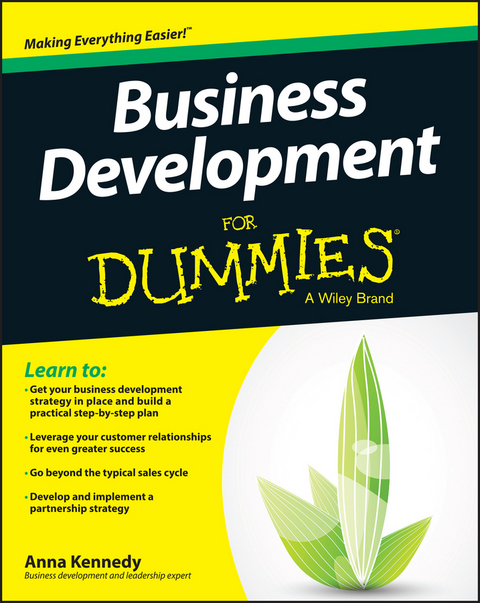
Business Development For Dummies (eBook)
John Wiley & Sons (Verlag)
978-1-118-96270-1 (ISBN)
Business Development For Dummies helps maximise the growth of small- or medium-sized businesses, with a step-by-step model for business development designed specifically for B2B or B2C service firms, By mapping business development to customer life cycle, this book helps owners and managers ensure a focus on growth through effective customer nurturing and management, It's not just sales! In-depth coverage also includes strategy, marketing, client management, and partnerships/alliances, helping you develop robust business practices that can be used every day, You'll learn how to structure, organise, and execute an effective development plan, with step-by-step expert guidance,
Realising that you can't just 'hire a sales guy' and expect immediate results is one of the toughest lessons small business CEOs have to learn, Developing a business is about more than just gaining customers - it's about integrating every facet of your business in an overarching strategy that continually works toward growth, Business Development For Dummies provides a model, and teaches you what you need to know to make it work for your business,
- Learn the core concepts of business development, and how it differs from sales
- Build a practical, step-by-step business development strategy
- Incorporate marketing, sales, and customer management in general planning
- Develop and implement a growth-enhancing partnership strategy
Recognising that business development is much more than just sales is the first important step to sustained growth, Development should be daily - not just when business starts to tail off, or you fall into a cycle of growth and regression, Plan for growth, and make it stick - Business Development For Dummies shows you how,
Anna Kennedy has almost twenty years' experience in business development and leadership with small/medium professional services companies, She also has on-the-ground experience in growing organizations, most recently in her own company, Rain Makers,
Growing a small business requires more than just sales Business Development For Dummies helps maximise the growth of small- or medium-sized businesses, with a step-by-step model for business development designed specifically for B2B or B2C service firms. By mapping business development to customer life cycle, this book helps owners and managers ensure a focus on growth through effective customer nurturing and management. It's not just sales! In-depth coverage also includes strategy, marketing, client management, and partnerships/alliances, helping you develop robust business practices that can be used every day. You'll learn how to structure, organise, and execute an effective development plan, with step-by-step expert guidance. Realising that you can't just "e;hire a sales guy"e; and expect immediate results is one of the toughest lessons small business CEOs have to learn. Developing a business is about more than just gaining customers it's about integrating every facet of your business in an overarching strategy that continually works toward growth. Business Development For Dummies provides a model, and teaches you what you need to know to make it work for your business. Learn the core concepts of business development, and how it differs from sales Build a practical, step-by-step business development strategy Incorporate marketing, sales, and customer management in general planning Develop and implement a growth-enhancing partnership strategy Recognising that business development is much more than just sales is the first important step to sustained growth. Development should be daily not just when business starts to tail off, or you fall into a cycle of growth and regression. Plan for growth, and make it stick Business Development For Dummies shows you how.
Anna Kennedy has almost twenty years' experience in business development and leadership with small/medium professional services companies. She also has on-the-ground experience in growing organizations, most recently in her own company, Rain Makers.
Chapter 1
Introducing Business Development for Services Firms
In This Chapter
Defining business development
Looking through your customer’s eyes
Making time for business development
If you ask ten people what they think business development is, you probably get ten different answers. Chances are that even your own view of business development isn’t completely aligned with others in your organization, unless you’ve taken special and unusual steps to make it so.
Whether you’re a business owner, involved in business development or just interested in discovering more, you probably inherited your view of business development from your business experiences, gleaned it from Google, created it yourself or perhaps used a mix of all these influences.
In this chapter, I set the scene for the whole book, providing a clear definition of business development, which involves strategy (see the chapters in Part II), marketing (Part III), sales (Part IV), customer management (Part V) and partnerships (Part VI) – and I set out why business development matters. I also describe the central role of your customers and tackle the problem of becoming overwhelmed, discussing how and why you need to find time for business development in your company.
Answering the Question: So What Is Business Development Anyway?
Here’s the $64,000 question: What is business development? Is it something to do with sales? For sure. Is it related to business growth? It had better be! Does is have anything to do with your business strategy? Probably.
When you set out to create something, say, a new company, a growth plan or a new service, nothing says how it ought to be: in other words, your ‘something’ is what you create it to be. You may have noticed, however, that in business what gets created soon becomes the norm, the accepted way, the way it has to be. So that when you try to change something, someone always says, ‘but we’ve always done it this way’. Boy, don’t some people take themselves seriously!
When this happens, you can find yourself forgetting that you created it, whatever it is, and that therefore you can recreate it. Successful businesses take recreation seriously – recreation is built into their DNA. Recreating is how they keep their offer (the service they bring to the marketplace and something I discuss in detail in Chapter 5) fresh, how they assimilate new ways to market themselves, how they reduce their sales cycles and how they find great partners to help them grow their businesses.
Check out Chapter 2 for lots more on the importance of business development.
Recognizing that business is a serious business
If you’re thinking that business is a serious matter, I agree with you. Professional football is a serious game (and a big money business). It has a purpose (get that ball over the touchline – or in the goal if you’re thinking soccer), it has rules and it’s clear what winning looks like (and the winners receive prizes!). Think about business like that and it becomes fun; well, some of the time.
Given the different ideas people hold about business development, having a definition is useful. Here’s mine:
Business development is the discipline required to achieve growth through the acquisition of profitable net new customers and expansion of existing customers.
Clearly business development is concerned with growth and most companies achieve growth by getting new customers. Even if you grow by acquisition, you’re still, at the root of it, acquiring new customers (though note that, unless they’re profitable to you, you really don’t want them). You also have existing customers and many firms neglect the opportunity for growth that lies within those existing (or historical) customers.
Discipline is required to acquire, keep and grow customers. Discipline has two meanings here:
- Discipline is the serious study of business development as a business competence. I’m frequently amazed how many people think that they can do business development when they’ve never studied it for a moment. If you think about your offer and the knowledge and experience it takes to do what you do for your customers, you probably don’t take that lightly. So start thinking of business development the same way. You have to study it, become an expert and use the discipline.
- Discipline is the rigor of doing business development every day. When small firms have plenty of business, they neglect business development, and when they’re running out of business they panic and start scurrying around for new opportunities. This approach is disastrous. Getting new business takes time. If you’re not looking ahead to where your revenue is going to come from in three or six months’ time, you’re facing the spectre of horrible revenue swings, which stress your company, your cash flow and your co-workers/employees.
Business development gives you a disciplined approach to creating your offer, taking it to the market, acquiring customers, developing them to enhance your success and partnering with others to grow still further.
The discipline helps you smooth out the bumps in the road. You know – the bumps that caused you to pick up this book, whatever they were.
Understanding how business development differs from selling
I need to dispel a myth: a lot of people equate business development with selling, but in fact selling is just one of its functions, not the whole thing.
Selling is only part of business development
Sales is the art and science of presenting a solution to a prospective customer’s need and getting to a transaction, where the customer ‘buys’ your solution.
By contrast, business development is much broader. To develop a business, you have to create solutions to the problems or pains that are sufficiently common in the marketplace for you to build a viable business. Then you have to figure out how to take that offer to the marketplace and generate results.
Business development encompasses:
- Your offer: Creating the solution you have or the reason your business exists. Move on over to Chapter 5 for more on your offer.
- Marketing: Making the market aware of your offer. Chapters 8 to 12 contain all you need to know about marketing in the context of business development.
- Selling: Acquiring new customers. Chapters 13, 14 and 15 are your guides here.
- Customer management: Delivering your solution so that you retain, expand and leverage your customer base. Check out Chapters 16, 17 and 18 for more on customer relationships.
- Partnerships: Joining with other firms to expand your opportunities. Chapters 19 and 20 are your friends here.
- Feedback: Using opinions to improve your offer (in other words, quality assurance). Chapters 3, 7 and 17 cover feedback from customers, from your staff and from the delivery department, respectively.
You can see that business development is cyclical – a feedback loop, with the potential to improve, recreate and enhance your performance. The power of business development lies within that cyclical nature (more on that in Chapters 3 and 4).
People always buy because they have a need. Even a ‘want’ such as ‘I want a diamond ring for my 25th anniversary’ is a need. I need to show myself, and everyone else, that my husband still loves me. I need to look good to the neighbors (‘did you see that ring he bought her!’). Businesses experience needs as problems or pains that need to be solved. So the purpose of selling is the same whatever the context – fulfilling customer needs.
Businesses that think of business development as only sales often have big gaps in their business development cycle that lose them money. Closing those gaps is one way you can boost your results – often dramatically.
Getting those spectacular results takes more than one person. It takes a village or, in a small company, a few key people pretending to be a village (also known as wearing multiple hats). Growth is dependent on creating the vision for business development and then dealing with the reality (something I tackle in the later section ‘Taking stock of where you are’).
Problems that result from getting things wrong
When companies confuse sales with the wider practice of business development, they often end up taking the wrong approach to growth.
Imagine that your firm has reached a certain size and as the owner you’re totally stressed trying to keep up with everything you have to do. You’ve exhausted your own network for getting customers, and sales are slowing down.
What do you do? Hire a salesperson, of course! Customer acquisition becomes the salesperson’s responsibility and you can get on with all the other stuff. The problem is that salespeople are born to sell and...
| Erscheint lt. Verlag | 4.2.2015 |
|---|---|
| Sprache | englisch |
| Themenwelt | Sachbuch/Ratgeber ► Beruf / Finanzen / Recht / Wirtschaft ► Wirtschaft |
| Wirtschaft ► Betriebswirtschaft / Management ► Unternehmensführung / Management | |
| Schlagworte | Anna Kennedy • Business & Management • Business & Management Special Topics • Business Development For Dummies • Business Development Model • business growth models • business management skills • Entrepreneurial Skills • Entrepreneurship • Geschäftsfeldentwicklung • Geschäftsfeldentwicklung • Growing a Business • Klein- u. mittelständische Unternehmen u. Existenzgründung • Klein- u. mittelständische Unternehmen u. Existenzgründung • Klein- und Mittelbetrieb • Management • Marketing • Marketing & Sales • Marketing u. Vertrieb • Rain Makers • running a small business • service industry development model • small B2B models • small B2C models • Small Business & Entrepreneurship • small business development • Small Business Growth • small business leadership • Small Business Management • small business planning • small business strategy • Spezialthemen Wirtschaft u. Management • sustainable small business growth • Wirtschaft u. Management |
| ISBN-10 | 1-118-96270-2 / 1118962702 |
| ISBN-13 | 978-1-118-96270-1 / 9781118962701 |
| Informationen gemäß Produktsicherheitsverordnung (GPSR) | |
| Haben Sie eine Frage zum Produkt? |
 EPUB (Adobe DRM)
Kopierschutz: Adobe-DRM
Adobe-DRM ist ein Kopierschutz, der das eBook vor Mißbrauch schützen soll. Dabei wird das eBook bereits beim Download auf Ihre persönliche Adobe-ID autorisiert. Lesen können Sie das eBook dann nur auf den Geräten, welche ebenfalls auf Ihre Adobe-ID registriert sind.
Details zum Adobe-DRM
Dateiformat: EPUB (Electronic Publication)
EPUB ist ein offener Standard für eBooks und eignet sich besonders zur Darstellung von Belletristik und Sachbüchern. Der Fließtext wird dynamisch an die Display- und Schriftgröße angepasst. Auch für mobile Lesegeräte ist EPUB daher gut geeignet.
Systemvoraussetzungen:
PC/Mac: Mit einem PC oder Mac können Sie dieses eBook lesen. Sie benötigen eine
eReader: Dieses eBook kann mit (fast) allen eBook-Readern gelesen werden. Mit dem amazon-Kindle ist es aber nicht kompatibel.
Smartphone/Tablet: Egal ob Apple oder Android, dieses eBook können Sie lesen. Sie benötigen eine
Geräteliste und zusätzliche Hinweise
Buying eBooks from abroad
For tax law reasons we can sell eBooks just within Germany and Switzerland. Regrettably we cannot fulfill eBook-orders from other countries.
aus dem Bereich