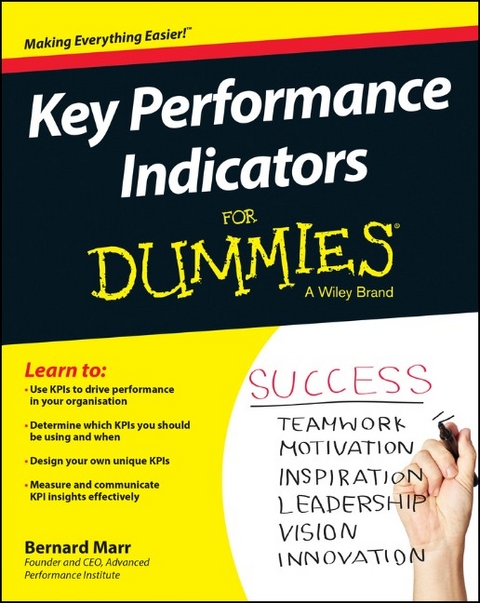
Key Performance Indicators For Dummies (eBook)
John Wiley & Sons (Verlag)
978-1-118-91324-6 (ISBN)
Is your business on track to achieve success? Key Performance Indicators For Dummies covers the essential KPIs that are useful to all kinds of businesses, and includes more than 100 different ways leaders can monitor and drive performance in their organisations,
This book helps managers understand the crucial KPIs that should be implemented for all different aspects of the organisation, including financial performance, operational and internal processes, sales and marketing, customer satisfaction and more, Good KPIs should be unique to every business, as every business has different objectives, To meet this need, the book provides tools and templates that leaders can use to develop unique KPIs that best suit their particular organisation or industry,
- Learn to design KPIs that are unique to your business and fit closely to your strategic objectives
- Determine which KPI questions you should be asking to achieve the right insights for your business
- Learn the specific KPIs that are appropriate for different business circumstances
- Turn KPIs into deep insights by mastering related reporting and communications practices
KPIs are a crucial part of every manager's toolkit, and are essential for helping to monitor the execution of business strategies and measure results, Key Performance Indicators For Dummies moves beyond a basic discussion of what KPIs are, and why they are needed to provide a complete guide for learning to design and use specific KPIs to drive organisational performance,
Bernard Marr is a bestselling author on organisational performance and business success, He regularly advises leading companies, organisations and governments across the globe, and is acknowledged by the CEO Journal as one of today's leading business brains, He has advised the Bank of England, Barclays, BP, Fujitsu, HSBC, Mars and others,
A complete guide to using KPIs to drive organisational performance Is your business on track to achieve success? Key Performance Indicators For Dummies covers the essential KPIs that are useful to all kinds of businesses, and includes more than 100 different ways leaders can monitor and drive performance in their organisations. This book helps managers understand the crucial KPIs that should be implemented for all different aspects of the organisation, including financial performance, operational and internal processes, sales and marketing, customer satisfaction and more. Good KPIs should be unique to every business, as every business has different objectives. To meet this need, the book provides tools and templates that leaders can use to develop unique KPIs that best suit their particular organisation or industry. Learn to design KPIs that are unique to your business and fit closely to your strategic objectives Determine which KPI questions you should be asking to achieve the right insights for your business Learn the specific KPIs that are appropriate for different business circumstances Turn KPIs into deep insights by mastering related reporting and communications practices KPIs are a crucial part of every manager's toolkit, and are essential for helping to monitor the execution of business strategies and measure results. Key Performance Indicators For Dummies moves beyond a basic discussion of what KPIs are, and why they are needed to provide a complete guide for learning to design and use specific KPIs to drive organisational performance.
Bernard Marr is a bestselling author on organisational performance and business success. He regularly advises leading companies, organisations and governments across the globe, and is acknowledged by the CEO Journal as one of today's leading business brains. He has advised the Bank of England, Barclays, BP, Fujitsu, HSBC, Mars and others.
Introduction 1
Part I: Getting Started with Key Performance Indicators 5
Chapter 1: Introducing Key Performance Indicators (KPIs) 7
Chapter 2: Types, Targets and KPI Mistakes 19
Chapter 3: Creating a Culture of Fact-Based Decision-Making 29
Chapter 4: Organising Your KPIs 43
Part II: Implementing and Using KPIs Effectively 63
Chapter 5: Developing a KPI 65
Chapter 6: Use it or Lose it: Turning KPIs into Insights 91
Chapter 7: Spreading the Word: Reporting and Communicating KPIs Effectively 105
Part III: Developing Financial KPIs 121
Chapter 8: The Holy Grail of Business: Revenue and Profit KPIs 123
Chapter 9: The Ones You Can't Take Your Eyes Off: Liquidity and Cash Flow KPIs 135
Chapter 10: Reporting to the Masters: Shareholder and Value-Added KPIs 145
Chapter 11: Measuring Your Financial Efficiency 153
Part IV: Developing Customer, Sales and Marketing KPIs 163
Chapter 12: The Customer is Always Right: Measuring Your Customer Success 165
Chapter 13: Measuring the Market and Your Place in It 183
Part V: Developing Operational and Internal Process KPIs 197
Chapter 14: Measuring Project Performance 199
Chapter 15: Measuring Internal Efficiency and Quality 207
Chapter 16: Measuring IT Performance 227
Part VI: Measuring Your Most Important Assets: Developing HR and People KPIs 237
Chapter 17: Measuring People Performance 239
Chapter 18: Measuring Human Resources Performance 253
Part VII: The Part of Tens 263
Chapter 19: Ten Tips for Developing Effective KPIs 265
Chapter 20: The Ten Biggest KPI Mistakes to Avoid 269
Chapter 21: The Top Ten KPIs to Use 275
Index 281
Chapter 1
Introducing Key Performance Indicators (KPIs)
In This Chapter
Understanding KPI basics
Identifying the most common errors
Identifying the key business areas to measure
So what the heck are Key Performance Indicators (KPIs) anyway?
KPIs help organisations understand how well they are performing in relation to their strategic goals and objectives. In the broadest sense, a KPI provides the most important performance information that enables organisations or their stakeholders to understand whether the organisation is on track toward its stated objectives or not. In addition KPIs serve to reduce the complex nature of organisational performance to a small, manageable number of key indicators that provide evidence that can in turn assist decision making and ultimately improve performance.
If you think about it, this is the same logical approach we use in our daily lives. Say you are not feeling very well and decide to visit your doctor. She may ask you what is wrong but she’s immediately searching for evidence to qualify your subjective opinion. She may, for example, take your blood pressure and measure your cholesterol levels, heart rate and body mass index as key indicators of your health. With KPIs we are trying to do the same in our organisations. And without them we are flying blind, relying on the often subjective assessment and opinion of key personnel.
In practice, the term KPI is overused and misunderstood. Too often, KPIs are assumed to be financial in nature or simply the numerical measures we can most easily count. However, such a definition is much too narrow. The data for KPIs can come from myriad sources, providing the best possible answer to your most important business questions. Anything, even the most esoteric or intangible elements of business can be measured simply by tracking the difference between one thing and another. If you can observe a move from one state, situation or element of performance to another that is strategically or operationally important to the success of your business then you can measure it. And if this is helping you to answer a critical business question then that measurement is a KPI.
Unfortunately there is often a disconnect between whether something can be measured and whether it should be measured. Instead of clearly identifying the information needed, and then carefully designing the most appropriate indicators to assess performance, businesses too often implement KPIs using what I call the ‘ICE’ approach:
- Identify everything that is easy to measure and count
- Collect and report the data on everything that is easy to measure and count
- End up scratching your head thinking, ‘What on earth does this all mean and what are we going to do with all this performance data?’
This opening chapter is designed to cover the basics of KPIs, explain what they are and why companies need them, and offers as a brief glimpse into what I’ll cover in more detail in the rest of the book.
Why Every Company Needs KPIs
KPIs act like navigation tools for your business and allow you to know where you are against where you think you are or where you want to be in the same way a compass would guide a fishing voyage.
The Fishing Analogy
As long as there have been fish, human beings have been fishing. Initially our efforts were probably pretty basic consisting of a net, a line and a stick! Over time we progressed to small boats and were able to search for fish further afield. By the 16th century fishermen had much larger boats capable of going to sea in search of bigger and bigger catches. Initially the ships would set out using little more than a compass, a sextant and some ‘inside knowledge’ passed down generations of fishing families. If they were sailing at night they would use celestial navigation techniques and plot a course by the stars in order to arrive in the right vicinity. When the fishermen arrived at the fishing grounds they would cast their nets and hope for the best.
Modern fishing, however, is very different. Huge trawlers, capable of travelling enormous distances and processing the fish on board, are also technology-rich, using high-tech navigation systems and GPS. Although shipbuilding technology helped, what really transformed fishing into the lucrative industry we see today was access to relevant information that allowed fisherman to know where they were on the ocean, where the fish were, where they would be tomorrow and when to cast their nets for maximum yield. Fishing has used KPIs to improve revenue and performance for centuries, and businesses must do the same if they are to prosper in an increasingly competitive world.
Just as GPS helps fishermen to navigate the ocean and find the fish in enough numbers to make money and be successful, KPIs, if used effectively, can help business leaders navigate the often treacherous waters of business to make better evidence-based decisions and implement their chosen strategy successfully.
Centuries or even decades ago an abundance of fish made success possible regardless of navigation tools. But that is no longer the case. And the same is true for business. Business must also go further – not just physically to new markets and territories opened up by globalisation but they must go further across the board including improved customer experience, quality control and efficiency. KPIs make that possible because they shine a light into the business, letting you see what’s really happening.
Businesses need a way to assess where they are and whether they are on or off course against their strategy. They need to be able to correct quickly and adapt to the changing conditions of the market. The days where good enough was good enough and competition was minimal so everyone prospered regardless of quality or customer satisfaction are long gone. In the years following WWII for example countries needed to re-build so there was often no competition and quality was poor but it was better than nothing. Hopefully those days will never come again. If you want to succeed in a fiercely competitive market you need a way to measure progress (or otherwise) in real time not just after the fact. If your business doesn’t have or use the right KPIs then, like the fisherman of old, you are effectively casting your nets and hoping for the best.
The Datafication of our World
The pressure to identify and perfect business navigation tools is only going to intensify as we get more and more access to more and more data. As in the previous section, the fishing analogy is useful in understanding the implications of the datafication of our world. If a fisherman is competing for fish in a lake, the information he needs is finite and restricted to information about the lake. But once he goes to sea the amount of possible data he could or should have access to increases exponentially.
Most modern businesses compete globally. Within those businesses and within those markets the amount of information we now have access to is truly mind-boggling. The massive uptake of social media, smart technology and quantum leaps in computer storage and computer power collectively means that we are now generating more information and more data than ever before. It is said that we are now producing five exabytes or billion gigabytes of data every two days! Behind closed doors many business leaders are already stressed about the amount of data they probably have in their business but don’t have adequate or meaningful access to and that situation is only going to get worse if we don’t start managing that data effectively.
When you identify and use the right KPIs for your business you can cut through the oceans of data that exists, could exist or should exist and get timely access to the nuggets of wisdom that you need to make better decisions and improve performance.
Without the right KPIs to navigate the swelling oceans of data that already exist and is increasing all the time you can so easily find yourself all at sea.
KPIs as vital decision support tools
When used effectively, KPIs provide the evidence and information required to make better, faster decisions without stress. Business experience matters, and clearly you sometimes need to make decisions when all the facts are not available but KPIs provide a vital decision support tool across the business that can reduce those occasions and minimise error and anxiety.
Using KPIs to answer your most critical business questions
Your business needs KPIs because they help to answer your most critical business questions. Depending on your strategy you will have a series of important business questions that you need to answer in order to work out if your business is doing what it needs to do to achieve that strategy or is moving away from it or going off course.
Once you know what those questions are you can work out what information you need in order to answer them. Once you know the information you need you can design the right KPI that will deliver that answer and use the KPI to guide the strategy.
Essentially KPIs allow you to measure performance accurately, which in turn allows you to:
- Learn from past outcomes and improve results in the future
- Report externally and demonstrate compliance
- Focus effort and monitor output
Using KPIs to learn and improve performance
When you have access to the information you need you are better...
| Erscheint lt. Verlag | 22.1.2015 |
|---|---|
| Sprache | englisch |
| Themenwelt | Sachbuch/Ratgeber ► Beruf / Finanzen / Recht / Wirtschaft ► Wirtschaft |
| Wirtschaft ► Betriebswirtschaft / Management ► Unternehmensführung / Management | |
| Schlagworte | Bernard Marr • Business & Management • Business & Management Special Topics • Business Performance • design KPIs • drive organisational performance • drive performance in an organisation • Key Performance Indicators • Key Performance Indicators For Dummies • KPI • KPI insights • KPI Reporting • Management • measure customer satisfaction • measure financial performance • measure internal processes • measure operational processes • measure organisational performance • measure sales • monitor an organisation • Spezialthemen Wirtschaft u. Management • what are KPIs • Wirtschaft u. Management |
| ISBN-10 | 1-118-91324-8 / 1118913248 |
| ISBN-13 | 978-1-118-91324-6 / 9781118913246 |
| Informationen gemäß Produktsicherheitsverordnung (GPSR) | |
| Haben Sie eine Frage zum Produkt? |
 EPUB (Adobe DRM)
Kopierschutz: Adobe-DRM
Adobe-DRM ist ein Kopierschutz, der das eBook vor Mißbrauch schützen soll. Dabei wird das eBook bereits beim Download auf Ihre persönliche Adobe-ID autorisiert. Lesen können Sie das eBook dann nur auf den Geräten, welche ebenfalls auf Ihre Adobe-ID registriert sind.
Details zum Adobe-DRM
Dateiformat: EPUB (Electronic Publication)
EPUB ist ein offener Standard für eBooks und eignet sich besonders zur Darstellung von Belletristik und Sachbüchern. Der Fließtext wird dynamisch an die Display- und Schriftgröße angepasst. Auch für mobile Lesegeräte ist EPUB daher gut geeignet.
Systemvoraussetzungen:
PC/Mac: Mit einem PC oder Mac können Sie dieses eBook lesen. Sie benötigen eine
eReader: Dieses eBook kann mit (fast) allen eBook-Readern gelesen werden. Mit dem amazon-Kindle ist es aber nicht kompatibel.
Smartphone/Tablet: Egal ob Apple oder Android, dieses eBook können Sie lesen. Sie benötigen eine
Geräteliste und zusätzliche Hinweise
Buying eBooks from abroad
For tax law reasons we can sell eBooks just within Germany and Switzerland. Regrettably we cannot fulfill eBook-orders from other countries.
aus dem Bereich