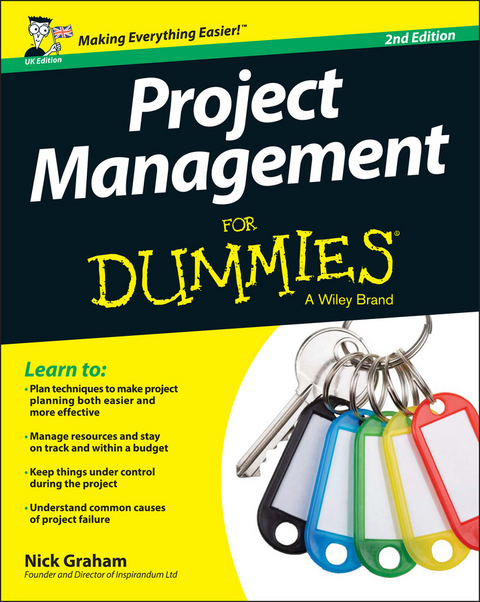
Project Management for Dummies, UK Edition (eBook)
John Wiley & Sons (Verlag)
978-1-119-02574-0 (ISBN)
In today's time-pressured and cost-conscious global businessenvironment, reliable project management and competent delivery aremore important than ever. Increasingly, project management is beingseen as an essential management skill for all, as well as a careerchoice for many. This new UK edition of Project Management ForDummies quickly introduces you to the principles of successfulproject management with a clear and logical approach to help youdeliver your projects, not only successfully, but also more easily.Unique to the UK edition, you'll find clear guidance on using thehighly logical product-based approach to project planning,along with advice on how to release the great power of thetechnique, not only for effective planning, but also for projectcontrol.
Updated with fresh content, tips, and tactics that covereverything you need to know from a project's start to finish, thisaccessible guide takes you through every stage of projectmanagement. You'll discover how to make project planning easier andmore effective, manage resources and stay on track within a budget.Then you'll find help and advice to help you motivate and manageyour teams to help them perform at their best. To help you stay atthe leading edge, you'll also find two new chapters in this editionexplaining project governance and the increasingly importantinternational standard ISO 21500. In short, this book will help youmaster a highly valuable skill for advancing your career.
- Provides clear descriptions of who should do what in a projectto prevent communication and control problems
- Presents the latest concepts in project managementtechniques
- Discusses how to keep risks under control during theproject
- Includes access to online project management templates andchecklists to aid in learning
If you're a manager taking on a project for the first time or amore experienced project professional looking to get up to speed onthe latest thinking and techniques, Project Management ForDummies equips you for project management success.
Get projects done on time, on budget, and with maximum efficiency - fully updated UK edition! In today's time-pressured and cost-conscious global business environment, reliable project management and competent delivery are more important than ever. Increasingly, project management is being seen as an essential management skill for all, as well as a career choice for many. This new UK edition of Project Management For Dummies, 2nd UK Edition quickly introduces you to the principles of successful project management with a clear and logical approach to help you deliver your projects, not only successfully, but also more easily. Unique to the UK edition, you'll find clear guidance on using the highly logical product-based approach to project planning, along with advice on how to release the great power of the technique, not only for effective planning, but also for project control. Updated with fresh content, tips, and tactics that cover everything you need to know from a project's start to finish, this accessible guide takes you through every stage of project management. You'll discover how to make project planning easier and more effective, manage resources and stay on track within a budget. Then you'll find help and advice to help you motivate and manage your teams to help them perform at their best. To help you stay at the leading edge, you'll also find two new chapters in this edition explaining project governance and the increasingly important international standard ISO 21500. In short, this book will help you master a highly valuable skill for advancing your career. Provides clear descriptions of who should do what in a project to prevent communication and control problems Presents the latest concepts in project management techniques Discusses how to keep risks under control during the project Includes access to online project management templates and checklists to aid in learning If you're a manager taking on a project for the first time or a more experienced project professional looking to get up to speed on the latest thinking and techniques, Project Management For Dummies, 2nd UK Edition equips you for project management success.
Nick Graham is Founder and Director of Inspirandum Ltd, a consultancy and training firm. His consultancy work has ranged from helping plan complex projects to advising top managers on how to implement project and project governance approaches.
Introduction 1
Part I: Understanding Projects and What You Want to Achieve 5
Chapter 1: Success in Project Management 7
Chapter 2: Thinking Through the Life of Your Project 19
Chapter 3: Defining the Scope and Producing a Business Case 35
Chapter 4: Knowing Your Project's Stakeholders 53
Part II: Planning Time: Determining What, When and How Much 71
Chapter 5: Planning with Deliverables First 73
Chapter 6: Planning the Activities 95
Chapter 7: Looking At Staff Resources 127
Chapter 8: Planning for Other Resources and Developing the Budget 149
Chapter 9: Planning at Different Times and Levels 163
Chapter 10: Venturing into the Unknown: Dealing with Risk and Uncertainty 173
Part III: Putting Your Management Team Together 197
Chapter 11: Organising the Project 199
Chapter 12: Working With Teams and Specialists 217
Chapter 13: Being an Effective Leader 237
Part IV: Steering the Project to Success 251
Chapter 14: Tracking Progress and Staying in Control 253
Chapter 15: Keeping Everyone Informed 279
Chapter 16: Bringing Your Project to Closure 299
Part V: Taking Your Project Management to the Next Level 313
Chapter 17: Managing Multiple Projects 315
Chapter 18: Using Technology to Up Your Game 325
Chapter 19: Monitoring Project Performance with Earned Value Management 339
Chapter 20: Project Governance and Why It's Really Important 349
Chapter 21: ISO 21500:2012 361
Part VI: The Part of Tens 369
Chapter 22: Ten Questions to Ask Yourself as You Plan Your Project 371
Chapter 23: Ten Tips for Writing a Convincing Business Case 377
Chapter 24: Ten Tips for Being a Better Project Manager 383
Index 387
Chapter 1
Success in Project Management
In This Chapter
Understanding what makes a project a project
Seeing what’s involved in project management
Coming to grips with the Project Manager’s role
Knowing what it takes to be a successful Project Manager
Organisations are constantly changing, and ever faster, as they adapt to new market conditions, new financial conditions, new business practices, new legal requirements and new technology. Then there is work to be done such as upgrading or moving premises, installing new facilities, carrying out major maintenance, improving manufacturing processes and re-branding commercial products. A lot of that work is carried out with projects, and as a result businesses are increasingly driven to find individuals who can excel in this project-oriented environment.
Taking on a Project
Because you’re reading this book, the chances are that you’ve been asked to manage a project for the first time or that you’re already running projects and are looking to see whether you can find easier and better ways of doing things. If the project is indeed your first one, that’s a challenge and may well give you the chance to excel in something you haven’t done before; for many, managing a project even opens a door to a new career.
The really good news here, whether you’re completely new or have some experience, is that project management has been around for a very long time. In that time, Project Managers have come up with highly effective strategies and a range of very practical techniques. You can benefit from all that experience, and this book takes you through what you need to know. You may be a bit guarded even now because you’ve heard of, read about or even seen, an awful lot of project problems and failures. More really good news is that most project failure comes from well-known and avoidable problems; you really don’t have to be part of the failure statistics if you manage your project in the right way.
So, hang on tight – you’re going to need an effective set of skills and techniques to steer your projects to successful completion. This chapter gets you off to a great start by showing you what projects and project management really are and by helping you separate projects from non-project work. The chapter also gives you some insight into exactly why projects go wrong. That will help you become absolutely determined to do things right and succeed where so many others have failed.
This book offers a generic approach to project management and isn’t based on any one approach. Specifically, if you’re interested in the PRINCE2® project method then you might like to get hold of a copy of PRINCE2 For Dummies. That book will help you to understand the method, but be aware that PRINCE2 hasn’t set out to cover all that’s involved in project management. It’s focused on planning and control but doesn’t even cover all of that, so you’ll find a lot in this book that isn’t in the PRINCE2 one.
Avoiding the Pitfalls
By following a sound approach to the project, you automatically avoid many of the pitfalls that continue to contribute to, or cause, project failure on a mind-boggling scale. You may ask why, if good ways of doing things exist, people ignore them and then have their projects fail. Good question. People make the same project mistakes repeatedly, and they’re largely avoidable. You may have come across the joke by comedian Tommy Cooper:
I went to the doctor and said ‘Every time I do this, it hurts.’ The doctor said, ‘Well, don’t do it then.’
A national public project run in the UK to create a database of offenders for use by the Prison Service, Probation Service and others has attracted heavy criticism for poor management. The National Audit Office, which checks up on government departments, investigated and reported that the project was delayed by three years, and the budget was double the original, but the scope had been radically cut back. Edward Leigh MP, chairman of the powerful Public Accounts Committee in Parliament at the time described the scheme as a ‘spectacular failure’ and ‘a master-class in sloppy project management’.
The following list takes a quick look at the main causes of project failure; you’ll find the remedies in later chapters in the book. The list makes for depressing reading, particularly if you recognise some elements in parts of your own organisation. Nevertheless, it gives a good background against which to contrast successful project management and the approach and techniques set down in this book.
- Lack of clear objectives: Nobody’s really sure what the project is about, much less are people agreed on it.
- Lack of risk management: Things go wrong that someone could easily have foreseen and then controlled to some degree, or even prevented.
- No senior management ‘buy in’: Senior managers were never convinced and so never supported the project, leading to problems such as lack of resource. Neither did those managers exercise effective management supervision (good project governance) as they routinely do in their other areas of responsibility.
- Poor planning: Actually, that’s being kind, because often the problem is that no planning was done at all. It’s not surprising, then, when things run out of control, and not least because nobody knows where the project should be at this point anyway.
- No clear progress milestones: This follows on from poor planning. The lack of milestones means nobody sees when things are off track, and problems go unnoticed for a long time.
- Understated scope: The scope and the Project Plan are superficial and understate both what the project needs to deliver and the resource needed to deliver it. Project staff (often team members) then discover the hidden but essential components later in the project. The additional work that is necessary then takes the project out of control, causing delay to the original schedule and overspending against the original budget.
- Poor communications: So many projects fail because of communication breakdown, which can stem from unclear roles and responsibilities and from poor senior management attitudes, such as not wanting to hear bad news.
- Unrealistic resource levels: It just isn’t possible to do a project of the required scope with such a small amount of resource – staff, money or both.
- Unrealistic timescales: The project just can’t deliver by the required time, so it’s doomed to failure.
- No change control: People add in things bit by bit – scope creep. Then it slowly dawns on everyone that the project’s now grown so big that it can’t be delivered within the fixed budget or by the set deadline.
That’s ten reasons for failure, but you can probably think of a few more. The interesting thing about these problems is that avoiding them is, for the most part, actually not that difficult.
Deciding Whether the Job is a Project
Before you start to think too deeply about how to set up the project, the first thing to do is check whether it really is one. No matter what your job is, you handle a myriad of assignments every day: prepare a memo, hold a meeting, design a sales campaign or move to new offices. Not all these assignments are projects. So what makes something a project?
Some people say that everything is a project, even making a cup of tea. Don’t listen to them. And don’t be fooled by references to ‘the Project Manager’ in TV programmes like The Apprentice either, unless you want an object lesson in how not to do things; Lord Sugar really should know better.
You can think about three things to determine whether a job is a project:
- Is it a one-off job or something that’s ongoing? If the job is ongoing, like producing bars of soap on a production line or taking customer orders, then it’s business as usual, not a project.
- Does the job justify project controls? Project management means incurring some overheads, although you can find advice in this book on how to keep overheads to the minimum. But the fact remains that there will be overheads in a project (such as for planning, approval and control) and some jobs are so small or straightforward that they just don’t justify that degree of control.
- This last one may sound a little weird, and it certainly doesn’t fit with the formal definitions; it’s the question, ‘Do you want to handle the job as a project?’ You may choose to deal with a block of work as a project, but I wouldn’t – so, in some instances, you have a choice.
Understanding the four control areas
Different project approaches have slightly different definitions of a project; here’s one:
A project is a temporary undertaking performed to produce a unique product, service or result.
The ‘unique product’ is true, but don’t let that put you off setting up projects that are effectively repeated, such as organising the annual company conference. Although, strictly speaking, the task is unique each time, you will nevertheless find large areas of commonality with previous projects so you...
| Erscheint lt. Verlag | 23.1.2015 |
|---|---|
| Sprache | englisch |
| Themenwelt | Sachbuch/Ratgeber ► Beruf / Finanzen / Recht / Wirtschaft ► Wirtschaft |
| Wirtschaft ► Betriebswirtschaft / Management ► Projektmanagement | |
| Schlagworte | best-practice project management • best-practice project management techniques • Business & Management • concepts in project management techniques • how to make project planning easier • how to make project planning easier and more effective • ISO 21500 • ISO 21500:2012 • latest concepts in project management techniques • Nick Graham • online project management templates • online project management templates and checklists • product based planning • product-based planning • product-led planning • Project Governance • Project Management • Project Management For Dummies • Project Management Skills • project management templates • project management templates and checklists • Project Planning • project planning techniques • project planning techniques that work • Project Professional • Projektmanagement • reliable project management • the stages of project management • Wirtschaft u. Management |
| ISBN-10 | 1-119-02574-5 / 1119025745 |
| ISBN-13 | 978-1-119-02574-0 / 9781119025740 |
| Informationen gemäß Produktsicherheitsverordnung (GPSR) | |
| Haben Sie eine Frage zum Produkt? |
 EPUB (Adobe DRM)
Kopierschutz: Adobe-DRM
Adobe-DRM ist ein Kopierschutz, der das eBook vor Mißbrauch schützen soll. Dabei wird das eBook bereits beim Download auf Ihre persönliche Adobe-ID autorisiert. Lesen können Sie das eBook dann nur auf den Geräten, welche ebenfalls auf Ihre Adobe-ID registriert sind.
Details zum Adobe-DRM
Dateiformat: EPUB (Electronic Publication)
EPUB ist ein offener Standard für eBooks und eignet sich besonders zur Darstellung von Belletristik und Sachbüchern. Der Fließtext wird dynamisch an die Display- und Schriftgröße angepasst. Auch für mobile Lesegeräte ist EPUB daher gut geeignet.
Systemvoraussetzungen:
PC/Mac: Mit einem PC oder Mac können Sie dieses eBook lesen. Sie benötigen eine
eReader: Dieses eBook kann mit (fast) allen eBook-Readern gelesen werden. Mit dem amazon-Kindle ist es aber nicht kompatibel.
Smartphone/Tablet: Egal ob Apple oder Android, dieses eBook können Sie lesen. Sie benötigen eine
Geräteliste und zusätzliche Hinweise
Buying eBooks from abroad
For tax law reasons we can sell eBooks just within Germany and Switzerland. Regrettably we cannot fulfill eBook-orders from other countries.
aus dem Bereich