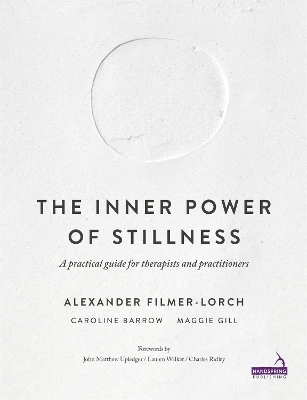
The Inner Power of Stillness
Handspring Publishing Limited (Verlag)
978-1-909141-33-9 (ISBN)
The Inner Power of Stillness is not just another book about therapeutic presence, mindfulness and meditation. It explores and highlights the next evolutionary step, leading us beyond the already well-researched teachings of these topics, by looking at the multidimensional scale of stillness from an entirely different point of view.
The focal point is the inner development by therapists, practitioners and teachers of the mainly dormant potential of stillness and the storage capacity of stillness-stimulus and imprints in our tissue/fascia, as well as their benefits, use and application in a treatment or teaching environment.
The Inner Power of Stillness endeavours to illuminate the lost value of stillness for the therapist and practitioner both as a person and as a professional. The authors anchor the possibility of this inner evolution of the power of stillness to the latest research into tissue and cell memory.
They introduce the concept of a potential new modality called 'stillness-memory', and build upon this new understanding a logical and practical framework in which science and philosophy truly inform each other.
This opens up access to a much larger scale of new ideas and possibilities which, providing the transformative teachings they embody are put into practice, carry the potential for practitioners to be the best person and the best professional they can be, without compromising their own overall health and wellbeing.
In-depth knowledge of how to arrive at this promising new modality, as well as how to apply it in everyday work and life, is at the heart of the book. It covers topics such as working from your inner power of stillness, the insightful self and, most importantly, the practitioner's toolkit.
Some thought-provoking themes that might be of great value to therapists, teachers and practitioners who intend to dedicate some of their time to working for the greater good can be found at the end of the book, where consideration is given to a universal view of compassion and the solace that stillness can bring to people who are nearing the end of their life and final departure.
The book concludes with a philosophical note acknowledging the timeless nature of ancient wisdom, and the ever more important relevance and role of the philosopher in our modern world today.
The Inner Power of Stillness is a comprehensive guide for people working with people. It provides practical knowledge that will revolutionise the way practitioners help others:
Working from a greater perspective, being aware of the whole as well as the parts, and responding to the cause and not only the effect.
Working from an internal place of stillness.
Innovative and practical exercises and techniques to dissolve friction/struggles in sustaining a state of authentic therapeutic presence, mindfulness and meditation.
Simple exercises to help clients build long-term memory of stillness as a foundation for successful mindfulness and meditation practice.
Includes Forewords from John Matthew Upledger, Lauren Walker and Charles Ridley
Alexander's career began as a state-approved professional dancer at the John Cranko Ballet Academy in Stuttgart, from where he went on to dance at the German Opera House in Düsseldorf. Following a back injury, which put an end to his dance career, Alexander decided to travel extensively to gain a deeper understanding of what animates the moving body and drives the mind. He studied the teachings of Eastern psychology and philosophy, yogic disciplines and meditation in the traditional one-to-one practice of teacher and student, throughout more than a decade of his life. In the intervening years, Alexander's dedication and passion for working with people inspired him to follow the work of his teachers, simplifying complex philosophical teachings and translating them into a framework that meets the requirements of our modern times. In 2011, he founded 'Inside Meditation' a modern school of neutral thought in London, offering regular CPD and mentoring programs, as well as a comprehensive Yoga Alliance UK accredited 200/500-hour Meditation Teacher Training, and CMM - Programs for Corporates. Alexander's first book 'Inside Meditation: In Search of the Unchanging Nature Within' which is a comprehensive analysis of the process, practice and science of meditation and eastern psychology, was published in July 2012. Today Alexander guides and facilitates professionals, teachers and students at an international level. His work as a practitioner, mentor, author, lecturer and teacher is a synthesis of 30 years of experience in movement, yogic disciplines and meditation, applied philosophy and Eastern psychology, aiming to bring the body, mind and spirit to a natural state of meditative synthesis. Maggie found Upledger Craniosacral therapy through experiencing its profound benefits when an injury forced a career change from educational management. Studying and practising a gentle form of Yoga complemented her journey back to health and vastly improved mobility. Maggie completed her core Upledger studies in the UK and supplemented them with classes with Dr John Upledger in the USA. She has led an Upledger Study Group since 2003 and created 'Developing Confidence' workshops to offer support and developmental opportunities for UK practitioners. An active member of the Board of the CranioSacral Society for many years, she currently has responsibility for Continuing Professional Development. In her current work as a therapist, mentor and teacher Maggie finds reminders that all her life experience, including her MBA, her deep interest in change leadership, and that of the psychology of adult learners, helps her to guide and inspire others. Caroline's initial degree in Psychology and Computer Science at Exeter University started what has become an ongoing pattern of combining unusual subjects and exploring ways to build bridges between them. A second degree in Biomedical Science from Kings College University London set her up for the business she has now run for 14 years, the College of Body Science, which specialises in teaching the anatomy and physiology for complementary health care practitioners, especially to a CPD level that is directed at what this group need to know. She has always felt it is important for the science to be understood in parallel with developing the 'art' of being a therapist in whatever discipline. Caroline initial qualified in Shiatsu, then went on to add Craniosacral Therapy and Visceral Manipulation to her treatments. Since 2010 she has also run the Upledger Institute UK, bringing the training of Craniosacral Therapy developed by Dr John Upledger to the UK. She strives to build community within this work and bridges with parallel modalities. She is an Associate Fellow of the Royal Society of Medicine, a board member of the Cranio Sacral Society and also practices as a therapist, in the time she has available, where she lives in Somerset.
The whole book in a nutshell
Forewords
Acknowledgements
Dedication
Reviews
Introduction
Part 1: The lost value of stillness
Chapter 1 Stillness
Chapter 2 Origins
Chapter 3 Stillness is universal
Chapter 4 How does stilling act on our physiology?
Part 2: Stillness in science
Chapter 5 What does science bring to the table?
Chapter 6 The heart of the matter
Chapter 7 The autonomic’s impression
Chapter 8 The inner power of water
Chapter 9 And then there was light
Part 3: The insightful self
Chapter 10 Stumbling blocks and obstacles
Chapter 11 What we need to know
Chapter 12 Perception
Chapter 13 Getting to neutral
Part 4: Working from the insightful self
Chapter 14 From the beginning – introduction and aims
Chapter 15 Starting with ourselves – preparing to embody a greater awareness
Chapter 16 Our breathing – where, when and how
Chapter 17 Our neck, arms and hands
Chapter 18 Our mouth, face and even our nose, ears and eyes
Chapter 19 So that’s all about us – what next?
Chapter 20 What’s the catch?
Part 5: The practitioners' toolkit
Chapter 21 What to do next?
Chapter 22 Remembering
Chapter 23 Utilising the proprioceptive sense
Chapter 24 Reclaiming force
Chapter 25 Working with mind and thought
Chapter 26 Whenever, wherever and for whoever – simple tools with profound results
Part 6: Scope and reach
Chapter 27 There is no one way
Chapter 28 Compassion
Chapter 29 Solace stillness – at the end of life and the final transition
Part 7: On a philosophical note
Chapter 30 ‘The whole book in a nutshell’ explained
Index
| Sprache | englisch |
|---|---|
| Maße | 188 x 244 mm |
| Gewicht | 600 g |
| Themenwelt | Sachbuch/Ratgeber ► Gesundheit / Leben / Psychologie ► Alternative Heilverfahren |
| ISBN-10 | 1-909141-33-X / 190914133X |
| ISBN-13 | 978-1-909141-33-9 / 9781909141339 |
| Zustand | Neuware |
| Informationen gemäß Produktsicherheitsverordnung (GPSR) | |
| Haben Sie eine Frage zum Produkt? |
aus dem Bereich