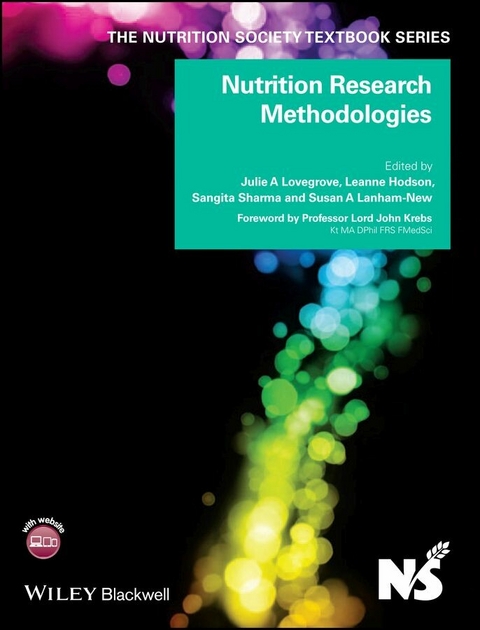
Nutrition Research Methodologies (eBook)
John Wiley & Sons (Verlag)
978-1-118-55466-1 (ISBN)
A new book in the acclaimed Nutrition Society Textbook Series, Nutrition Research Methodologies addresses the rapidly advancing field of nutrition research. It covers the diverse methodologies required for robust nutritional research to ensure thorough understanding of key concepts, both for students at undergraduate and postgraduate levels and for scientists working in nutrition research.
Combining theory with practical application, Nutrition Research Methodologies addresses both traditional research methods and new technologies, and focuses on a range of complex topics, including energy compensation, nutrient-gene interactions and metabolic adaptation. It also considers statistical issues as well as application of data to policy development.
- Provides the reader with the required scientific basics of nutrition research in the context of a systems and health approach
- Written specifically to meet the needs of individuals involved in nutrition research
- Combines the viewpoints of world-leading nutrition experts from academia and research with practical applications
- Accompanied by a companion website with a range of self-assessment material (www.wiley.com/go/lovegrove/nutritionresearch)
Professor Julie A Lovegrove, Hugh Sinclair Unit of Human Nutrition and Institute for Cardiovascular Research, Department of Food and Nutritional Sciences, University of Reading, UK.
Associate Professor Leanne Hodson, Oxford Centre for Diabetes, Endocrinology & Metabolism, Radcliffe Department of Medicine, University of Oxford, UK.
Professor Sangita Sharma, Centennial Professor, Endowed Chair in Aboriginal Health, Professor of Aboriginal & Global Health Research, Aboriginal and Global Health Research Group, Department of Medicine, Faculty of Medicine & Dentistry, University of Alberta, Canada.
Professor Susan A Lanham-New, Department of Nutritional Sciences, School of Biosciences and Medicine, Faculty of Health and Medical Sciences, University of Surrey, UK.
A new book in the acclaimed Nutrition Society Textbook Series, Nutrition Research Methodologies addresses the rapidly advancing field of nutrition research. It covers the diverse methodologies required for robust nutritional research to ensure thorough understanding of key concepts, both for students at undergraduate and postgraduate levels and for scientists working in nutrition research. Combining theory with practical application, Nutrition Research Methodologies addresses both traditional research methods and new technologies, and focuses on a range of complex topics, including energy compensation, nutrient-gene interactions and metabolic adaptation. It also considers statistical issues as well as application of data to policy development. Provides the reader with the required scientific basics of nutrition research in the context of a systems and health approach Written specifically to meet the needs of individuals involved in nutrition research Combines the viewpoints of world-leading nutrition experts from academia and research with practical applications Accompanied by a companion website with a range of self-assessment material (www.wiley.com/go/lovegrove/nutritionresearch)
Professor Julie A Lovegrove, Hugh Sinclair Unit of Human Nutrition and Institute for Cardiovascular Research, Department of Food and Nutritional Sciences, University of Reading, UK. Associate Professor Leanne Hodson, Oxford Centre for Diabetes, Endocrinology & Metabolism, Radcliffe Department of Medicine, University of Oxford, UK. Professor Sangita Sharma, Centennial Professor, Endowed Chair in Aboriginal Health, Professor of Aboriginal & Global Health Research, Aboriginal and Global Health Research Group, Department of Medicine, Faculty of Medicine & Dentistry, University of Alberta, Canada. Professor Susan A Lanham-New, Department of Nutritional Sciences, School of Biosciences and Medicine, Faculty of Health and Medical Sciences, University of Surrey, UK.
Contributors vii
Series Foreword ix
Preface x
About the Companion Website xii
1 Nature, Purpose and Implications of Research in Nutrition 1
Alan A Jackson, Stephen A Wootton and Martin Wiseman
2 Study Design: Population-Based Studies 13
Janet Cade and Jayne Hutchinson
3 Study Design: Intervention Studies 28
Jayne V Woodside, Robert W Welch, Chris C Patterson and Michelle
C McKinley
4 Methods to Determine Dietary Intake 48
Nadia Slimani, Heinz Freisling, Anne-Kathrin Illner and Inge
Huybrechts
5 Food Composition 71
Barbara Burlingame and U Ruth Charrondiere
6 Biomarkers of Intake 90
Gunter G C Kuhnle
7 Methods of Data Analysis 108
Graham Horgan
8 Considerations for Including Different Population Groups in
Nutrition Research 123
Maria J Maynard
9 Use of Biobanks in Nutrition Research 141
Kurt Zatloukal, Pieter van't Veer, Christian Viertler,
Marc-Jeroen Bogaardt and Peter Hollman
10 Methods Investigating Food-Related Behaviour 151
Moira Dean, Monique M Raats and Liisa
Lähteenmäki
11 Methods for Assessing Nutritional Status and Body Composition
169
Peter Murgatroyd, Les Bluck and Laura Watson
12 Energy Expenditure and Intake Methods 186
Klaas R Westerterp
13 Application of 'Omics' Technologies 198
Helen M Roche, Baukje de Roos and Lorraine Brennan
14 Epigenetics 212
John C Mathers
15 Nutrient-Gene Interactions 225
Anne Marie Minihane
16 Data Analytical Methods for the Application of Systems
Biology in Nutrition 235
Corrado Priami and Melissa J Morine
17 Stable Isotopes in Nutrition Research 250
Margot Umpleby and Barbara A Fielding
18 Animal Models in Nutrition Research 265
Andrew M Salter
19 Cellular Models in Nutrition Research 278
Kathleen M Botham
20 Translation of Nutrition Research 307
Judith Buttriss
Glossary 326
Index 335
1
Nature, Purpose and Implications of Research in Nutrition
Alan A Jackson, Stephen A Wootton and Martin Wiseman
NIHR Southampton Biomedical Research Centre, University of Southampton
A fundamental feature of life: The needs for survival
The subject of nutrition concerns the nature of foods and food nutrients and the needs of humans and animals for these substances.
Metabolism is the name given to the sum of the chemical and physical processes continuously going on in the living organism.
(Lloyd, McDonald and Crampton 1959)
1.1 Introduction: The defining characteristic
The enabling science for nutritional investigation embraces many disciplines, including mathematics, physics, chemistry, biochemistry, physiology, physical and mental development, disease prevention, clinical care, food production, food processing, food marketing, consumer behaviour and choice, social relations, micro- and macroeconomics, policy and planning. This invites the important question of whether nutrition is a discrete discipline in its own right. If these threads are to be brought together to make a whole, then it is important to be clear about the particular or defining characteristic of that whole that represents nutrition research. This requires an agreed conceptual framework based on fundamental principles. These principles underlie every aspect of nutrition and should be explicitly acknowledged and taken into account at all times.
By the end of this chapter you should be able to recognise that:
- Nutrition is a demand-led process, the study of which draws on many disciplines to understand how energy and nutrients are made available to the cells of the body to enable function.
- By its nature nutrition is integrative and complex, because it relates to how cells, tissues and the body are organised, as well as how people organise themselves in society, to ensure ongoing availability of a sufficient and appropriate mix of energy and nutrients.
- This complexity comes about because of the nature of two major systems and their interaction: the (internal) metabolic system of the body, and the (external) system through which food is acquired from the environment.
- Each system in its own right is inherently complex and their interaction adds an additional level of complexity, thus each system requires explicit investigation of how the component parts act in concert to satisfy the demand.
- Diet plays a pivotal role in these processes, but is only part of the story. The dietary intake is the ultimate source of energy and nutrients for the body, but in addition cells and tissues satisfy their needs for nutrients through integrated processes involving endogenous formation of nutrients, mobilisation of nutrients from structural and functional pools and the availability of nutrients as products of the gut microbiome.
- Research in nutrition requires a focus on a particular aspect of these complex interactions, but that focus needs to be interpreted as an integral part of the wider whole.
Therefore, research in nutrition can be seen at one level as quite simple, but at another as increasingly complex. The diet contains many components, some of which are necessary for metabolism (nutrients), others which have biological activity but are not metabolically essential or may be toxic, and still others which cannot be utilised. Consumption of too little, or of too much, of the nutrients themselves can have adverse effects in terms of deficiency or toxicity, respectively. Thus, there is a preferred range of consumption for each nutrient. Extreme changes in any one aspect of nutritional exposure can induce dramatic and readily measurable change. More modest variability within the usual or preferred range of consumption also has effects, but these may be more subtle and less immediately obvious, as the integrated system operates to maintain an assured and balanced supply of nutrients to the cells of the body.
This chapter outlines some of the fundamental principles of nutrition, how they contribute to building and maintaining the complex systems that represent the function of the body, and how the systems through which food is extracted from the environment can and do exert influence on this. The principles outlined here act as a foundation on which it is possible to consider different aspects of nutrition research methodology. At the same time, we highlight specific limitations of our conceptual understanding that need to be addressed.
1.2 Simplicity to complexity
The nature of nutritional science
We live, survive and thrive in a world of almost infinite variety and complexity. Like other living organisms, we are able to do this by maintaining a constant internal environment. Maintaining this constancy requires the behaviour of all cells, tissues and organs, which maintain structure and function and protect against challenge from the external environment, to be integrated and regulated. The integrity of the body depends on the complex interaction of physical and chemical processes that together characterise metabolism. This is supported by energy derived from the oxidation of macronutrients contained in food. These chemical reactions take place within an aqueous environment, so water is the major constituent of individual cells and the body as a whole. Hence, a fundamental feature of life is that we have to draw continually from the environment around us the oxygen, water and food that we require to stay alive. These are dynamic processes operating within a dynamic system and they are fundamental to the maintenance of health at all ages.
From the time of conception, normal growth and development through childhood to adulthood create a demand for energy and nutrients and depend on their availability, as well as on the body’s ability to perform the processes of normal metabolism that allow it to utilise them. Healthy infancy, childhood, adolescence and pregnancy are characterised by a positive energy and nutrient balance, with ordered net tissue deposition leading to increased capability in both structure and function. Health in adulthood is generally represented by an energy and nutrient balance, with constant height and weight and similar body composition over extended periods of time, consistent with physical, mental, intellectual and social function.
By its nature, nutrition is an integrative discipline. A core feature of nutritional science is the exploration of how chemicals, most of which comprise the substance of other living organisms, are drawn from the environment to provide the energy, substrates and co-factors needed to support and enable life. Nutrition occupies the space between the food we eat and the health we enjoy. Its core is the endogenous environment, including the colonic microbiome, where a varied and inconstant intake is transformed into a constant and appropriate supply for normal function. Nutrition is by nature multifaceted, embracing a wide spectrum of biological and other human experience.
Any individual’s needs vary with age, gender, physiological state, lifestyle and behaviour, as well as in comparison to other individuals. At the same time, the foods we consume are also very varied. This contrasts with the relative constancy of the internal environment within and among individuals. Such constancy is enabled through regulatory processes and assured through adaptive mechanisms. There is a need to organise our understanding, and our approach to scientific investigation, more effectively to determine more clearly the nature of our nutritional demands and how they might be adequately met across all contexts.
Maintaining integrity – the science of nutrition
The cell is the basic unit of all life. The maintenance of cellular integrity ensures integrated organ and tissue function, keeping intact the body’s defences with appropriate inflammatory and immune responses. An intrinsic feature of health is the ability to cope with a changing environment associated with the usual challenges of everyday life, and unusual stresses from time to time, as well as the ability to recover. The stresses may be biological, such as infections with bacteria or viruses, or physical trauma; behavioural or psychological, as with smoking, alcohol, inactivity or poor mental health; or social, as associated with poverty, deprivation or lack of personal control. The ability to maintain the internal environment is called homeostasis; the ability to cope with external stresses, allostasis. The summary of all the internal and external stresses that tax the ability of the organism to maintain constancy represents the allostatic load. The ability of the organism to adapt – to accommodate changes in the internal and external environment – is fundamental to survival and is central to the achievement of homeostasis and allostasis. For this to be achieved in the face of the uncertain nature, extent, severity and duration of changes in the internal or external environment requires a reserve capability that can be drawn on as required, and that is known as resilience. Thus, the nutritional integrity of the organism requires the ability to maintain the usual function, but is intimately linked to the adaptive responses. An insufficient intake of food or a poor-quality diet constrain the adaptive responses, leading to loss of resilience and vulnerability to both internal and external perturbations and hence susceptibility to ill-health.
The balance and amount of energy and nutrients needed depend on this range of experiences with...
| Erscheint lt. Verlag | 12.1.2015 |
|---|---|
| Reihe/Serie | The Nutrition Society Textbook |
| The Nutrition Society Textbook | The Nutrition Society Textbook |
| Vorwort | John Krebs |
| Sprache | englisch |
| Themenwelt | Sachbuch/Ratgeber ► Gesundheit / Leben / Psychologie |
| Medizin / Pharmazie ► Gesundheitsfachberufe ► Diätassistenz / Ernährungsberatung | |
| Schlagworte | Adaptation • Dietetics • Ernährungslehre • Ernährung u. Diätetik • Ernährungslehre • Ernährung u. Diätetik • Gesundheits- u. Sozialwesen • Health & Social Care • metabolic • Metabolism & Biochemistry of Nutrition • Methods • Nutrition • Nutrition & Dietetics General • Research • scientists • Stoffwechsel u. Biochemie der Ernährung • Stoffwechsel u. Biochemie der Ernährung • Textbook |
| ISBN-10 | 1-118-55466-3 / 1118554663 |
| ISBN-13 | 978-1-118-55466-1 / 9781118554661 |
| Informationen gemäß Produktsicherheitsverordnung (GPSR) | |
| Haben Sie eine Frage zum Produkt? |
 EPUB (Adobe DRM)
Kopierschutz: Adobe-DRM
Adobe-DRM ist ein Kopierschutz, der das eBook vor Mißbrauch schützen soll. Dabei wird das eBook bereits beim Download auf Ihre persönliche Adobe-ID autorisiert. Lesen können Sie das eBook dann nur auf den Geräten, welche ebenfalls auf Ihre Adobe-ID registriert sind.
Details zum Adobe-DRM
Dateiformat: EPUB (Electronic Publication)
EPUB ist ein offener Standard für eBooks und eignet sich besonders zur Darstellung von Belletristik und Sachbüchern. Der Fließtext wird dynamisch an die Display- und Schriftgröße angepasst. Auch für mobile Lesegeräte ist EPUB daher gut geeignet.
Systemvoraussetzungen:
PC/Mac: Mit einem PC oder Mac können Sie dieses eBook lesen. Sie benötigen eine
eReader: Dieses eBook kann mit (fast) allen eBook-Readern gelesen werden. Mit dem amazon-Kindle ist es aber nicht kompatibel.
Smartphone/Tablet: Egal ob Apple oder Android, dieses eBook können Sie lesen. Sie benötigen eine
Geräteliste und zusätzliche Hinweise
Buying eBooks from abroad
For tax law reasons we can sell eBooks just within Germany and Switzerland. Regrettably we cannot fulfill eBook-orders from other countries.
aus dem Bereich