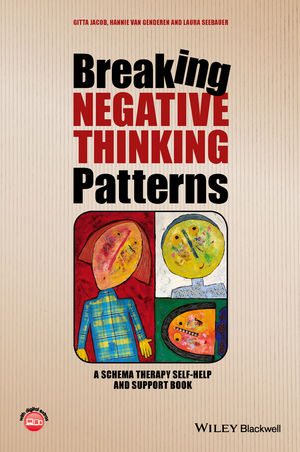
Breaking Negative Thinking Patterns (eBook)
Breaking Negative Thinking Patterns is the first schema-mode focused resource guide aimed at schema therapy patients and self-help readers seeking to understand and overcome negative patterns of thinking and behaviour.
- Represents the first resource for general readers on the mode approach to schema therapy
- Features a wealth of case studies that serve to clarify schemas and modes and illustrate techniques for overcoming dysfunctional modes and behavior patterns
- Offers a series of exercises that readers can immediately apply to real-world challenges and emotional problems as well as the complex difficulties typically tackled with schema therapy
- Includes original illustrations that demonstrate the modes and approaches in action, along with 20 self-help mode materials which are also available online
- Written by authors closely associated with the development of schema therapy and the schema mode approach
Gitta Jacob is a Clinical Psychologist and Schema Therapist at GAIA, a therapy development and research company in Hamburg, Germany. A founding board member of the International Society for Schema Therapy (ISST), Dr. Jacob is also co-author of Schema Therapy in Practice: An Introductory Guide to the Schema Mode Approach (2012).
Hannie van Genderen is a Clinical Psychologist, Supervisor of the Dutch Association for Behavioural and Cognitive Therapy, and Chair of the Dutch Schema Therapy Association. She is also a Psychotherapist at the Maastricht Community Mental Health Centre and co-author of Schema Therapy for Borderline Personality Disorder (2009).
Laura Seebauer is a Psychologist, Psychotherapist and Schema Therapist in the Department of Clinical Psychology and Psychotherapy, University Medical Centre, University of Freiburg, Germany.Breaking Negative Thinking Patterns is the first schema-mode focused resource guide aimed at schema therapy patients and self-help readers seeking to understand and overcome negative patterns of thinking and behaviour. Represents the first resource for general readers on the mode approach to schema therapy Features a wealth of case studies that serve to clarify schemas and modes and illustrate techniques for overcoming dysfunctional modes and behavior patterns Offers a series of exercises that readers can immediately apply to real-world challenges and emotional problems as well as the complex difficulties typically tackled with schema therapy Includes original illustrations that demonstrate the modes and approaches in action, along with 20 self-help mode materials which are also available online Written by authors closely associated with the development of schema therapy and the schema mode approach
Gitta Jacob is a Clinical Psychologist and Schema Therapist at GAIA, a therapy development and research company in Hamburg, Germany. A founding board member of the International Society for Schema Therapy (ISST), Dr. Jacob is also co-author of Schema Therapy in Practice: An Introductory Guide to the Schema Mode Approach (2012). Hannie van Genderen is a Clinical Psychologist, Supervisor of the Dutch Association for Behavioural and Cognitive Therapy, and Chair of the Dutch Schema Therapy Association. She is also a Psychotherapist at the Maastricht Community Mental Health Centre and co-author of Schema Therapy for Borderline Personality Disorder (2009). Laura Seebauer is a Psychologist, Psychotherapist and Schema Therapist in the Department of Clinical Psychology and Psychotherapy, University Medical Centre, University of Freiburg, Germany.
Preface viii
Credit for Images x
1 Introduction 1
1.1 What Is Schema Therapy? 2
1.2 Understanding the Origin of Your Patterns 4
1.2.1 Recognizing your Modes 5
1.2.2 Changing your Modes 5
Part I: Become Familiar with Your Modes 7
2 Child Modes 9
2.1 Vulnerable Child Modes 12
2.1.1 Get in contact with your own Vulnerable Child Mode 17
2.1.2 Detecting Vulnerable Child Modes in others 20
2.2 Angry and Impulsive Child Modes 20
2.2.1 Get in contact with your own Angry or Impulsive Child Mode 26
2.2.2 Detecting Angry or Impulsive Child Modes in others 28
2.3 Happy Child Mode 32
2.3.1 Get in contact with your own Happy Child Mode 34
2.3.2 Detecting the Happy Child in others 36
2.4 Summary 36
3 Dysfunctional Parent Modes 38
3.1 Demanding Parent Modes 44
3.1.1 How can I detect my own Demanding Parent Mode? 49
3.1.2 How can I detect a Demanding Parent Mode in other people? 49
3.2 Guilt-Inducing Parent Modes 51
3.2.1 How can I detect Guilt-inducing Parent Modes? 55
3.3 Punitive Parent Mode 57
3.3.1 How can I detect a Punitive Parent Mode in myself? 60
3.3.2 How can I detect a Punitive Parent Mode in others? 62
3.4 Summary 63
4 Coping Modes 65
4.1 Compliant Surrender Mode 73
4.1.1 How can I detect a Compliant Surrender Coping Mode in myself? 74
4.1.2 How can I detect a Compliant Surrender Mode in others? 81
4.2 Avoidant Coping Mode 81
4.2.1 How can I detect Avoidant Coping Mode in myself? 84
4.2.2 How can I detect Avoidant Coping Mode in others? 84
4.3 Overcompensatory Coping Mode 88
4.3.1 How can I detect Overcompensatory Coping Mode in myself? 88
4.3.2 How can I detect Overcompensatory Coping Mode in others? 92
4.4 Summary 95
5 Healthy Adult Mode 96
5.1 How can I detect a Healthy Adult Mode in myself? 98
5.2 How can I detect a Healthy Adult Mode in others? 99
5.3 How can I distinguish the Healthy Adult Mode from other modes? 101
5.4 Summary 104
Part II: Change Your Modes 105
6 Healing Vulnerable Child Modes 107
6.1 Get Acquainted with your Vulnerable Child Mode 108
6.2 Taking care of your Vulnerable Child Mode 111
7 Gaining Control over Angry and Impulsive Child Modes 117
7.1 Get Acquainted with your Angry or Impulsive Child Mode 119
7.2 Setting Limits to Angry or Impulsive Child Modes 120
7.2.1 Goals and needs 122
7.2.2 Chair dialogues 123
7.2.3 Learn to direct your behavior 124
7.2.4 How can I learn to control my anger? 126
8 Strengthen the Happy Child Mode 130
8.1 Get Acquainted with your Happy Child Mode 130
8.2 Exercises to Strengthen the Happy Child Mode 133
9 Setting Limits to Dysfunctional Parent Modes 136
9.1 Get in Touch with your Dysfunctional Parent Mode 137
9.2 Silence Dysfunctional Parent Modes 144
9.2.1 Exercises to reduce Dysfunctional Parent Messages 147
10 Changing Coping Modes 150
10.1 Get in Touch with your Coping Modes 151
10.2 Reducing Coping Modes 151
10.2.1 Reducing the Compliant Surrender Mode 157
10.2.2 Reducing avoidance 157
10.2.3 Reducing Overcompensation 160
11 Promoting Your Healthy Adult Mode 165
Glossary 175
References and Further Reading 179
Index 181
The authors have distilled their extensive clinical experience
as therapists, supervisors, trainers and researchers in Schema
Therapy into a wonderfully clear and enlightening self-help guide.
Their ability to explain and address complex issues in such a
straightforward and compassionate manner means that this book will
be invaluable for people struggling with 'negative thinking
patterns', and a great inspiration for therapists looking to
explain the concepts and ideas of schema therapy to others.
Harnessing the use of mental imagery is a useful addition too to
many standard texts. Super case examples and vivid images
illustrate the concepts throughout.--Emily Holmes, MRC
Cognition & Brain Sciences Unit, Cambridge UK and Department
for Clinical Neuroscience, Karolinska Institutet,
Sweden
This book is an amazingly successful explanation of the essence of
Schema Therapy. It is perfect for anyone interested in
understanding what drives our emotional, thinking and behavioral
patterns, and how those patterns can be changed. It is already a
bestseller in the Netherlands and Germany and a great help to its
readers, so it is fantastic that it is now available in
English.--Arnoud Arntz, PhD, Professor of Clinical
Psychology, University of Amsterdam, the Netherlands
1
Introduction
Case Example “Exclusion”
Carol is a 34-year-old mother of a 4-year-old son, in a stable relationship. She works part-time as a bank assistant. She could be quite satisfied with her life, but minor incidents sometimes trigger severe feelings of exclusion or rejection. This may happen, for example, when her colleagues who work full-time make an “insider joke” she doesn’t get. Most often, she reacts by drawing back from them. But she may also respond like a stroppy child to her colleagues, in particular when she is having a bad day anyway. Then she is not only annoyed by her colleagues, but also feels ashamed of her own reaction.
Carol has had this kind of problem all her life… maybe it has something to do with her childhood. Because of her father’s frequent job changes, she was forced to move and start all over again several times. Facing a new school class, she often made the experience of feeling excluded. At the age of 12, she even experienced severe mobbing in school.
Does that sound familiar to you? Persistent patterns you just cannot get rid of? The same kind of feelings mixing up your life over and over again?
If you want to change your patterns, you should first understand and recognize which patterns are bothering you right now in your daily life. Find out how these patterns developed over your life and why they are so persistent. In the first part of this book we explain how you can explore the origins of your patterns. You will also discover your real needs and how you can meet them better.
In Part II we will introduce methods to change your patterns step by step and in the way that you want. You can either deal with this by yourself, using the advice in this book, or, if and when this seems too difficult, you might consider seeking help from a therapist.
The therapy that’s aiming to change your patterns is called schema therapy. The central concept in schema therapy is called “schema mode” or simply “Mode.” A Mode is a persistent pattern of behaving and feeling that always causes the same type of problems. In fact, it is a state of mind that is connected to bad experiences in your youth or childhood.
In this book we will explain the schema Modes we know about and the ways that you can change them. You can use this book both as a self-help guide and as a support during a schema therapy. If you decide to change your Modes by yourself we recommend that you get someone you trust to discuss your patterns with you. We also recommend that you read this book step by step. Think about each chapter you read before going ahead. In this way you will learn to deal better with difficult situations, your negative feelings will diminish and you will fulfill your needs in a healthier way.
1.1 What Is Schema Therapy?
Schema therapy is one of the latest advances in psychotherapy. It is a development of cognitive behavior therapy, combining ideas from various psychotherapeutic approaches. Box 1.1 lists psychotherapy approaches that have been influential on schema therapy.
Box 1.1: Approaches That Have Influenced Schema Therapy
Cognitive behavioral therapy: Focusing on changes in thoughts and behavior in concrete, current life problems.
Depth psychology: Most psychological problems have their origin in experiences in childhood and youth.
Psychodrama and Gestalt therapy: Techniques to change problematic emotions.
Humanistic therapy/ Client-centered therapy: Focusing on human needs and on their importance for mental health.
Emotions play the most important role in schema therapy. Both positive and negative childhood experiences form our adult emotional reactions. Imagine that you have been humiliated as a child, because your clothes were different or your nose was extraordinarily big. If you often felt rejected and humiliated as a child, it’s very likely that you will easily feel rejected or humiliated as an adult, too – even if nobody means to make you suffer this way. Such feelings typically lead to many problems: for instance, you might not make contact with others easily and thus not be able to establish healthy and close relationships; or you might react aggressively to prevent further humiliation, even if your action is not at all appropriate.
Therefore, the very first step of schema therapy is always to understand your negative feelings and their origin in your biography. Then, all current negative consequences of these feelings and childhood experiences are explored. The second step is to support you in changing your feelings and your dysfunctional behaviors. Thus, you will more satisfied and better able to fulfill your needs in a healthy and appropriate way.
1.2 Understanding the Origin of Your Patterns
A basic principle of the Mode concept is that everyone experience themselves differently at different moments. While you may feel very healthy and relaxed in one moment, you may feel vulnerable and sad in another. In some other situation you may rather be emotionally cold and feel nothing. Such different states are called “Modes.” In schema therapy we define the following Modes:
- Vulnerable and Angry Child Modes. Most people are familiar with feelings of weakness, inferiority, sadness or intense rage, defiance or anger, in which they do not feel grown up. In schema therapy such states are called “Child Modes.” We call them Child Modes because we assume that when important needs are not met in someone’s childhood, they will have emotional parts that cannot grow up.
- Dysfunctional Parent Modes. People with intense Child Modes often tend to devalue themselves or to put excessive pressure upon themselves. These Modes are called Dysfunctional Parent Modes, as they have often been “modeled” by devaluing or abusive parents, or bullying class mates or siblings. The term parent in Parent Modes does not only relate to real parents, but also to any other important maladaptive attachment figure.
- Coping Modes. When someone is affected by negative feelings they tend to use one or more favored strategies to reduce those feelings or to hide them from others. The technical term for such psychological “survival strategies” is “Coping Mode.” Such coping includes avoidant behaviors like social retreat or cannabis use in order to calm down negative feelings. Another way of coping with negative feelings is to behave aggressively or excessively self-confidently when actually feeling weak or inferior.
- Healthy Adult Mode. Of course we do not only have dysfunctional or immature modes: we also have healthy parts with high-level functioning, healthy connections with other people, and positive emotions. The part that is able to organize your life, solve problems and take care of good relationships is called the “Healthy Adult Mode.”
- Happy Child Mode. All people – both children and adults – have a need for fun, happiness and easiness. The Happy Child Mode is related to these feelings.
1.2.1 Recognizing your Modes
The first part of this book is all about becoming familiar with your Modes. It will describe and explain all the Modes. It includes many examples illustrating how to detect Modes in yourself and in others. We will find out how strong the different Modes are in your life. How did they develop in your life and why are some Modes more significant than others? We will focus on how your Modes make you feel and what type of situations cause them to pop up.
1.2.2 Changing your Modes
In the second part of the book you will learn strategies and exercises which can help you to change your Modes. The general aim is to enable you to cope with difficult situations in the way that suits you. You’ll get to know your own needs better and learn how to fulfill them. These exercises and changes are related to three different levels of human experience:
- Thoughts (Cognitive level). On the cognitive level it’s most relevant to learn everything about your Modes and to reflect on the appropriateness of the cognitions related to your Modes. On this level you also work out realistic plans about what you want to change. Protocols and worksheets will guide and help you with this.
- Feelings (Emotional level). You will find many suggestions on how to change distressing emotions. Imagery exercises are powerful emotional techniques. In these exercises you imagine yourself in a certain situation, and think about what you need and what you want to change. Next, you imagine that you behave in a certain way to change the situation. The influence of this exercise on emotions is much stronger than merely thinking about the same issue.
- Behaviors (Behavioral level). Behavior changes usually follow work with cognitions and emotions. The book will offer many examples and suggestions on how to change persistent behavior patterns in your life.
Of course, every person is unique, and your Modes differ from other people’s. You will take different things out of this book than someone else will. Maybe you just want to get some information about schema therapy. Or maybe you want to try to find out how the Mode perspective applies to...
| Erscheint lt. Verlag | 31.12.2014 |
|---|---|
| Sprache | englisch |
| Themenwelt | Sachbuch/Ratgeber ► Gesundheit / Leben / Psychologie ► Psychologie |
| Geisteswissenschaften ► Psychologie ► Klinische Psychologie | |
| Medizin / Pharmazie ► Gesundheitsfachberufe | |
| Medizin / Pharmazie ► Medizinische Fachgebiete ► Psychiatrie / Psychotherapie | |
| Schlagworte | Change • Clinical psychology • Klinische Psychologie • Psychologie • Psychology • Psychotherapie • Psychotherapie u. Beratung • Psychotherapy & Counseling • Ratgeber • Schema therapy, ST, CBT, schemas, modes, schema modes, cognitive therapy, CT, dysfunction, dysfunction modes, problematic behavior patterns • Self-Help • self-improvement • thinking patterns, self-destructive |
| ISBN-13 | 9781118881736 / 9781118881736 |
| Informationen gemäß Produktsicherheitsverordnung (GPSR) | |
| Haben Sie eine Frage zum Produkt? |
 EPUB (Adobe DRM)
Kopierschutz: Adobe-DRM
Adobe-DRM ist ein Kopierschutz, der das eBook vor Mißbrauch schützen soll. Dabei wird das eBook bereits beim Download auf Ihre persönliche Adobe-ID autorisiert. Lesen können Sie das eBook dann nur auf den Geräten, welche ebenfalls auf Ihre Adobe-ID registriert sind.
Details zum Adobe-DRM
Dateiformat: EPUB (Electronic Publication)
EPUB ist ein offener Standard für eBooks und eignet sich besonders zur Darstellung von Belletristik und Sachbüchern. Der Fließtext wird dynamisch an die Display- und Schriftgröße angepasst. Auch für mobile Lesegeräte ist EPUB daher gut geeignet.
Systemvoraussetzungen:
PC/Mac: Mit einem PC oder Mac können Sie dieses eBook lesen. Sie benötigen eine
eReader: Dieses eBook kann mit (fast) allen eBook-Readern gelesen werden. Mit dem amazon-Kindle ist es aber nicht kompatibel.
Smartphone/Tablet: Egal ob Apple oder Android, dieses eBook können Sie lesen. Sie benötigen eine
Geräteliste und zusätzliche Hinweise
Buying eBooks from abroad
For tax law reasons we can sell eBooks just within Germany and Switzerland. Regrettably we cannot fulfill eBook-orders from other countries.
aus dem Bereich