


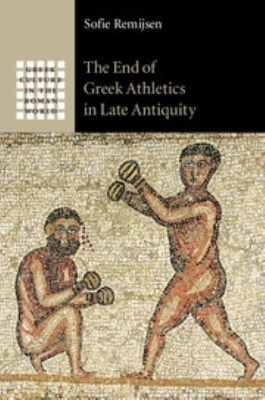
The End of Greek Athletics in Late Antiquity
Seiten
2015
Cambridge University Press (Verlag)
978-1-107-05078-5 (ISBN)
Cambridge University Press (Verlag)
978-1-107-05078-5 (ISBN)
The demise of the ancient Olympics has commonly been blamed on a ban imposed by the Christian emperor Theodosius I. Sofie Remijsen challenges this conventional view, and traces instead the collapse of the entire professional circuit of Greek athletics under the pressure of changing institutions and perceptions in late antiquity.
This book presents the first comprehensive study of how and why athletic contests, a characteristic aspect of Greek culture for over a millennium, disappeared in late antiquity. In contrast to previous discussions, which focus on the ancient Olympics, the end of the most famous games is analyzed here in the context of the collapse of the entire international agonistic circuit, which encompassed several hundred contests. The first part of the book describes this collapse by means of a detailed analysis of the fourth- and fifth-century history of the athletic games in each region of the Mediterranean: Greece, Asia Minor, Syria, Egypt, Italy, Gaul and northern Africa. The second half continues by explaining these developments, challenging traditional theories (especially the ban by the Christian emperor Theodosius I) and discussing in detail both the late antique socio-economic context and the late antique perceptions of athletics.
This book presents the first comprehensive study of how and why athletic contests, a characteristic aspect of Greek culture for over a millennium, disappeared in late antiquity. In contrast to previous discussions, which focus on the ancient Olympics, the end of the most famous games is analyzed here in the context of the collapse of the entire international agonistic circuit, which encompassed several hundred contests. The first part of the book describes this collapse by means of a detailed analysis of the fourth- and fifth-century history of the athletic games in each region of the Mediterranean: Greece, Asia Minor, Syria, Egypt, Italy, Gaul and northern Africa. The second half continues by explaining these developments, challenging traditional theories (especially the ban by the Christian emperor Theodosius I) and discussing in detail both the late antique socio-economic context and the late antique perceptions of athletics.
Sofie Remijsen is a Junior Professor in the Department of History at Universität Mannheim, Germany.
Introduction; Part I. An Overview of Athletics in Late Antiquity: 1. Greece; 2. Asia Minor; 3. Syria; 4. Egypt; 5. Italy; 6. Gaul; 7. North Africa; Conclusions to Part I; Part II. Agones in a Changing World: 8. A religious ban?; 9. An imperial ban?; 10. The athletic professionals; 11. Athletics as elite activity; 12. The practical organization of agones; 13. The agon as spectacle; Conclusions to Part II.
| Reihe/Serie | Greek Culture in the Roman World |
|---|---|
| Zusatzinfo | 6 Maps; 6 Halftones, unspecified; 6 Halftones, black and white; 3 Line drawings, black and white |
| Verlagsort | Cambridge |
| Sprache | englisch |
| Maße | 152 x 229 mm |
| Gewicht | 710 g |
| Themenwelt | Sachbuch/Ratgeber ► Sport |
| Geschichte ► Allgemeine Geschichte ► Vor- und Frühgeschichte | |
| Geschichte ► Allgemeine Geschichte ► Altertum / Antike | |
| Geisteswissenschaften ► Geschichte ► Regional- / Ländergeschichte | |
| ISBN-10 | 1-107-05078-2 / 1107050782 |
| ISBN-13 | 978-1-107-05078-5 / 9781107050785 |
| Zustand | Neuware |
| Informationen gemäß Produktsicherheitsverordnung (GPSR) | |
| Haben Sie eine Frage zum Produkt? |
Mehr entdecken
aus dem Bereich



aus dem Bereich
Konzepte – Methoden – Theorien
Buch | Softcover (2024)
UTB (Verlag)
CHF 55,85
auf den Spuren der frühen Zivilisationen
Buch | Hardcover (2023)
C.H.Beck (Verlag)
CHF 27,95


