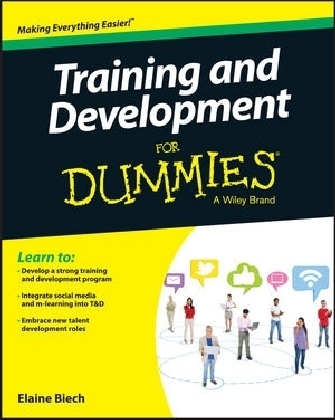
Training & Development For Dummies
For Dummies (Verlag)
978-1-119-07633-9 (ISBN)
- Titel erscheint in neuer Auflage
- Artikel merken
Develop and deliver a robust employee training and development program Training and Development For Dummies gives you the tools you need to develop a strong and effective training and development program. Covering the latest in talent development, this informative guide addresses classroom, virtual, and blended learning to open up your options and help you design the program that's right for your company. You'll explore the different modes of formal learning, including social learning, m-learning, and MOOCs, and delve into the benefits and implementation of self-directed and informal learning. The discussion covers mentoring and coaching, rotational and stretch assignments, and how to align talent development with the company's needs. You'll learn how to assess employee skills, design and deliver training, and evaluate each step of the process to achieve the goals of both the employee and the organization.
Most employees have some weaknesses in their skill sets. A robust training program allows you to strengthen those skills, and a development program brings all employees up to the highest possible level of productivity and success. This book helps you create consistency in your company by developing and delivering the exact training and development program your people need.
Develop a strong training and development program
Foster a supportive and innovative work environment
Learn about social learning, m-learning, and MOOCs
Assess and evaluate your staff more effectively
A great training and development program boosts performance, productivity, job satisfaction, and quality of services, while reducing costs and supervision. Investing in your employees gives an excellent ROI, as talent development is a primary driver behind both motivation and loyalty. Training and Development For Dummies shows you how to reap these benefits, with step by step guidance and essential expert insight.
Elaine Biech has been in the training and consulting field for over a quarter of a century. She is President of ebb associates inc, an organizational development and custom training design firm that helps organizations work through large-scale change, and has been featured in The Wall Street Journal.
Foreword xiv
Introduction 1
About This Book 1
Foolish Assumptions 2
Icons Used in This Book 2
Beyond the Book 3
Where to Go from Here 4
Part I: So You’re Going to Be a Trainer 5
Chapter 1: What’s Training and Development? 7
What Is Training and Development? 8
What forms does T&D take? 8
Why is training necessary? 10
Is training just for business? 12
What Do Trainers Do? 13
Assessing your training potential 14
Take stock of your skills 15
Your self‐assessment 19
How do you become a trainer? 19
The Many Hats of a 21st Century Trainer 20
Do You Have What It Takes? 21
Chapter 2: Why Adults Learn 25
Adult Learning Theory 25
Who is Malcolm Knowles? 26
Applying adult learning theory to training 28
How Do People Learn? 29
Three types of learning: KSAs 29
Brain‐based learning: It’s a no‐brainer 31
Other considerations for learning 33
Helping Adults Learn in the Classroom and Online 34
Create a safe haven for learning 34
Create a comfortable environment 35
Encourage participation 36
Facilitate more than you deliver 37
One Last Note: Who’s Who and What’s What 38
Who’s who? 38
What’s what? 39
Chapter 3: The Training Cycle 41
The Training Cycle: An Overview 41
Assess and analyze needs 42
Develop objectives 43
Design and develop the program 44
Implement the design 45
Evaluate performance 46
Other options to ADDIE 47
T&D Jargon 48
Learning and The Training Cycle 51
Variety and flexibility 51
Conditions of learning 52
Part II: Designing the Best Darn Training in the World 53
Chapter 4: Assessing Needs and Developing Learning Objectives 55
Conducting Needs Assessments 55
The why, how, who, and when of needs assessment 56
Is it training? 65
If your time is limited 65
Writing Objectives 67
What objectives should do 68
Task analysis 71
Chapter 5: Developing the Training Design 73
How Do I Begin? 75
Online or classroom 76
Let’s design 78
Designing a Dynamic Opening 79
All about icebreakers 80
What else will your participants expect in your design? 82
Designing the Body to Ensure Learning Occurs 83
Lectures 84
Countless alternatives to lecture 86
Selecting activities 92
Adding Zest with Visuals 97
Knowing why you need visuals 98
Creating effective visuals 98
Designing a Finale That Brings Closure 102
Ensuring that expectations are met 103
Providing a shared group experience 103
Evaluating the learning experience 103
Requesting feedback and suggestions 103
Accomplishments and commitment to action 104
Sending them off with an encouraging word 104
Selecting Off‐the‐Shelf Materials 105
Will off‐the‐shelf meet your needs? 105
Adapting the design 106
Pulling It All Together 107
Factors that affect a design 107
Strategies for a good design 109
Developing materials 111
Chapter 6: Nuances of Using Technology for Learning 113
Technology Basics 114
Exploring E-Learning’s Benefits and Drawbacks 115
Benefits of e‐learning 115
Drawbacks of e‐learning 116
Overcome drawbacks for your success 117
Delivering Webinars and Virtual Classes 118
What about software? 118
Technical preparation 120
Encouraging engagement 123
The Technical Stuff 124
Choosing a learning management system 124
SCORM, Tin Can, and 508 compliance 126
Blended Learning and New Options 126
Social media expands T&D’s options 127
Chapter 7: Being Prepared to Succeed 129
Preparing Your Training Environment 129
Know when, where, what, who 130
Room arrangements 130
Equipment and visuals 134
Preparing Your Participants 138
Preparing participants: What works? 138
Unique virtual participant preparation 139
Preparing participants: What doesn’t work? 140
Preparing Yourself 140
Prepare to avoid crises 140
Prepare for Virtual ILT 143
Identifying your training style 144
Find out who’s in your session 145
Practice, practice, practice 146
Tips for staying organized 147
Prepare your body and brain 151
Travel if you must 152
The procrastinator’s checklist 153
Last‐minute virtual session preparation 155
Being prepared to succeed 156
Part III: Showtime: Delivering a Dynamic Training Session 157
Chapter 8: Implementing Training Designs: Your Job as a Facilitator 159
Training, Facilitation, and Presentation: What’s the Difference? 160
Are you a trainer or a facilitator? 160
Use facilitative skills when you present 162
Facilitating Successful Training 164
Experience is the best teacher 166
Tips for facilitating activities 169
Participation Prescription: Continue to Increase the Dosage 172
Gotta play the game to perform 172
Participants’ expectations of participation 173
Increasing participation — or why are they called “participants”? 175
REACTing 180
Chapter 9: It’s Showtime: Delivering Success 181
Opening Your Training Session with a BANG, Online or Off 182
Build interest in the session 183
Ask what participants know and what they want to know 183
Note the ground rules and what to expect 183
Get them involved 184
Looking at Six Disastrous Debuts 185
Creating a Supportive Learning Environment 186
Get to know your participants 186
What’s in a name: Five secrets to remembering names 187
Let them know about you 189
Training Like a Pro 190
Presentation skills 190
The participants’ materials 195
Notes: To be or note to be 196
Asking and Answering Questions 198
Encouraging participants to ask questions 198
Guidelines for answering questions 199
Asking questions 201
Questions in action 202
Smooth Transitions 203
Wrap Up an Effective Training Session 204
Ensure that expectations were met 204
Provide a shared group experience 205
Evaluate the learning experience 205
Summarize the accomplishments and gain commitment to action 205
Send them off with a final encouraging word — or two 206
Chapter 10: Mastering Media and Other Visuals 207
Select the Best Visual to Do the Job 208
What’s available? 208
What are the benefits? 210
Ensure That the Visual Adds to the Learning 210
Computer projection systems 211
Videos and DVDs 212
Participant devices 212
Flipcharts 213
Boards of all types (including electronic) 215
Props 215
Look Like a Pro 215
Tips for using visuals in general 216
Guidelines for using specific media and visuals 218
The Other Media: Social 223
Hot Tips for a Cool Ending 225
Chapter 11: Training with Style 227
Understand Your Training Style Strengths 227
Building the training style model 228
The four training styles 230
Using your training style 232
Group Dynamics 234
Composition 234
Atmosphere 235
Norms 236
Values 236
Communication and participation 237
Roles 237
Power and influence 238
Creating an Energizing, Exciting, Encouraging Environment 239
Coloring outside the lines 239
Energize the group 242
Let me entertrain you! 244
Add creativity to training 246
Celebrate success 248
Putting It All Together 249
Chapter 12: Addressing Problems: What’s a Trainer to Do? 251
Problems in the Classroom 251
Problems with logistics 252
Equipment problems 253
Difficult personal situations 256
Difficult group situations 257
If training is not the solution 259
Take a COOL approach 261
Using humor to deal with problems 261
Managing Disruptive Behaviors 262
Prevent disruptions 263
Manage disruptive types 264
Sweaty Palms, Parched Throat: Overcoming Nervousness 269
Understanding pre‐performance jitters 269
Accept your nervousness as natural 270
Master nervous symptoms 272
Tips for specific anxiety problems 276
Problems Can Be Prevented or Resolved 278
Part IV: It’s Not Over Yet: The Follow‐Up 279
Chapter 13: Evaluation: It’s Not Over Yet! 281
Purpose of Evaluations 282
Review of Kirkpatrick’s Four Levels of Evaluation 283
Level 1: Reaction 284
Level 2: Learning 285
Level 3: Behavior 285
Level 4: Results 286
Guidelines for measuring the Four Levels 288
Evaluation methods 295
ROI for Training 298
Return on Investment 298
Exploring the ROI process 298
Benefits of planning for ROI 299
Evaluation: The Last Training Cycle Stage but the
First Step to Improvement 302
Chapter 14: Transfer of Learning 307
Make Your Training Memorable: Follow‐Up for the Other 50 Percent 308
Barriers to transfer of learning 308
Strategies for transfer of learning 309
What Great Trainers Do After Training 314
Part V: The Professional Trainer 317
Chapter 15: The Consummate Professional 319
Grow Professionally 319
Attend formal learning events 320
Ask others 321
Do it yourself 322
Go the Extra Mile: Stay on Top of Your Game! 323
Good to great 324
Where’s your energy? Stay pumped! 325
Design 326
What does professional mean to you? 327
Give Back to the Profession 329
Chapter 16: Trainer Certification 331
All About ATD 332
Why is ATD’s mission important? 332
What does ATD do? 332
Introducing the ATD Competency Model 334
Overview of the model 334
The value of a competency model 337
Certification: What It Means for You 338
Certification versus certificate 338
Certification: Why now? 339
Certification: Show me the value 339
ATD CI Certification: A Quick Look 340
Competencies and certification 340
Certification design 340
Applicant process 341
Be a role model for learning 342
Staying Current 343
Chapter 17: The Future of the T&D Profession 345
Blame It on the VUCA World 346
VUCA defined 346
What does this have to do with me? 346
The Changing T&D Environment 347
Doing more with less 347
Brain‐based learning 349
Microbursts, capsules, and mini trends 349
Training on the run 350
Globalization 351
The multi‐generational workforce 353
Supporting the C‐Suite 355
Expanded Role for T&D 356
Onboarding 356
Facilitating change 357
Coaching managers 357
Creating mentoring opportunities 358
Internal consulting 359
Building teams 359
Alternative Delivery Options 360
Team training 360
Help for the part‐time trainer 363
Informal learning on the job 364
Where is this Heading? 365
How to Prepare Yourself 366
Content 366
Future roles 368
Become a lifelong learner 370
Part VI: The Part of Tens 373
Chapter 18: Ten Tips to Start Off on the Right Foot 375
Establish a Climate Conducive to Learning 376
Clarify Participants’ Expectations 377
Introduce the Content 378
Surprise! 378
Introduce Participants 379
Learn About the Group 380
Establish Ground Rules 381
Confront Any Issues 382
Establish Your Credibility and Style 382
Take a Break! 383
Chapter 19: Ten Webinar Warmups 385
Someone Once Said 386
Test Their Mettle 386
Chat Away 387
Expect Expectations 387
At the Movies 388
Going Live 388
Vote Early, Vote Often 388
Show Me the Picture 389
How Was the Homework? 389
Annotate It 389
Chapter 20: Ten Ways to Save Time While Training 391
Consider the Relationship of Time to Small Groups 391
One Activity, Two (Or More) Objectives 392
Gentle Prods 392
Different Pace for Different Folks 393
Divvy Up the Work 393
The Time Is Now 394
Be Prepared 394
Cut Out the Fat 395
Use Timekeepers 396
Pre-Training Strategies 396
Chapter 21: Ten Icebreakers That Work 397
Bingo 400
Expectations 402
Hopes and Fears 402
Introduce Me, I Introduce You 403
Go to Your Corners 403
Little White Lie 404
Personal Coat of Arms 404
Autographs 405
Name Association 406
Ask a Question 406
Chapter 22: Ten Guidelines for M‐Learning Success 409
Does the Rationale Fit? 411
Think Small 411
Think Concise 412
Plan for Diversions 412
Create Just‐in‐Time 413
Expect the Unexpected 413
Extend Learning 414
Create and Present Videos 414
You’ve Got the Touch 415
Clarify Expectations 415
Index 417
| Erscheint lt. Verlag | 14.7.2015 |
|---|---|
| Sprache | englisch |
| Maße | 188 x 234 mm |
| Gewicht | 590 g |
| Themenwelt | Sachbuch/Ratgeber ► Beruf / Finanzen / Recht / Wirtschaft ► Wirtschaft |
| Sozialwissenschaften ► Pädagogik ► Berufspädagogik | |
| Wirtschaft ► Betriebswirtschaft / Management ► Personalwesen | |
| ISBN-10 | 1-119-07633-1 / 1119076331 |
| ISBN-13 | 978-1-119-07633-9 / 9781119076339 |
| Zustand | Neuware |
| Informationen gemäß Produktsicherheitsverordnung (GPSR) | |
| Haben Sie eine Frage zum Produkt? |
aus dem Bereich