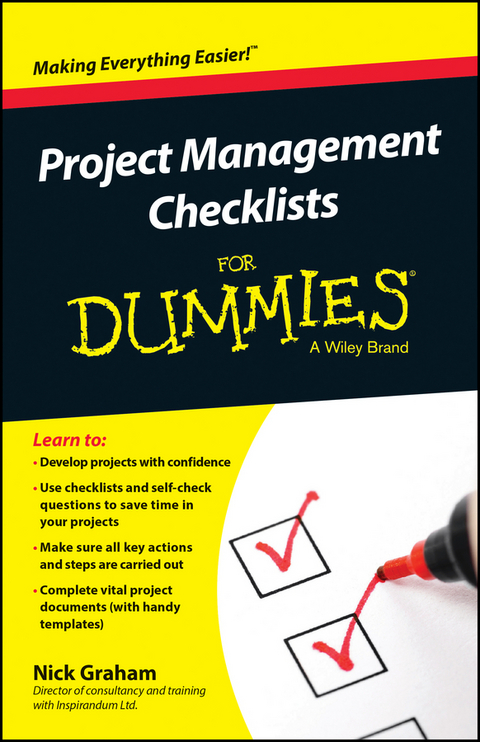
Project Management Checklists For Dummies (eBook)
John Wiley & Sons (Verlag)
978-1-118-93141-7 (ISBN)
Want to take your career to the next level and be a master of planning, organising, motivating and controlling resources to meet your goals? This easy-to-use guide has you covered! Project Management Checklists For Dummies takes the intimidation out of project management, and shows you step by step how to use rigorous self-check questions to save significant time—and headaches—in managing your projects effectively.
Project Management Checklists For Dummies gives you to-do lists, hands-on checklists and helpful guidance for managing every phase of a project from start to finish. Before you know it, you'll be a star project manager as you organise, estimate and schedule projects in today's time-crunched, cost-conscious global business environment.
- Includes useful to-do lists and checklists to ensure all the necessary steps are completed
- Offers simple exercises to help clarify needs and requirements along the way
- Provides templates to complete, which can also be downloaded from Dummies.com and customised to suit your unique requirements
- Supplies hints and tips to help you along the way
If you're a project manager—or any professional charged with managing a project and wondering where to start—Project Management Checklists For Dummies is your ready-made tool for success.
Your must-have tool for perfect project management Want to take your career to the next level and be a master of planning, organising, motivating and controlling resources to meet your goals? This easy-to-use guide has you covered! Project Management Checklists For Dummies takes the intimidation out of project management, and shows you step by step how to use rigorous self-check questions to save significant time and headaches in managing your projects effectively. Project Management Checklists For Dummies gives you to-do lists, hands-on checklists and helpful guidance for managing every phase of a project from start to finish. Before you know it, you'll be a star project manager as you organise, estimate and schedule projects in today's time-crunched, cost-conscious global business environment. Includes useful to-do lists and checklists to ensure all the necessary steps are completed Offers simple exercises to help clarify needs and requirements along the way Provides templates to complete, which can also be downloaded from Dummies.com and customised to suit your unique requirements Supplies hints and tips to help you along the way If you're a project manager or any professional charged with managing a project and wondering where to start Project Management Checklists For Dummies is your ready-made tool for success.
Nick Graham founded the consultancy and training company, Inspirandum Ltd and is a member of the Association for Project Management and of the Institute of Directors. This is his fourth For Dummies book.
Introduction 1
Part I: The Questions 7
Chapter 1: Getting Started with Algebra Basics 9
Chapter 2: Solving Some Equations and Inequalities 15
Chapter 3: Function Basics 21
Chapter 4: Graphing and Transforming Functions 29
Chapter 5: Polynomials 37
Chapter 6: Exponential and Logarithmic Functions 45
Chapter 7: Trigonometry Basics 53
Chapter 8: Graphing Trig Functions 61
Chapter 9: Getting Started with Trig Identities 67
Chapter 10: Continuing with Trig Identities 73
Chapter 11: Working with Triangles and Trigonometry 79
Chapter 12: Complex Numbers and Polar Coordinates 89
Chapter 13: Conic Sections 97
Chapter 14: Systems of Equations and Inequalities 103
Chapter 15: Sequences and Series 111
Chapter 16: Introducing Limits and Continuity 117
Part II: The Answers 125
Chapter 17: Answers 127
Index
Chapter 1
Using Checklists and Templates in Projects
In This Chapter
The power of project checklists
The types of checklist in this book
Avoiding checklist pitfalls
The templates and how to use them
Understanding the Project Structure
This chapter, and indeed the whole of this first part of Project Checklists for Dummies, may seem a bit strange in a book of checklists. You may think that you just want to get going with your project and start ticking some boxes. However, to get the best out of the checklists and templates and use them really effectively you need to appreciate how to use them … and also how not to.
The checklists are designed to help you make sure that you have got everything right at different points in the project and haven’t missed out anything important. It’s so easy to make mistakes that are actually avoidable. As well as helping you to think things through for each project, the checklists also draw on lots of experience and help you make sure that you get it right for ‘this’ project, whether ‘this’ project is your first one or just your latest.
History repeats itself because nobody listens the first time.
Anonymous
If you’re new to projects, it will also pay you to go through the last part of this chapter to understand the project structure that the checklists are designed to fit in with. If you’re already familiar with project structure you can skip that section if you prefer.
Using the Checklists
When running any project you’ll find that checklists are a very powerful tool. They help you to ensure that you produce sound, well thought-out plans and control documents the first time around. That will not only save time and trouble later, but will also help you develop a deserved reputation as a thorough and effective Project Manager.
This section gives you a few pointers on using the checklists, including tackling problems where you want other staff to use them too, but where they are not quite as keen as you. Some don’t like things like project methods and checklists, and say that they have no need of them because of their experience and knowledge.
I like the example of an airline pilot here. Imagine that you’re standing in an airport waiting to check in for your flight over the Atlantic Ocean. The captain and co-pilot for your flight happen to walk past you and you overhear what the Captain is saying. ‘I’m not bothering with the pre-flight checklist on this trip. I’ve been flying aircraft for years, I’m very experienced and I’m sure I’ll remember everything important.’ You might feel slightly unhappy about that and start scanning the departure board to see if you can find an alternative flight. You certainly wouldn’t take the captain’s words as a sign of expertise and professionalism.
Using checklists is not unprofessional; rather the reverse. As far as you possibly can, you want to be sure that you get things right and that you don’t miss anything important. Quite apart from the consequences for the project if you get things wrong, avoiding problems will also save you a lot of time and hassle later.
I’m sure that you will use the project checklists in this book intelligently and appropriately, but to make absolutely sure you do, here are a few pitfalls to avoid.
- Use the checklists thoughtfully: Adjust them to the needs of your project, then use them. Otherwise you may be in danger of, for example, applying large project controls to a small project that simply doesn’t need them. Continuing with the aircraft analogy from the start of this section, different aircraft have different pre-flight checklists.
- Be extra careful in audit: Following on from the last point, if you’re using checklists to check up on someone else’s project (Project Audit) don’t apply some generic checklist to every project and ignore the individual project characteristics and specific control needs.
- Don’t get ‘tick happy’: The objective is not to fill up all the boxes with ticks, but to do the project work so that you can tick the boxes – if you see the difference. When you tick a box it should mean that the item is properly dealt with.
- Add to the checklists: If you need extra things on the checklists because of the nature of those projects, then add them.
- Take away from the checklists: As a reverse of the last point, if you never need to do something that’s on a checklist then take it off. Always keep the checklists relevant to what you are doing.
In short, keep your brain in gear and don’t drive up project overheads by doing unnecessary work because you haven’t thought through whether everything on a checklist is relevant to your project.
Using Lists As An Expert – Or Not
You’ll find the checklists useful if you’re a project expert – back to the analogy of an experienced aircraft pilot. You’ll also find them useful if you are less experienced in project management and need a bit of help. The format used for the lists in the book looks like this.
- Item: Explanation and help.
If you’re very experienced, you can just run down the bold headed items to be sure that you’ve covered everything you need to. If you’re less experienced, or just unsure of a particular point, you’ll see that each checklist item is followed by a short explanation to help you see why that item may be important in your project.
Understanding Checklist Types
There are four different types of checklist in the book. Although you’d probably have spotted that anyway, it helps to explain up front what the types are so you can watch out for them.
- Activity checklists: The activity checklists are to make sure that you are doing, or have done, everything you need to at a particular point in the project. For example, if you’re approaching the end of a Delivery Stage, have you done all the necessary checking and preparation for the ‘Stage Gate’ review?
- Thinking checklists: This type of checklist helps you think across different areas to make sure that you’ve looked into all the areas that you need to. For example, when considering who the stakeholders in your project are, have you remembered customers and suppliers?
- Completion checklists: The completion type of checklist is to make sure that you’ve got everything. So, when you’re doing the organisation chart of who is needed for the project, have you got all of the management roles covered or have you missed one?
- Information checklists: These tell you about the range of things in a particular area. For example, when you’re writing a Business Case for your project, you have to be really clear about the three sorts of benefit, because they’re very different. There’s a checklist to say what the three types of benefit are and to briefly explain each one.
Using Templates
Templates are helpful, they really are, but of course you should use them intelligently as you do the checklists. In fact the same do’s and don’ts apply that are in the bullet point list in the ‘Using the Checklists’ section earlier in this chapter. Templates can work powerfully for you in four ways:
- To save you significant time and effort ‘re-inventing the wheel’, such as in designing a document from scratch when it would be much quicker to use a template.
- Even if you can’t quite use the templates in this book ‘as is’, you can use them as a starting point and adapt them. That’s usually a whole lot faster and much less effort than starting from scratch. You’re bound to want quite a few of the sections even if you take a few out and add one or two others in.
- To help instruct others on how documents should be completed, improving the relevance and accuracy of the information that they enter.
- To help make sure that you haven’t missed anything.
Following on from the second point in the list, many people assume that their organisation and its projects are going to be very different from everyone else’s. In fact the core of project management is very similar, so you may well find that you only need minor changes to the templates, or even none at all, in which case you can relax and go home early today.
In each main part of this book you’ll find one or two chapters of templates for things like documents, reports and logs. You, or your project team members, then replace the ‘advice’ text in each section with the actual content. Easy, huh? And it’s that ease of use which again demonstrates the value of project templates.
On the For Dummies web site (www.dummies.com) we’re also making the templates available in Microsoft Word format. That way you can load a template straight into your computer and you don’t have to copy all of the information out of the book. Helpful of us and sensible too, don’t you think? But then that’s why you bought a For Dummies title in the first place.
Understanding Project Structure
To understand how the checklists...
| Erscheint lt. Verlag | 29.9.2014 |
|---|---|
| Sprache | englisch |
| Themenwelt | Sachbuch/Ratgeber ► Beruf / Finanzen / Recht / Wirtschaft ► Wirtschaft |
| Wirtschaft ► Betriebswirtschaft / Management ► Projektmanagement | |
| Schlagworte | Business & Management • managing a project • managing every phase of a project • Managing Projects • managing your projects • managing your projects effectively • Nick Graham • perfect project management • Project Management • project management checklist • project management checklists • Project Management Checklists For Dummies • Project Management For Dummies • project management tool • Project Manager • project managers • Projektmanagement • Wirtschaft u. Management |
| ISBN-10 | 1-118-93141-6 / 1118931416 |
| ISBN-13 | 978-1-118-93141-7 / 9781118931417 |
| Informationen gemäß Produktsicherheitsverordnung (GPSR) | |
| Haben Sie eine Frage zum Produkt? |
 EPUB (Adobe DRM)
Kopierschutz: Adobe-DRM
Adobe-DRM ist ein Kopierschutz, der das eBook vor Mißbrauch schützen soll. Dabei wird das eBook bereits beim Download auf Ihre persönliche Adobe-ID autorisiert. Lesen können Sie das eBook dann nur auf den Geräten, welche ebenfalls auf Ihre Adobe-ID registriert sind.
Details zum Adobe-DRM
Dateiformat: EPUB (Electronic Publication)
EPUB ist ein offener Standard für eBooks und eignet sich besonders zur Darstellung von Belletristik und Sachbüchern. Der Fließtext wird dynamisch an die Display- und Schriftgröße angepasst. Auch für mobile Lesegeräte ist EPUB daher gut geeignet.
Systemvoraussetzungen:
PC/Mac: Mit einem PC oder Mac können Sie dieses eBook lesen. Sie benötigen eine
eReader: Dieses eBook kann mit (fast) allen eBook-Readern gelesen werden. Mit dem amazon-Kindle ist es aber nicht kompatibel.
Smartphone/Tablet: Egal ob Apple oder Android, dieses eBook können Sie lesen. Sie benötigen eine
Geräteliste und zusätzliche Hinweise
Buying eBooks from abroad
For tax law reasons we can sell eBooks just within Germany and Switzerland. Regrettably we cannot fulfill eBook-orders from other countries.
aus dem Bereich