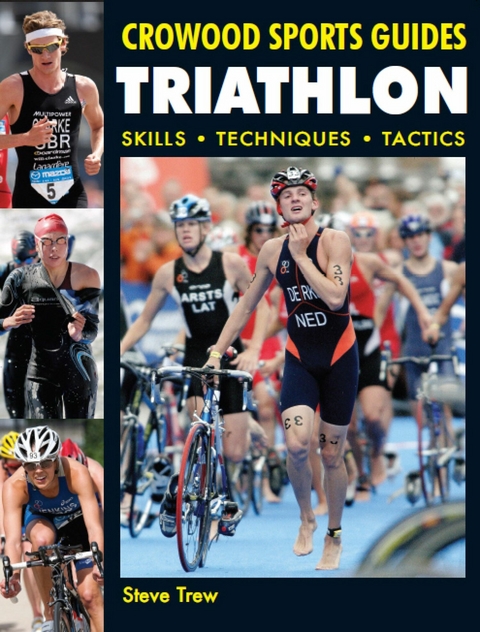
Triathlon (eBook)
218 Seiten
Crowood (Verlag)
978-1-84797-862-2 (ISBN)
Crowood Sports Guides provide sound, practical advice that will make you a better sportsperson, whether you are learning the basic skills, discovering more advanced techniques or reviewing the fundamentals of your sport.
CHAPTER 2
GETTING STARTED: FACILITIES AND EQUIPMENT
What do we need in the way of facilities – a place to train—for triathlon? Ideally, the same facilities that are needed for our three discipline sports: swimming, cycling and running.
Swimming
For swimming, a swimming pool is of course essential and additionally, access to a safe open water venue is a big advantage. Swimming pools come in all shapes and sizes, perhaps the most common are the standard 25-metre long pool although some areas still have the older 33.3-metre pool. (There still some 25-yard pools in existence, and many of the older 33.3-metre pools are actually 362/3 yards, because the distances competed in Great Britain were 110 yards rather than 100m.) There are 50-metre pools, but these are still few and far between. There is almost always public swimming in local authority pools but this can sometimes be crowded and unpleasant for novice swimmers. However, most enlightened authorities now have time set aside, often in the early mornings, for serious swimmers who perhaps don’t want to belong to a swimming club. At these times, some (perhaps all) of the pool will be sectioned or laned off, and swimmers will be able to swim up and down the lane. Most pools will also have designated slow, medium and fast lanes or recreational, semi-serious and serious swimmer lanes so that people are able to choose the most appropriate standard for them. However, it is far better to be able to swim under guidance, particularly for novice swimmers. Swimming is all about technique, and without a good technique, progress will be minimal. Most swimming clubs now have a ‘masters’ section for swimmers (normally) over the age of twenty years, some even have a fitness or triathlon section to cater for adults. The importance of the help of a qualified teacher or coach cannot be over-emphasized, and improvement in technique can be fast. You will normally be told to swim in a clockwise or anticlockwise direction for safety reasons to avoid collisions. Alternate lanes will swim in alternate directions to avoid the possibility of arms clashing as they recover over the water.
Alternate lanes clockwise and anticlockwise to avoid unnecessary collisions
Pool layout and lane patterns.
Access to a safe, open water venue is a huge advantage for the triathlete intending to race in open water events. It is essential that the venue is safe, that the water quality is good and that there is always some form of safety and rescue on hand. Triath letes and swimmers should never swim alone or unsupervised. Lakes are normally safer than rivers or the sea; currents and tides can be deceptive and dangerous.
Kit and Equipment for Swimming
While some triathletes prefer to wear an all-in-one ‘trisuit’ for competitions, for training swimming trunks or costume are the essentials, but there are also the almost-essentials and a variety of other equipment that will help in training.
Foremost of these are swimming goggles. Swimming goggles have only really been in existence for twenty years or so and prior to this, weeping eyes during and after swimming training sessions were commonplace amongst swimmers. Goggles protect the eyes from chemicals and infection and also greatly assist sighting, looking at their own or other swimmers’ techniques under water.
Swimming caps or hats will keep long hair out of a swimmer’s eyes and will also help in maintaining body heat, particularly in open water swims (one-third of body heat is lost through the head). Neoprene or insulated hats are also a great advantage in open water swimming when the temperature is low.
Many triathletes prefer to wear a trisuit. © Nigel Farrow
The swimmer’s kit.
Kickboards and pull buoys are used to isolate and focus on the leg action and arm action. However, overuse of these can be detrimental. Good kick action is essential to make progress in swimming, even though it is predominantly an upper body activity; new triathletes will often try to ‘short-cut’ their swimming deficiencies by too much use of the pull buoy that will lift their body position artificially. Similarly, too much use of kickboards can make the lower back sore and make the kicking process artificial.
Fins (often wrongly called flippers) are extremely useful, particularly when starting to learn new drills and techniques, as they remove the necessity of having to kick hard to maintain a good, flat body position. They are also very useful for kick practice but kicking work should also take place without the use of fins. Short, specialist swim fins are essential. The long, underwater and snorkelling fins can slow down the kick, giving a false sense of ability; they also put pressure on ankles and feet when kicking hard.
A water bottle is essential for all the disciplines, not only swimming. Particularly in swimming, the effects of not drinking enough, early enough, and possible dehydration can easily be underrated.
Rubber tubing can be used around the ankles to isolate the legs and force the swimmer to focus on pulling. They quickly give an insight into how important good kicking is for balance and position.
A wetsuit is essential for open water swimming in Great Britain. A specialist swimming wetsuit is advisable and recommended. Diving, surfing and canoeing wetsuits are often too inflexible and are unsuitable. The neoprene rubber of the wetsuit comes in different thicknesses (often 3mm and 5mm) and you should take advice on what is best for you.
Wetsuits are essential when the water is cold. © Nigel Farrow
Cycling
Cycling can be practised wherever there are roads. However, traffic on roads is inherently dangerous and care must always be taken when deciding where to ride. This is particularly important when in a new area, perhaps arriving early at a race venue. (Greg Welch, Australian Triathlon world champion was stopped when found cycling along the motorway when in Manchester for the 1993 World Championships.) Ideally, stay away from main and busy roads; also be wary in country lanes where traffic may not anticipate one or more cyclists coming around a corner. Above all, exercise caution! Hills are a necessary and welcome evil. If you don’t ride hills in training, then you won’t ride hills well in races.
Getting off the roads and mountain biking in safe surroundings is recommended, but you will need caution again if you are not an experienced mountain bike rider: the chance of falls and accidents can be higher.
Highly recommended is a turbo trainer (sometimes called a ‘wind trainer’ or ‘wind load simulator’). A turbo trainer is a floor-based metal frame with a roller at the back. You set your bike on this with the rear wheel on the roller. Pressure can be adjusted for the roller and wheel. The front wheel is sometimes still attached to the bike, sometimes removed, and the front forks safely fixed. You are ready to train safely on the cycle indoors. One advantage of this is that there can be no distractions when doing a quality, interval-based training session. The turbo trainer is a valuable tool that will help training immensely.
Cycling Equipment and Clothing
You will need a bike that must fit you perfectly. Your mechanical efficiency and aerodynamics position will depend on this. You also need to be comfortable. The main components and equipment on a bike are: frame, wheels and tyres, freewheel, chain, brakes, headset, handlebars and stem, gears, chainwheel and bottom bracket, pedals.
Although bike size is important, it is not the be-all and end-all as there are a number of adjustments that can be made. Sizing and position adjustments can only be guidelines, and if you do need to make changes, make them gradually and in easy stages of a maximum half-centimetre each time. The adjustments that can be easily made for height and for reach are: saddle height, saddle front and rear position, handlebar height, and handlebar forward and back position (stem length).
The most important piece of clothing is not shoes, shorts or jersey, but a crashhat. You have to wear a crash-hat to be allowed to compete; you can be disqualified if you are seen riding at a race without one. Wearing a crash-hat may save your life; it did mine.
Cycle shorts have a chamois or padded insert in the crotch area to make you comfortable when sitting on a saddle for a long time. A cycle jersey has two or three pockets at the back to allow you to carry food and emergency repair articles. Make sure that you always have a water bottle, puncture repair outfit and/or spare inner tube, and a mobile phone. Your bike should have a water bottle carrier and a pump attached to the frame. Wearing cycle mitts (gloves) will stop your hands rubbing on the handlebars.
Riding up hills is a necessary evil. © Nigel Farrow
Olympic triathlete Hollie Avil on the turbo trainer. © Nigel Farrow
Running
You can run anywhere. However, as with cycling it can be pleasant to choose a quiet route away from main roads. Running on grass can often be easier on the legs because of the softer surfaces. The down-side of a grass surface is that it may not always be level so it is important to watch where you are running. It is extremely useful to have access to a 400-metre running track so that periodically you can check and monitor your training times. Most running tracks are now all-weather surfaces with eight lanes. If you choose to run in any lane except lane one (and some tracks insist on...
| Erscheint lt. Verlag | 30.6.2014 |
|---|---|
| Verlagsort | London |
| Sprache | englisch |
| Themenwelt | Sachbuch/Ratgeber ► Sport ► Leichtathletik / Turnen |
| ISBN-10 | 1-84797-862-2 / 1847978622 |
| ISBN-13 | 978-1-84797-862-2 / 9781847978622 |
| Informationen gemäß Produktsicherheitsverordnung (GPSR) | |
| Haben Sie eine Frage zum Produkt? |
 EPUB (Adobe DRM)
Kopierschutz: Adobe-DRM
Adobe-DRM ist ein Kopierschutz, der das eBook vor Mißbrauch schützen soll. Dabei wird das eBook bereits beim Download auf Ihre persönliche Adobe-ID autorisiert. Lesen können Sie das eBook dann nur auf den Geräten, welche ebenfalls auf Ihre Adobe-ID registriert sind.
Details zum Adobe-DRM
Dateiformat: EPUB (Electronic Publication)
EPUB ist ein offener Standard für eBooks und eignet sich besonders zur Darstellung von Belletristik und Sachbüchern. Der Fließtext wird dynamisch an die Display- und Schriftgröße angepasst. Auch für mobile Lesegeräte ist EPUB daher gut geeignet.
Systemvoraussetzungen:
PC/Mac: Mit einem PC oder Mac können Sie dieses eBook lesen. Sie benötigen eine
eReader: Dieses eBook kann mit (fast) allen eBook-Readern gelesen werden. Mit dem amazon-Kindle ist es aber nicht kompatibel.
Smartphone/Tablet: Egal ob Apple oder Android, dieses eBook können Sie lesen. Sie benötigen eine
Geräteliste und zusätzliche Hinweise
Buying eBooks from abroad
For tax law reasons we can sell eBooks just within Germany and Switzerland. Regrettably we cannot fulfill eBook-orders from other countries.
aus dem Bereich