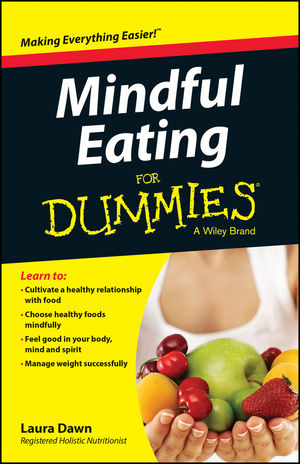
Mindful Eating For Dummies (eBook)
John Wiley & Sons (Verlag)
978-1-118-87770-8 (ISBN)
Packed with tips to help you make lasting dietary changes, Mindful Eating For Dummies paves the way for redefining your relationship with food, challenging your attitude about eating and making attainable changes to integrate mindful eating into everyday life, This no-nonsense, friendly guide offers essential guidance to get healthy, lose weight and avoid negative thought patterns associated with food-the mindful way,
Mindfulness allows you to pay attention to what is going on in your surroundings in order to keep yourself alert and able to react effectively in the present, When applied to eating habits, the practice of mindfulness helps you to pay close attention to the sensation and purpose of each mouthful of food to avoid overeating and fully discover the joys of your meals,
- Learn how to reduce overeating and change your approach to food forever
- Begin to choose healthy foods mindfully
- Find advice on eating mindfully when you're dining out
- Discover how mindful eating can combat emotional hunger
Whether you want to develop a healthier relationship with food to lose weight, manage a diet- or lifestyle-related illness or simply experience a better awareness and connection at mealtime, Mindful Eating For Dummies is your go-to guide for getting it done,
Laura Dawn is a Registered Holistic Nutritionist, raw food chef and mindful eating mentor, She is the founder of Happy and Raw (www,happyandraw,com) and leads transformational health retreats in Hawaii,
Mindful Eating Embrace mindful eating and be a whole new you Are you struggling to lose weight? Wanting to end chronic overeating? Are you seeking a healthier relationship with food? Say goodbye to yo-yo dieting and find a long-term, sustainable solution to health and weight-loss with Mindful Eating For Dummies! This comprehensive guide will show you how to avoid negative thought patterns, reduce overeating and establish a healthy relationship with food through scientifically proven methods. Don t be mindless kick mindlessness to the curb by understanding bad habits and overeating triggers Embrace the journey dive right in to the mindful eating journey by setting realistic expectations and keeping a journal Get mindful with meal prep establish good habits in your kitchen to prepare meals mindfully Overcome obstacles explore your strong cravings, navigate mindless mistakes and make mindfulness part of your busy schedule Open the book and find: Tips to help reduce overeating How mindful eating can increase enjoyment of food Tricks to maintain a supportive mindful mindset How to identify your hunger and fullness levels The lowdown on implementing mindful eating for families Ways to maintain mindful eating in social situations
Laura Dawn is a Registered Holistic Nutritionist, raw food chef and mindful eating mentor. She is the founder of Happy and Raw (www.happyandraw.com) and leads transformational health retreats in Hawaii.
Introduction 1
Part I: Getting Started with Mindful Eating 5
Chapter 1: Discovering Mindful Eating 7
Chapter 2: What You Can Expect to Gain (or Lose) from Mindful Eating 25
Part II: Preparing the Ground for Mindful Eating 43
Chapter 3: Getting Mindless by the Mouthful 45
Chapter 4: Getting Ready for Your Mindful Eating Journey 61
Chapter 5: Cultivating a Supportive Mindful Eating Mindset 79
Chapter 6: Choosing Healthy Foods Mindfully 97
Chapter 7: Mindful Meal Preparation 115
Part III: Practicing Mindful Eating 131
Chapter 8: Tooling Up for Mindful Eating 133
Chapter 9: The Many Ways to Practice Mindful Eating 153
Part IV: Mindful Eating, Mindful Life 175
Chapter 10: Mindful Eating for Families 177
Chapter 11: Mindful Eating in Social Situations 191
Chapter 12: Overcoming Obstacles to Mindful Eating 203
Chapter 13: Feeding Your Emotional Hunger 217
Part V: The Part of Tens 233
Chapter 14: Ten (or so) Misconceptions about Mindfulness 235
Chapter 15: Top Ten Tips for Mindful Eating 241
Chapter 16: (Almost) Ten Ways to Mindlessly Eat Less 247
Chapter 17: Ten Paths to Expand Your Mindful Eating Experience 255
Index 261
Chapter 1
Discovering Mindful Eating
In This Chapter
Defining mindful eating
Exploring your relationship with food
Understanding mindfulness
Discovering the mind-body connection
Looking at the beauty of the now
At first glance, mindful eating may sound simple. And at its most basic level, it is simple, yet mindful eating is also extremely profound and goes far beyond merely slowing down or removing distractions while you eat.
In this chapter I lay the groundwork for the chapters to come by exploring in-depth what mindful eating actually is, uncovering its roots in the art and practice of mindfulness, and looking at who can benefit the most from incorporating mindful eating into their everyday lives.
Exploring the Different Slices of the Mindful Eating Pie
To help you understand what mindful eating is and how it can help you, check out the opposite side of the coin and examine a few mindless eating scenarios. See if you can identify with any or all of the following situations:
- Can you remember a time when you walked up to your fridge, opened the door, picked out some leftovers and started eating them without really paying attention to what you were doing, as if you were on some kind of automatic pilot? And then all of a sudden you clued back in, realized what you were doing and noticed that half the food was already gone, but you only vaguely remembered tasting it.
- What about this scenario: you walk into your kitchen and there it is, in plain sight on the counter – the chocolate cake. You ate two pieces of that chocolate cake yesterday, felt subpar afterwards and told yourself that you wouldn’t do that again. But today’s a new day … and that’s a new piece of cake! You go back and forth in your mind, struggling with the lure of the cake, and before you know it, you’re eating another piece of cake faster than you’d like to admit while feelings of guilt, shame and blame start to arise before the last bite is gone.
- Can you remember a time you continued to eat so much food your stomach hurt, even though you knew you would regret it shortly afterwards?
- Do you ever notice other things often distract you while you eat? Perhaps you routinely eat (and often overeat) without paying attention to what you’re doing because you’re distracted by a movie, a conversation over dinner or preoccupied with emails while working at your desk. Afterwards you’re left feeling unsatisfied and wanting more, despite being full.
- Have you ever eaten something and noticed that before you were even finished eating it, you were already lost in thoughts of how you wanted more of that food and had started mentally planning how you were going to get it?
- Do you ever turn to food as a means of avoiding an uncomfortable situation or because you’re procrastinating on a project, or simply because you feel bored? What about after an argument with a friend or your partner? Ever notice yourself automatically turning to the pleasure of food as a means of distracting yourself from feeling something you’d rather not feel?
- What about using food as a pick-me-up from the pressures of leading a busy and stressful life, or as a way to wake yourself up when you’re feeling tired or run down?
Whatever is the case for you, the common thread here is a tendency towards mindless eating, the antidote to which is mindful eating – the topic of this book.
At mindless times like these you can benefit from the practice of mindfulness, which helps you to snap out of that all-too-familiar knee-jerk reaction mode (see cake, eat cake) into conscious-choice mode (does my body really want cake right now? How will I feel after I eat this?).
This book is a guide to help you step out of the mindless eating patterns that most everyone is familiar with and into a way of living that cultivates mindfulness as its foundation and incorporates mindful eating as a solution to many of the food-related troubles so many people experience.
Who Can Benefit from Mindful Eating?
The wonderful part about mindful eating is that it can benefit anyone and everyone. No matter how old you are, what you do, where you live, how active you are or how much you weigh, everyone can reap the rewards of eating more mindfully.
Mindful eating can be especially helpful to you if:
- You notice you regularly eat when you’re not hungry.
- You’ve tried many different diets with little success.
- You struggle with being over- or underweight.
- Your health is having a negative impact on other areas of your life, including your relationships.
- Your health is causing you pain, suffering or general discontent.
- Your health is preventing you from living the life you truly want to be living.
- You’re constantly thinking about food and what you should or shouldn’t be eating.
- You feel uncomfortable in your body.
- You want to discover how to become more mindful about your food choices.
- You regularly eat to cover up your emotions.
- You eat as a method of distraction.
- You’re afraid to eat from fear of gaining weight.
- You’re afraid to eat in front of other people.
- You want to feel better about and more accepting of your body.
- You feel that you’re too busy to eat healthfully.
Indulging in the richness of mindful eating
At the most basic level, mindful eating is simply paying attention while you eat. It may sound simple, yet this seemingly mundane task has the capacity to offer you a vast array of life-changing insights and has enough depth to keep you busy exploring new territory for at least a lifetime!
At this point, you may be asking yourself: what am I supposed to be paying attention to? Great question! To which there are innumerable answers! When it comes to where you choose to place your awareness, you have a buffet of choices that can be divided into two fundamental categories:
- Your inner reality
- Your outer reality
Exploring the world around you
One of the joys of living is being able to experience the world around you through your senses; by touching, seeing, smelling, tasting and hearing life, you have the opportunity to explore countless experiences through your senses. Using the full range of your senses is one of the easiest techniques at your immediate disposal to practice mindfulness.
Put down this book for a moment and close your eyes. What do you hear? The art and act of listening is enough to ground you in this moment. See how long you can listen before your mind steps in to label the experience. Try to have a direct experience with the sounds without the need to identify what they are (bird, cars, dog barking and so on). When thoughts do arise, just notice the thoughts without adding another layer of labeling on top of that, as if you’re watching your thoughts pass by like clouds in the sky and continuously bring your attention back to the direct experience of listening.
This was your first mindfulness practice. How did it feel? What did you notice? I’ll dive into mindfulness a little further along in the chapter, so stay tuned in – literally!
When it comes to eating, you can have a whole new experience of food through the simple practices of becoming mindful of your sensory experience before, during and after you eat. This practice of mindfulness includes paying attention to the taste, smell, sight, sound and touch, as well as the mouthfeel (the way food feels in your mouth), of food. You can choose to focus on many aspects of your senses, but one of the most important things to remember is that the gifts of these unique experiences are all fleeting and require awareness and attention towards them. Otherwise these gifts pass by without you registering that they even happened. You don’t get to experience them, and that means you’re missing out on life. All of these sensory experiences are occurring in the present moment, which makes tuning into your senses a technique that anchors you to the gift of here and now.
Chapter 9 provides a more in-depth look at experiencing food through your senses.
Welcoming the universe within
Think of your senses as the doorway that connects your outer reality to your inner reality. Your interpretation of the world that you experience around you with all of your senses makes your experience unique to you. The way you perceive, process and filter your reality through your thoughts, feelings and emotions makes up your personal experience of life. Twenty people can attend the same dinner event and all have a completely different experience based on the way that they experienced the food, their social interactions and even the surrounding environment.
In addition to paying attention to your outer reality with your senses, mindful eating invites you to explore your thoughts, feelings, cravings and emotions surrounding food and eating. When it comes to eating something, you may think to yourself, ‘I’ve tasted that a million times before! I know what that tastes like,’ and without realizing it, you’ve defined your experience before you’ve even had it! When practicing mindful eating, you allow yourself to approach food and eating as though every...
| Erscheint lt. Verlag | 19.8.2014 |
|---|---|
| Sprache | englisch |
| Themenwelt | Sachbuch/Ratgeber ► Gesundheit / Leben / Psychologie ► Ernährung / Diät / Fasten |
| Medizin / Pharmazie ► Allgemeines / Lexika | |
| Medizin / Pharmazie ► Gesundheitsfachberufe ► Diätassistenz / Ernährungsberatung | |
| Schlagworte | Gesundheit, Ernährung u. Diät • Gesundheit, Ernährung u. Diät • Gesundheits- u. Sozialwesen • Health & Social Care • Health, Diet & Nutrition |
| ISBN-10 | 1-118-87770-5 / 1118877705 |
| ISBN-13 | 978-1-118-87770-8 / 9781118877708 |
| Informationen gemäß Produktsicherheitsverordnung (GPSR) | |
| Haben Sie eine Frage zum Produkt? |
 EPUB (Adobe DRM)
Kopierschutz: Adobe-DRM
Adobe-DRM ist ein Kopierschutz, der das eBook vor Mißbrauch schützen soll. Dabei wird das eBook bereits beim Download auf Ihre persönliche Adobe-ID autorisiert. Lesen können Sie das eBook dann nur auf den Geräten, welche ebenfalls auf Ihre Adobe-ID registriert sind.
Details zum Adobe-DRM
Dateiformat: EPUB (Electronic Publication)
EPUB ist ein offener Standard für eBooks und eignet sich besonders zur Darstellung von Belletristik und Sachbüchern. Der Fließtext wird dynamisch an die Display- und Schriftgröße angepasst. Auch für mobile Lesegeräte ist EPUB daher gut geeignet.
Systemvoraussetzungen:
PC/Mac: Mit einem PC oder Mac können Sie dieses eBook lesen. Sie benötigen eine
eReader: Dieses eBook kann mit (fast) allen eBook-Readern gelesen werden. Mit dem amazon-Kindle ist es aber nicht kompatibel.
Smartphone/Tablet: Egal ob Apple oder Android, dieses eBook können Sie lesen. Sie benötigen eine
Geräteliste und zusätzliche Hinweise
Buying eBooks from abroad
For tax law reasons we can sell eBooks just within Germany and Switzerland. Regrettably we cannot fulfill eBook-orders from other countries.
aus dem Bereich