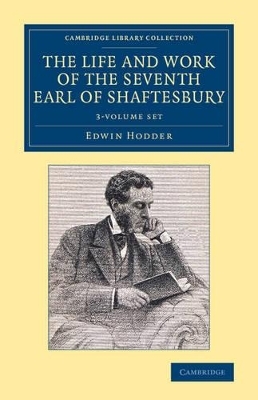
The Life and Work of the Seventh Earl of Shaftesbury, K.G. 3 Volume Set
Seiten
2014
Cambridge University Press
978-1-108-07556-5 (ISBN)
Cambridge University Press
978-1-108-07556-5 (ISBN)
- Keine Verlagsinformationen verfügbar
- Artikel merken
Through his activities, including legislation to improve conditions in mines and factories, and practical work to aid the destitute, Anthony Ashley-Cooper (1801–85), the seventh earl of Shaftesbury, became the best-known philanthropist of his age. This three-volume biography by Edwin Hodder (1837–1904) was first published in 1886.
In the preface to this three-volume work of 1886, Edwin Hodder (1837–1904) writes that the seventh earl of Shaftesbury 'resisted every appeal that was made to him to allow his biography to be written'. In the end, he succumbed to the inevitable, and shared with Hodder, a professional author, both his archives and his memories. Anthony Ashley-Cooper (1801–85) was an evangelical Christian with a profound sense of the duty owed by the aristocracy to their country and to the less fortunate. He first came to prominence as the leader of the parliamentary campaign for shorter working hours, which led to the Factory Act of 1833. He also worked strenuously on behalf of miners, child chimney-sweeps, cotton spinners, and lunatics. Entering the House of Lords on his father's death, he extended his activities, especially towards the homeless and destitute of London, becoming the best-known philanthropist of his age.
In the preface to this three-volume work of 1886, Edwin Hodder (1837–1904) writes that the seventh earl of Shaftesbury 'resisted every appeal that was made to him to allow his biography to be written'. In the end, he succumbed to the inevitable, and shared with Hodder, a professional author, both his archives and his memories. Anthony Ashley-Cooper (1801–85) was an evangelical Christian with a profound sense of the duty owed by the aristocracy to their country and to the less fortunate. He first came to prominence as the leader of the parliamentary campaign for shorter working hours, which led to the Factory Act of 1833. He also worked strenuously on behalf of miners, child chimney-sweeps, cotton spinners, and lunatics. Entering the House of Lords on his father's death, he extended his activities, especially towards the homeless and destitute of London, becoming the best-known philanthropist of his age.
Volume 1: Preface; 1. Ancestry and home; 2. Childhood and early years; 3. 1828–33; 4. Italy, 1833; 5. 1834–8; 6. 1838–9; 7. Scotland, 1839; 8. 1840; 9. 1841; 10. 1842; 11. 1843. Volume 2: 12. 1844; 13. 1845; 14. 1846; 15. 1847–50, the Ten Hours Bill; 16. 1847; 17. 1848; 18. 1849; 19. 1850–1; 20. 1851 (June)–2; 21. 1853; 22. 1854–5. Volume 3: 23. The inner life; 24. 1856–8; 25. 1859–60; 26. 1861–3; 27. 1864–5; 28. Lord Palmerston and church appointments; 29. 1866–7; 30. 1868–9; 31. 1870–1; 32. The shadow of death, 1872; 33. 1873–5; 34. 1876–8; 35. 1879–82; 36. Word and work, 1874–84; 37. Last years, 1883–5; Appendix; Index.
| Erscheint lt. Verlag | 28.8.2014 |
|---|---|
| Reihe/Serie | Cambridge Library Collection - British and Irish History, 19th Century |
| Zusatzinfo | 3 Plates, black and white |
| Verlagsort | Cambridge |
| Sprache | englisch |
| Gewicht | 2090 g |
| Themenwelt | Literatur ► Biografien / Erfahrungsberichte |
| Sachbuch/Ratgeber ► Geschichte / Politik | |
| Geschichte ► Allgemeine Geschichte ► Neuzeit (bis 1918) | |
| Geisteswissenschaften ► Geschichte ► Regional- / Ländergeschichte | |
| ISBN-10 | 1-108-07556-8 / 1108075568 |
| ISBN-13 | 978-1-108-07556-5 / 9781108075565 |
| Zustand | Neuware |
| Informationen gemäß Produktsicherheitsverordnung (GPSR) | |
| Haben Sie eine Frage zum Produkt? |