


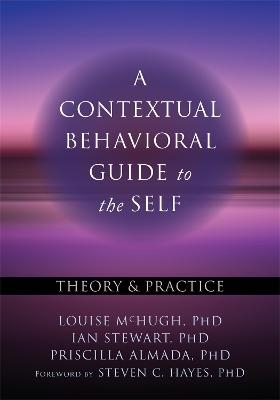
A Contextual Behavioral Guide to the Self
Seiten
2019
New Harbinger Publications (Verlag)
978-1-62625-176-2 (ISBN)
New Harbinger Publications (Verlag)
978-1-62625-176-2 (ISBN)
The self plays an integral role in human motivation, cognition, and social identity. That's why observing the self is such an important element of acceptance and commitment therapy (ACT). However, for many ACT clinicians, it can be difficult to apply this complex theory in everyday practice.
The self plays an integral role in human motivation, cognition, and social identity. A must-have addition to any acceptance and commitment therapy (ACT) practitioner's library, The Self in Practice translates the ACT model's most difficult-yet essential-process into easy-to-apply steps and user-friendly language.
Every client who partakes in ACT must identify a self as part of their treatment, and clinicians often report that observing the self is the most difficult of all six core ACT processes. This is because it's so hard for people to shed preconceived notions of "who they really are," and negative perceptions of the self can lead to feelings of low self-worth that stand in the way of treatment.
Problems with the self arise when clients orient themselves in the world and learn to relate to others, but these problems can vary considerably. For example, some clients may have deficits in developing a strong sense of self in the first place-particularly if they are diagnosed with autism spectrum conditions (ASC). Depressed clients or those with borderline personality disorder (BPD) may develop a skewed, negative sense of self, and those with narcissistic personality disorder (NPD) may develop an inflated sense of self.
With this unique road map, you will learn to apply the complex theory of the self into everyday practice, and help all clients develop empathy, compassion, and flexible perspective taking-leading to better treatment outcomes and better lives for clients.
The self plays an integral role in human motivation, cognition, and social identity. A must-have addition to any acceptance and commitment therapy (ACT) practitioner's library, The Self in Practice translates the ACT model's most difficult-yet essential-process into easy-to-apply steps and user-friendly language.
Every client who partakes in ACT must identify a self as part of their treatment, and clinicians often report that observing the self is the most difficult of all six core ACT processes. This is because it's so hard for people to shed preconceived notions of "who they really are," and negative perceptions of the self can lead to feelings of low self-worth that stand in the way of treatment.
Problems with the self arise when clients orient themselves in the world and learn to relate to others, but these problems can vary considerably. For example, some clients may have deficits in developing a strong sense of self in the first place-particularly if they are diagnosed with autism spectrum conditions (ASC). Depressed clients or those with borderline personality disorder (BPD) may develop a skewed, negative sense of self, and those with narcissistic personality disorder (NPD) may develop an inflated sense of self.
With this unique road map, you will learn to apply the complex theory of the self into everyday practice, and help all clients develop empathy, compassion, and flexible perspective taking-leading to better treatment outcomes and better lives for clients.
Louise McHugh (Author) Louise McHugh, PhD, is a faculty member in the school of psychology at University College Dublin, and coeditor of The Self and Perspective Taking. Ian Stewart (Author) Ian Stewart, PhD, is a faculty member in the school of psychology at the National University of Ireland, Galway. He is coauthor of The Art and Science of Valuing in Psychotherapy, ACT and RFT in Relationships, and coeditor of The Self and Perspective Taking. Priscilla Almada (Author) Priscilla Almada, PhD, is a research scientist. Over the last decade, she has been committed to exploring the science, art, and practice of cultivating prosocial and sustainable communities. She lives in Sydney, Australia.
| Erscheint lt. Verlag | 28.3.2019 |
|---|---|
| Verlagsort | Oakland, CA |
| Sprache | englisch |
| Maße | 176 x 252 mm |
| Gewicht | 500 g |
| Themenwelt | Sachbuch/Ratgeber ► Sport |
| Medizin / Pharmazie ► Medizinische Fachgebiete ► Psychiatrie / Psychotherapie | |
| ISBN-10 | 1-62625-176-2 / 1626251762 |
| ISBN-13 | 978-1-62625-176-2 / 9781626251762 |
| Zustand | Neuware |
| Informationen gemäß Produktsicherheitsverordnung (GPSR) | |
| Haben Sie eine Frage zum Produkt? |
Mehr entdecken
aus dem Bereich


aus dem Bereich
Zwischen Normvariante, Persönlichkeitsstörung und …
Buch | Softcover (2022)
Kohlhammer (Verlag)
CHF 49,95
Menschen mit psychischer Erkrankung wirksam unterstützen
Buch | Hardcover (2023)
Psychiatrie Verlag
CHF 48,95


