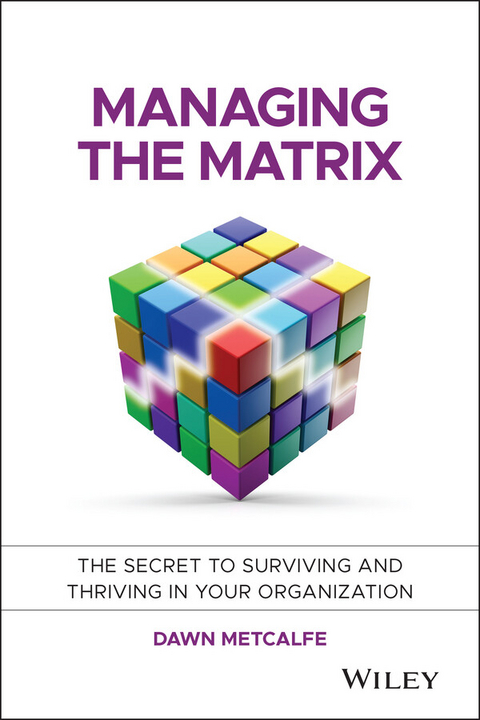
Managing the Matrix (eBook)
John Wiley & Sons (Verlag)
978-1-118-76535-7 (ISBN)
Debra was not in a good mood as she entered Johann’s office for their third meeting. One of her colleagues had just been promoted and, although the guy who got it was good, she didn’t think he was any better than her. Well, except at one thing, he was always playing politics - sucking up to the more senior guys and volunteering to be on any committee going.
Debra knew the type - went to the same school, belonged to the same club - she didn’t have a hope against the kind of connections he had so she might as well give up. It seemed doing a good job just wasn’t enough around here.
Debra and Johann work in an environment with multiple and complex reporting lines – in other words, a matrix. There’s room to “slip between the cracks” – if a person wants to take advantage of confusion over who is managing performance; or if they can’t make the necessary transition to self-management. Communication can be difficult even when there is an apparently shared language.
Read how Johann and Debra work together to identify the skills needed to succeed in a matrix, and how using Emotional Intelligence (EI) can develop specific behaviours you can incorporate in your daily job. The result will help reduce stress and increase your chances of success.
Dawn Metcalfe, Managing Director of PDS, based in Dubai, uses her experience as a coach and trainer to give us a behind the curtain look at how mentoring can help an individual develop the skills they need to survive and thrive in today’s complex work environments.
Dawn Metcalfe is the Managing Director of Performance Development Services (PDS) and an experienced and qualified trainer, facilitator and coach who works across a wide range of industries.
Her clients are usually already highly effective and skilled people who wish to consider new tools that might help them as they face their next challenge.
Dawn has extensive experience of working with different cultures having lived and worked in the UK, France, Spain, Japan, China and now Dubai where she is based.
Dawn works regularly with board directors, senior managers and top management teams across the region to improve performance by changing the way individuals and groups see the world and the impact they have on it and others.
Performance Development Services (PDS) helps individuals, teams and organizations to change behaviour and improve performance be it through 1:1 Executive Coaching, mentoring or delivering Leadership and Management Development Programmes.
A comprehensive guide to excelling in a complex matrix organization Debra was not in a good mood as she entered Johann s office for their third meeting. One of her colleagues had just been promoted and, although the guy who got it was good, she didn t think he was any better than her. Well, except at one thing, he was always playing politics - sucking up to the more senior guys and volunteering to be on any committee going. Debra knew the type - went to the same school, belonged to the same club - she didn t have a hope against the kind of connections he had so she might as well give up. It seemed doing a good job just wasn t enough around here. Debra and Johann work in an environment with multiple and complex reporting lines in other words, a matrix. There s room to slip between the cracks if a person wants to take advantage of confusion over who is managing performance; or if they can t make the necessary transition to self-management. Communication can be difficult even when there is an apparently shared language. Read how Johann and Debra work together to identify the skills needed to succeed in a matrix, and how using Emotional Intelligence (EI) can develop specific behaviours you can incorporate in your daily job. The result will help reduce stress and increase your chances of success. Dawn Metcalfe, Managing Director of PDS, based in Dubai, uses her experience as a coach and trainer to give us a behind the curtain look at how mentoring can help an individual develop the skills they need to survive and thrive in today s complex work environments.
Dawn Metcalfe is the Managing Director of Performance Development Services (PDS) and an experienced trainer, facilitator and coach who works across a wide range of industries. Her clients are usually already highly effective and skilled people who wish to consider new tools that might help them as they face their next challenge. Dawn has extensive experience of working with different cultures having lived and worked in the UK, France, Spain, Japan, China and now Dubai where she is based. Dawn works regularly with board directors, senior managers and top management teams across the region to improve performance by changing the way individuals and groups see the world and the impact they have on it and others. Performance Development Services (PDS) helps individuals, teams and organizations change behaviour and improve performance through 1:1 Executive Coaching, mentoring or delivering Leadership and Management Development Programmes.
Introduction ix
1 The Challenge is Set 1
2 Laying the Cards on the Table 11
3 Preparing for Change 27
4 Working on Objectives 35
5 How Quickly We Forget 51
6 The Matrix - the Good, the Bad and the Ugly 55
7 What do the Successes in the Matrix do? 71
8 Defining EI 81
9 A Short and (Emotionally) Intelligent Review 103
10 Working Out How EI Can Help 107
11 Why IQ isn't Enough 125
12 Learning EI 139
13 Fake It Until You Make It 149
14 How Managers Can Help Improve EI 175
15 Understanding the Importance of Culture and Strong Leadership in the Matrix 181
Epilogue 193
Acknowledgements 199
About the Author 203
Useful Resources 207
1
The Challenge is Set
Johann Spilk was frazzled. He couldn't understand why he'd done it. Why had he just staked his reputation on something that he had only just been convinced himselfwould work? He sighed.
Shrugging off his jacket, he hung it up before greeting a couple of colleagues. Then he checked in with his assistant (as always, here before him and already organized for the day ahead), sat down behind his desk and took a sip of the over-priced and highly calorific coffee he'd started drinking since giving up smoking during Ramadan a few months ago. He turned on the computer screen and logged in, ready to prepare for his day of meetings.
Johann's first meeting was with Debra, a young “up and comer” currently doing a rotation in the finance department working on a company-wide project. He didn't really know much about her as they had never come into contact.
At a workshop the previous week, Debra had been identified both as “talent” and “at high risk”. In other words, she was doing her current job really well and was likely to be able to move up at least two levels in the next three years, but was known to be actively looking for a new job. The exec team wanted to keep her but she had just been turned down for a promotion as they felt she wasn't ready for the next role yet.
So far so good. But then Johann had had the bright idea of suggesting that she be given a place on a new mentoring programme he had set up.
Background: about two years ago the new HR director at the time, Amy, had flagged up a trend where the time taken to get new hires up to speed was taking longer with each intake. And, then, when they did get them functionally competent, the best of those people were disappearing. When HR asked them why they were leaving, the most common response was that they weren't getting the development they wanted and were going somewhere smaller. They felt like they were slipping between the cracks and not learning.
The company decided to create a training programme where money was spent on an online university. Employees could now watch multimedia presentations and earn credits for undergoing training courses. Some of these courses were made mandatory to emphasize the importance. This initiative worked well for technical training, but the behaviours that the programme was meant to address – giving feedback and helping employees develop – hadn't changed. In fact, it was found that, after training, most people reverted to their standard way of behaving within a few weeks, especially if their own managers didn't support them.
Johann had been travelling on the day that a task force had been set up to deal with this and so, obviously, he had been “volunteered”. The “task force chief” (he cringed) had asked him to investigate and come up with some solutions. One of the things on the list of recommendations had been mentoring. Johann did a bit more research, engaged in training and, despite himself, had become convinced of its merits.
After 20 years of managing others in different multinational companies, in different locations, preceded by 10 years in the army where he believed he received the best training money could buy, Johann had approached the mentoring course with what he would describe as “some scepticism”. Others might regard it as hostility. Despite himself, however, he found it was helpful to have a basic model or theory to refer to when working with others, and it offered a chance to practise important behaviours.
The idea he was mainly interested in – and so the area he tended to work with most with his mentees – was emotional intelligence (EI). He didn't claim to be an expert but rather an interested layperson who believed, after doing his homework, that EI was somehow key to the success of individuals in a matrix organization. He came to realize that EI might be the only tool beyond being skilled at your job that works. He was starting to believe that you could teach EI by using it, and by being transparent about using it, during mentoring or coaching.
Setting up the programme had proved quite a battle. The CFO, Sara, had already described it as a “colossal waste of money” and on mention of his new mentee Debra, she had simply huffed, “that's a great idea” in a sarcastic tone. Johann had decided that he'd had enough of her snide comments and said so.
From there things had disintegrated into an ultimatum: he said that either he'd keep Debra and make sure that she was ready in nine months or he'd get rid of the mentoring programme which he'd spent a lot of time and energy fighting for.
Huh! He knew how much she spent on air travel last quarter alone and the mentoring programme was a bargain. Still, he had to admit that the whole premise could seem to come across as a bit “airy fairy”. Not to mention, given his behaviour in the meeting with Sara, he probably wasn't the best advert for how EI can help you succeed in a matrix. And, given that was what the whole premise of the mentoring he was providing, Johann couldn't help feeling a bit worried.
How, he wondered, had he got himself into a situation where now, despite having a to-do list as long as his arm, he had to carve yet another hour out of his day to meet with this young, disaffected high-flyer? Normally Johann would have done a bit of research and been prepared with basic information and good questions, but he hadn't found the time. So, to some extent, he'd have to wing it.
Quickly skimming the notes in the performance management system he remembered what the Talent Manager in Debra's department had said: high potential and clearly not as engaged as she was last year. It was suspected that Debra was annoyed not to have been promoted but her manager had not had that conversation with her. Johann thought – so many problems could be solved if people would just step up and have that difficult conversation.
Not that he necessarily believed everything the Talent Manager, Yulia, was it?, said. He'd learned over the years that, even with no malice or deliberate attempt to mislead, important things get lost in translation and motives are ascribed where they don't exist. And, with HR, he thought with a smirk, you can never be sure that there isn't malice!
As he dismissed this uncharitable thought, there was a tentative knock at his door. He raised his voice:
“Come in!”
A head poked around the door. In her early 30s, Debra was well-dressed with a couple of quirky touches – Johann particularly noticed the enormous green ring on her right hand. Making eye contact she enquired:
“Johann?”
Johann smiled in return and nodded asking:
“Debra? Come in! Come in!”
Johann was moving around the desk as Debra approached.
She entered the office confidently and leaned forward to shake his hand. Johann was pleased – he always found it, despite himself, difficult to warm to someone with a limp or overly strong handshake and knew he wasn't alone in this having just the other day discussed it with some of his colleagues.
“Take a seat! Will you have a coffee? A tea?”
Debra asked if she might have a cappuccino and Johann called for his assistant to take the order.
“Two of your famous cappuccinos please Roshan.”
Reflecting on how he found himself waiting for coffee to arrive with this woman who now had his reputation in her hands, Johann sighed.
He had pushed very hard to be given one day a week to devote to mentoring people from across the organization. The attendees had been chosen by a mixture of line manager nomination, HR approval and exec committee final signoff. Not that the signoff had been more than a rubber stamp. Until he'd made a fuss nobody had known about the programme. He'd been quietly getting on with it – seeing all of his mentees once a week – some just for a few minutes on occasion, and others for much longer. He should have kept it like that – off to the side. Less pressure. Ah, well. It was done now and he'd just have to make the most of it.
Anyway, he enjoyed the mentoring. It was fun to meet colleagues from across the organization, and he found that he often learned as much or more than he taught. But, even with the time he'd been given, it was difficult fitting in these sessions in addition to his “day job”. Johann took it seriously and was constantly trying new approaches. He'd even joined a LinkedIn group and signed up for advanced training so that he could be a certified mentor and stay on top of any new research. Apart from anything else, and the management meeting debacle aside, he found that it made him better at his day job because he was more reflective – aware of what he was doing and the impact it was having so he could be more flexible and get better results. Not that it worked without fail. He sighed again. “I really must focus on keeping my temper or at least managing it better,” Johann reminded himself.
Today was going to present more challenges than usual – he fully expected to meet some resistance...
| Erscheint lt. Verlag | 7.3.2014 |
|---|---|
| Sprache | englisch |
| Themenwelt | Sachbuch/Ratgeber ► Beruf / Finanzen / Recht / Wirtschaft ► Bewerbung / Karriere |
| Sachbuch/Ratgeber ► Gesundheit / Leben / Psychologie ► Lebenshilfe / Lebensführung | |
| Wirtschaft ► Betriebswirtschaft / Management | |
| Schlagworte | Business & Management • circuitous decision making • Coaching • Communication • complex reporting lines • Conflict Management • confusion over accountability • constant restructuring • Dawn Metcalfe • Functional organization • Influencing • job performance • lack of role clarity • matrix management • matrix management model • Matrix organization • matrix organizational structure • matrix organization chart • matrix-style business • Negotiation • Personal Career Development • Personalwesen • Wirtschaft u. Management |
| ISBN-10 | 1-118-76535-4 / 1118765354 |
| ISBN-13 | 978-1-118-76535-7 / 9781118765357 |
| Informationen gemäß Produktsicherheitsverordnung (GPSR) | |
| Haben Sie eine Frage zum Produkt? |
 EPUB (Adobe DRM)
Kopierschutz: Adobe-DRM
Adobe-DRM ist ein Kopierschutz, der das eBook vor Mißbrauch schützen soll. Dabei wird das eBook bereits beim Download auf Ihre persönliche Adobe-ID autorisiert. Lesen können Sie das eBook dann nur auf den Geräten, welche ebenfalls auf Ihre Adobe-ID registriert sind.
Details zum Adobe-DRM
Dateiformat: EPUB (Electronic Publication)
EPUB ist ein offener Standard für eBooks und eignet sich besonders zur Darstellung von Belletristik und Sachbüchern. Der Fließtext wird dynamisch an die Display- und Schriftgröße angepasst. Auch für mobile Lesegeräte ist EPUB daher gut geeignet.
Systemvoraussetzungen:
PC/Mac: Mit einem PC oder Mac können Sie dieses eBook lesen. Sie benötigen eine
eReader: Dieses eBook kann mit (fast) allen eBook-Readern gelesen werden. Mit dem amazon-Kindle ist es aber nicht kompatibel.
Smartphone/Tablet: Egal ob Apple oder Android, dieses eBook können Sie lesen. Sie benötigen eine
Geräteliste und zusätzliche Hinweise
Buying eBooks from abroad
For tax law reasons we can sell eBooks just within Germany and Switzerland. Regrettably we cannot fulfill eBook-orders from other countries.
aus dem Bereich