


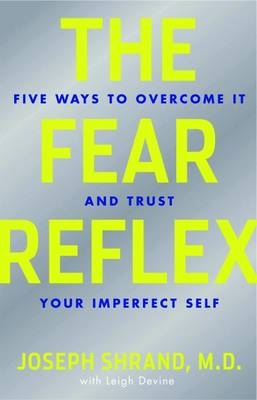
The Fear Reflex
Seiten
2014
Hazelden Information & Educational Services (Verlag)
978-1-61649-554-1 (ISBN)
Hazelden Information & Educational Services (Verlag)
978-1-61649-554-1 (ISBN)
- Titel ist leider vergriffen;
keine Neuauflage - Artikel merken
Some fears are genetically wired. Others begin in childhood or adolescence and may leave us feeling inadequate to face the dangerous unknown. Dr. Shrand, a leading expert on the psychology of fear, teaches us how to use the rational parts of our brain to change our perspective and respond rationally to fears as they present themselves.
Some fears are genetically wired. Others begin in childhood or adolescence and may leave us feeling inadequate to face the dangerous unknown.Dr. Shrand, a leading expert on the psychology of fear, teaches us how to use the rational parts of our brain to change our perspective and respond rationally to fears as they present themselves. Shrand's iMaximum resiliency-based approach starts with the assumption that we're all doing the best we can with what we know at any given time. Using this mindset as a foundation, this model features five proven strategies to: Find better ways to connect with others to reduce fear.Transform fear into trustExplore our biological responses to fearLook at the role of social groups and society in fostering fearExamine the role of fear in our childhood and home life. By developing a radical self-acceptance that allows us to step back and question our fearful thoughts, we can confront and process them in healthier ways, leading to a better, more confident self.
Some fears are genetically wired. Others begin in childhood or adolescence and may leave us feeling inadequate to face the dangerous unknown.Dr. Shrand, a leading expert on the psychology of fear, teaches us how to use the rational parts of our brain to change our perspective and respond rationally to fears as they present themselves. Shrand's iMaximum resiliency-based approach starts with the assumption that we're all doing the best we can with what we know at any given time. Using this mindset as a foundation, this model features five proven strategies to: Find better ways to connect with others to reduce fear.Transform fear into trustExplore our biological responses to fearLook at the role of social groups and society in fostering fearExamine the role of fear in our childhood and home life. By developing a radical self-acceptance that allows us to step back and question our fearful thoughts, we can confront and process them in healthier ways, leading to a better, more confident self.
Joseph Shrand, MD, is triple Board certified in adult psychiatry, child and adolescent psychiatry and addiction medicine, is an instructor of psychiatry at Harvard Medical School, USA, and is medical director of an intervention unit for high-risk teens at the High Point Treatment Centers. He is co-author with Leigh Devine of Manage Your Stress. Dr. Shrand lives in Marshfield, MA, USA.Leigh Devine, MS, has a master of science from the Columbia School of Journalism, USA, and is a journalist, writer, and producer who has created several award winning educational and commercial programs and documentaries. Leigh lives in New York, NY, USA.
| Verlagsort | Center City |
|---|---|
| Sprache | englisch |
| Maße | 1 x 1 mm |
| Themenwelt | Sachbuch/Ratgeber |
| Geisteswissenschaften ► Psychologie ► Angst / Depression / Zwang | |
| ISBN-10 | 1-61649-554-5 / 1616495545 |
| ISBN-13 | 978-1-61649-554-1 / 9781616495541 |
| Zustand | Neuware |
| Informationen gemäß Produktsicherheitsverordnung (GPSR) | |
| Haben Sie eine Frage zum Produkt? |
Mehr entdecken
aus dem Bereich



aus dem Bereich
State of the Art 2026
Buch | Softcover (2025)
Urban & Fischer in Elsevier (Verlag)
CHF 82,55
Psychotherapien wirksam gestalten
Buch | Hardcover (2025)
Klett-Cotta (Verlag)
CHF 83,95


