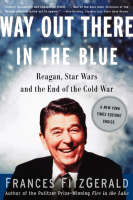
Way Out There In the Blue (eBook)
592 Seiten
Simon & Schuster (Verlag)
9780743203777 (ISBN)
Way Out There in the Blue is a major work of history by the Pulitzer Prizewinning author of Fire in the Lake. Using the Star Wars missile defense program as a magnifying glass on his presidency, Frances FitzGerald gives us a wholly original portrait of Ronald Reagan, the most puzzling president of the last half of the twentieth century.
Reagan's presidency and the man himself have always been difficult to fathom. His influence was enormous, and the few powerful ideas he espoused remain with us still -- yet he seemed nothing more than a charming, simple-minded, inattentive actor. FitzGerald shows us a Reagan far more complex than the man we thought we knew. A master of the American language and of self-presentation, the greatest storyteller ever to occupy the Oval Office, Reagan created a compelling public persona that bore little relationship to himself.
The real Ronald Reagan -- the Reagan who emerges from FitzGerald's book -- was a gifted politician with a deep understanding of the American national psyche and at the same time an executive almost totally disengaged from the policies of his administration and from the people who surrounded him.
The idea that America should have an impregnable shield against nuclear weapons was Reagan's invention. His famous Star Wars speech, in which he promised us such a shield and called upon scientists to produce it, gave rise to the Strategic Defense Initiative. Reagan used his sure understanding of American mythology, history and politics to persuade the country that a perfect defense against Soviet nuclear weapons would be possible, even though the technology did not exist and was not remotely feasible. His idea turned into a multibillion-dollar research program. SDI played a central role in U.S.-Soviet relations at a crucial juncture in the Cold War, and in a different form it survives to this day.
Drawing on prodigious research, including interviews with the participants, FitzGerald offers new insights into American foreign policy in the Reagan era. She gives us revealing portraits of major players in Reagan's administration, including George Shultz, Caspar Weinberger, Donald Regan and Paul Nitze, and she provides a radically new view of what happened at the Reagan-Gorbachev summits in Geneva, Reykjavik, Washington and Moscow.
FitzGerald describes the fierce battles among Reagan's advisers and the frightening increase of Cold War tensions during Reagan's first term. She shows how the president who presided over the greatest peacetime military buildup came to espouse the elimination of nuclear weapons, and how the man who insisted that the Soviet Union was an 'evil empire' came to embrace the Soviet leader, Mikhail Gorbachev, and to proclaim an end to the Cold War long before most in Washington understood that it had ended.
Way Out There in the Blue is a ground-breaking history of the American side of the end of the Cold War. Both appalling and funny, it is a black comedy in which Reagan, playing the role he wrote for himself, is the hero.
Way Out There in the Blue is a major work of history by the Pulitzer Prizewinning author of Fire in the Lake. Using the Star Wars missile defense program as a magnifying glass on his presidency, Frances FitzGerald gives us a wholly original portrait of Ronald Reagan, the most puzzling president of the last half of the twentieth century. Reagan's presidency and the man himself have always been difficult to fathom. His influence was enormous, and the few powerful ideas he espoused remain with us still -- yet he seemed nothing more than a charming, simple-minded, inattentive actor. FitzGerald shows us a Reagan far more complex than the man we thought we knew. A master of the American language and of self-presentation, the greatest storyteller ever to occupy the Oval Office, Reagan created a compelling public persona that bore little relationship to himself. The real Ronald Reagan -- the Reagan who emerges from FitzGerald's book -- was a gifted politician with a deep understanding of the American national psyche and at the same time an executive almost totally disengaged from the policies of his administration and from the people who surrounded him. The idea that America should have an impregnable shield against nuclear weapons was Reagan's invention. His famous Star Wars speech, in which he promised us such a shield and called upon scientists to produce it, gave rise to the Strategic Defense Initiative. Reagan used his sure understanding of American mythology, history and politics to persuade the country that a perfect defense against Soviet nuclear weapons would be possible, even though the technology did not exist and was not remotely feasible. His idea turned into a multibillion-dollar research program. SDI played a central role in U.S.-Soviet relations at a crucial juncture in the Cold War, and in a different form it survives to this day. Drawing on prodigious research, including interviews with the participants, FitzGerald offers new insights into American foreign policy in the Reagan era. She gives us revealing portraits of major players in Reagan's administration, including George Shultz, Caspar Weinberger, Donald Regan and Paul Nitze, and she provides a radically new view of what happened at the Reagan-Gorbachev summits in Geneva, Reykjavik, Washington and Moscow. FitzGerald describes the fierce battles among Reagan's advisers and the frightening increase of Cold War tensions during Reagan's first term. She shows how the president who presided over the greatest peacetime military buildup came to espouse the elimination of nuclear weapons, and how the man who insisted that the Soviet Union was an "e;evil empire"e; came to embrace the Soviet leader, Mikhail Gorbachev, and to proclaim an end to the Cold War long before most in Washington understood that it had ended. Way Out There in the Blue is a ground-breaking history of the American side of the end of the Cold War. Both appalling and funny, it is a black comedy in which Reagan, playing the role he wrote for himself, is the hero.
Chapter One: The American Everyman
On March 23, 1983, President Reagan announced that after consultations with the Joint Chiefs of Staff he had decided to embark on a long-range research-and-development effort to counter the threat of Soviet ballistic missiles and to make these nuclear weapons 'impotent and obsolete.' The announcement, made in an insert into a routine defense speech, came as a surprise to everyone in Washington except for a handful of White House aides. The insert had not been cleared with the Pentagon, and although Reagan was proposing to overturn the doctrine which had ruled U.S. nuclear strategy for more than three decades, the secretary of defense and the secretary of state were informed only a day or so before the speech was broadcast.
In background briefings White House aides explained that the research effort would be directed towards producing space-borne laser and particle-beam weapons with the potential to provide a reliable defense for the entire United States. Most of the scientists and defense experts invited to the White House for dinner that evening expressed incredulity: the technologies were so futuristic they would not be ready for decades, if then, and the cost of an all-out development effort would be staggering. Some further objected that any effort to develop an anti-ballistic missile capability would lead to a new and more dangerous form of arms race with the Soviet Union.
Reagan's proposal was so vague and so speculative that it was not taken altogether seriously at the time. Press attention soon shifted away from it and did not fully return until March 1985, when the administration launched the Strategic Defense Initiative with fanfare and asked the Congress to appropriate twenty-six billion dollars for it over the next five years.
At this point the debate over anti-missile defenses began in earnest, and journalists for the first time inquired about the origins of the proposal that Reagan had made so abruptly two years before. The President maintained that the idea was his to begin with, but said nothing more about it. However, Martin Anderson, an economist at the Hoover Institution and a former Reagan aide for domestic policy, told journalists that the idea had first come to Reagan during a visit to the North American Aerospace Defense Command (NORAD) that he had made at the beginning of his presidential campaign in July 1979. In his book Revolution, published in 1988, Anderson described that visit at some length. His account subsequently became embedded in the history of the Strategic Defense Initiative. Journalists, academics and official SDI historians have all quoted it in more or less detail -- and small wonder, for it is a marvelous story. To paraphrase Anderson's text, it is this:
On July 31, 1979, Anderson accompanied Reagan from Los Angeles to the NORAD base in Cheyenne Mountain, Colorado. The visit had been arranged by a Hollywood screenwriter and producer, Douglas Morrow, whom Reagan had known for some years, and Morrow came along on the trip. NORAD, Anderson explains, 'is the nerve center of a far-flung, world-wide network of radar detectors that alerts us to any surprise attack.' Its computers, he writes, would track a Soviet missile from its launch pad and give the President the facts he would have to rely on in deciding whether to launch a retaliatory strike. As for the command post, it is 'a vast underground city, a multi-level maze of rooms and corridors carved deep into the solid granite core of Cheyenne Mountain,' with 'a massive steel door several feet thick.' Once inside these portals, the visitors spent most of the day in a series of windowless conference rooms...
| Erscheint lt. Verlag | 21.2.2001 |
|---|---|
| Sprache | englisch |
| Themenwelt | Literatur ► Biografien / Erfahrungsberichte |
| Sachbuch/Ratgeber ► Geschichte / Politik | |
| Geschichte ► Allgemeine Geschichte ► Zeitgeschichte | |
| Geisteswissenschaften ► Geschichte ► Regional- / Ländergeschichte | |
| Sozialwissenschaften ► Politik / Verwaltung | |
| ISBN-13 | 9780743203777 / 9780743203777 |
| Informationen gemäß Produktsicherheitsverordnung (GPSR) | |
| Haben Sie eine Frage zum Produkt? |
 EPUB (Adobe DRM)
Kopierschutz: Adobe-DRM
Adobe-DRM ist ein Kopierschutz, der das eBook vor Mißbrauch schützen soll. Dabei wird das eBook bereits beim Download auf Ihre persönliche Adobe-ID autorisiert. Lesen können Sie das eBook dann nur auf den Geräten, welche ebenfalls auf Ihre Adobe-ID registriert sind.
Details zum Adobe-DRM
Dateiformat: EPUB (Electronic Publication)
EPUB ist ein offener Standard für eBooks und eignet sich besonders zur Darstellung von Belletristik und Sachbüchern. Der Fließtext wird dynamisch an die Display- und Schriftgröße angepasst. Auch für mobile Lesegeräte ist EPUB daher gut geeignet.
Systemvoraussetzungen:
PC/Mac: Mit einem PC oder Mac können Sie dieses eBook lesen. Sie benötigen eine
eReader: Dieses eBook kann mit (fast) allen eBook-Readern gelesen werden. Mit dem amazon-Kindle ist es aber nicht kompatibel.
Smartphone/Tablet: Egal ob Apple oder Android, dieses eBook können Sie lesen. Sie benötigen eine
Geräteliste und zusätzliche Hinweise
Buying eBooks from abroad
For tax law reasons we can sell eBooks just within Germany and Switzerland. Regrettably we cannot fulfill eBook-orders from other countries.
aus dem Bereich