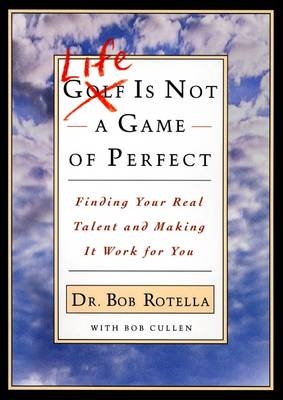
Life is Not a Game of Perfect (eBook)
224 Seiten
Simon & Schuster (Verlag)
978-1-4391-3709-3 (ISBN)
Most people think talent is genetically determined. Either you can sing or you can't. You get calculus or it's beyond you. You have what it takes to succeed -- or you don't.
The truth about human performance is far more encouraging, says Dr. Bob Rotella in Life Is Not a Game of Perfect. Dr. Rotella, the bestselling author of Golf Is Not a Game of Perfect and Golf Is a Game of Confidence, believes that talent, as conventionally defined and measured, plays a secondary role in determining one's fate. Far more important is real talent, a combination of character, attitude, and devotion, which makes greatness possible. And the good news is that anyone can develop real talent.
As always, Dr. Bob Rotella speaks from experience. He has made a career of helping people chase and catch their dreams. His authority as a sports psychologist is well known. Golfers from Tom Kite to David Duval to Pat Bradley have relied on him to help them break through to triumphs on the PGA Tour. But Bob Rotella's practice extends beyond the sports world. He is a consultant on performance enhancement to leading businesses such as Merrill Lynch, General Electric, and PepsiCo. He has worked with successful people in businesses ranging from law to entertainment.
From hundreds of clients and countless students, Dr. Bob Rotella has learned what works. In Life Is Not a Game of Perfect, he shares what he has learned and what he teaches his clients. Real talent, he explains, is 'brilliance of a different sort.' It is the nerve to choose a career doing something you love or the ability to learn to love what you do. It is courage, persistence, and determination. It is the ability to handle failure and honor commitments.
Whether you think so or not, real talent is within your grasp. In Life Is Not a Game of Perfect, Dr. Bob Rotella will help you make it a decisive element in your life. He can show you how to identify and cultivate the qualities that lead to success, prosperity, and happiness.
Most people think talent is genetically determined. Either you can sing or you can't. You get calculus or it's beyond you. You have what it takes to succeed -- or you don't. The truth about human performance is far more encouraging, says Dr. Bob Rotella in Life Is Not a Game of Perfect. Dr. Rotella, the bestselling author of Golf Is Not a Game of Perfect and Golf Is a Game of Confidence, believes that talent, as conventionally defined and measured, plays a secondary role in determining one's fate. Far more important is real talent, a combination of character, attitude, and devotion, which makes greatness possible. And the good news is that anyone can develop real talent. As always, Dr. Bob Rotella speaks from experience. He has made a career of helping people chase and catch their dreams. His authority as a sports psychologist is well known. Golfers from Tom Kite to David Duval to Pat Bradley have relied on him to help them break through to triumphs on the PGA Tour. But Bob Rotella's practice extends beyond the sports world. He is a consultant on performance enhancement to leading businesses such as Merrill Lynch, General Electric, and PepsiCo. He has worked with successful people in businesses ranging from law to entertainment. From hundreds of clients and countless students, Dr. Bob Rotella has learned what works. In Life Is Not a Game of Perfect, he shares what he has learned and what he teaches his clients. Real talent, he explains, is "e;brilliance of a different sort."e; It is the nerve to choose a career doing something you love or the ability to learn to love what you do. It is courage, persistence, and determination. It is the ability to handle failure and honor commitments. Whether you think so or not, real talent is within your grasp. In Life Is Not a Game of Perfect, Dr. Bob Rotella will help you make it a decisive element in your life. He can show you how to identify and cultivate the qualities that lead to success, prosperity, and happiness.
Chapter One: Brilliance of a Different Sort Most of us think we know what talent is. We hear a soprano hit and hold a clear, high C and we think she's talented. We see a basketball player soar above the defense, turn in the air, and jam the ball through the hoop for two points. We think he's talented. We see a skinny kid in the front row of a math class who effortlessly glides through calculus and scores an 800 on the SAT test. We think he's talented. Talent, we think, is something granted or withheld by fate. It's in our genes or it's not in our genes. It's speed and leaping ability. It's a lyrical voice. It's a facile mastery of calculus. And we think that talent, defined in this way, by and large determines an individual's ability to succeed. Television and the press reinforce this notion. They glorify the precocious, natural achievers and make it seem as if they live on a mountaintop high above the valley in which the rest of the world plods along. I don't dispute that the soprano, the math whiz, and the slam-dunk artist have talent as talent is conventionally defined. But in twenty-five years as a psychologist, working with people who want to succeed in fields ranging from golf to finance, I've learned that this conventional talent, while important and helpful, is not sufficient to make an individual successful. In many cases, it's not even necessary. I've learned that other abilities and qualities, traits of character less easily observed than physical gifts or test scores, do lead to success. These traits are brilliance of a different sort. They comprise what I call real talent. This book is about real talent. It's a book of good news, because unlike the talent to hit high C or execute the tomahawk slam, real talent doesn't depend on your genes. Real talent is something anyone can develop. Take the case of a friend of mine, Bob Sherman. Bob grew up in the 1950s in Durand, Michigan, a small town near Lansing and Flint. He was the quintessential small-town sports star. He quarterbacked the football team. He ran the hurdles on the track team. He excelled in baseball. In fact, he attracted a bonus offer from the Boston Red Sox organization. In an athletic sense, he seemed well endowed with conventional talent. But his parents had not been to able to go to college, and they were determined that Bob would. 'They saw a college degree as a way of getting out of the blue-collar world, of getting a high-class job,' Bob recalls. So he turned down the Red Sox, temporarily, and chose to go to the University of Iowa on a football scholarship. Iowa, unlike some of the other schools that recruited him, did not insist that he forgo baseball in favor of spring football practice. But Iowa was, in those days, a football powerhouse, and an interesting thing happened to Bob when he got there. He found out that he was no longer considered supremely talented in the conventional sense of the word. He was still as fast and as agile as he had been at home in Durand. But there were faster, more agile athletes at Iowa. And a lot of them were bigger than Bob was. In the context of big-time college athletics, Bob recalls, 'I wasn't very gifted. I didn't have great ability.' He had to adjust. He didn't lose faith in his physical gifts. He still believed in them. But he understood that they were no longer sufficient. If he was going to succeed at Iowa, he had to discover his real talent. And he did. He started with some of the qualities of character his parents had instilled in him. They had always told him the important thing was doing his best. They had helped him to learn that there is no shame in failure if you fail after giving...
| Erscheint lt. Verlag | 2.4.1999 |
|---|---|
| Co-Autor | Bob Cullen |
| Sprache | englisch |
| Themenwelt | Sachbuch/Ratgeber ► Gesundheit / Leben / Psychologie ► Lebenshilfe / Lebensführung |
| Sachbuch/Ratgeber ► Gesundheit / Leben / Psychologie ► Psychologie | |
| Sport ► Ballsport ► Golf | |
| Geisteswissenschaften ► Psychologie ► Allgemeine Psychologie | |
| ISBN-10 | 1-4391-3709-9 / 1439137099 |
| ISBN-13 | 978-1-4391-3709-3 / 9781439137093 |
| Informationen gemäß Produktsicherheitsverordnung (GPSR) | |
| Haben Sie eine Frage zum Produkt? |
 EPUB (Adobe DRM)
Kopierschutz: Adobe-DRM
Adobe-DRM ist ein Kopierschutz, der das eBook vor Mißbrauch schützen soll. Dabei wird das eBook bereits beim Download auf Ihre persönliche Adobe-ID autorisiert. Lesen können Sie das eBook dann nur auf den Geräten, welche ebenfalls auf Ihre Adobe-ID registriert sind.
Details zum Adobe-DRM
Dateiformat: EPUB (Electronic Publication)
EPUB ist ein offener Standard für eBooks und eignet sich besonders zur Darstellung von Belletristik und Sachbüchern. Der Fließtext wird dynamisch an die Display- und Schriftgröße angepasst. Auch für mobile Lesegeräte ist EPUB daher gut geeignet.
Systemvoraussetzungen:
PC/Mac: Mit einem PC oder Mac können Sie dieses eBook lesen. Sie benötigen eine
eReader: Dieses eBook kann mit (fast) allen eBook-Readern gelesen werden. Mit dem amazon-Kindle ist es aber nicht kompatibel.
Smartphone/Tablet: Egal ob Apple oder Android, dieses eBook können Sie lesen. Sie benötigen eine
Geräteliste und zusätzliche Hinweise
Buying eBooks from abroad
For tax law reasons we can sell eBooks just within Germany and Switzerland. Regrettably we cannot fulfill eBook-orders from other countries.
aus dem Bereich