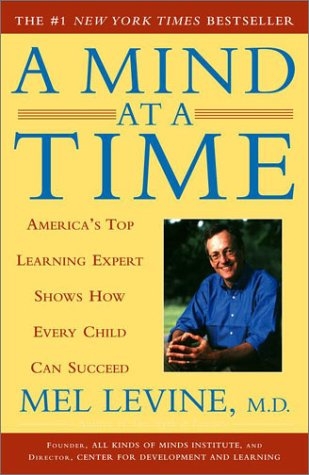
Mind at a Time (eBook)
352 Seiten
Simon & Schuster (Verlag)
9780743217682 (ISBN)
'Different minds learn differently,' writes Dr. Mel Levine, one of the best-known education experts and pediatricians in America today. And that's a problem for many children, because most schools still cling to a one-size-fits-all education philosophy. As a result, these children struggle because their learning patterns don't fit the schools they are in.
In A Mind at a Time, Dr. Levine shows parents and others who care for children how to identify these individual learning patterns. He explains how parents and teachers can encourage a child's strengths and bypass the child's weaknesses. This type of teaching produces satisfaction and achievement instead of frustration and failure.
Different brains are differently wired, Dr. Levine explains. There are eight fundamental systems, or components, of learning that draw on a variety of neurodevelopmental capacities. Some students are strong in certain areas and some are strong in others, but no one is equally capable in all eight. Using examples drawn from his own extensive experience, Dr. Levine shows how parents and children can identify their strengths and weaknesses to determine their individual learning styles.
For example, some students are creative and write imaginatively but do poorly in history because weak memory skills prevent them from retaining facts. Some students are weak in sequential ordering and can't follow directions. They may test poorly and often don't do well in mathematics. In these cases, Dr. Levine observes, the problem is not a lack of intelligence but a learning style that doesn't fit the assignment. Drawing on his pioneering research and his work with thousands of students, Dr. Levine shows how parents and teachers can develop effective strategies to work through or around these weaknesses.
'It's taken for granted in adult society that we cannot all be 'generalists' skilled in every area of learning and mastery. Nevertheless, we apply tremendous pressure to our children to be good at everything. They are expected to shine in math, reading, writing, speaking, spelling, memorization, comprehension, problem solving...and none of us adults can' do all this, observes Dr. Levine. Learning begins in school but it doesn't end there. Frustrating a child's desire to learn will have lifelong repercussions. This frustration can be avoided if we understand that not every child can do equally well in every type of learning. We must begin to pay more attention to individual learning styles, to individual minds, urges Dr. Levine, so that we can maximize children's learning potential. In A Mind at a Time he shows us how.
"e;Different minds learn differently,"e; writes Dr. Mel Levine, one of the best-known education experts and pediatricians in America today. And that's a problem for many children, because most schools still cling to a one-size-fits-all education philosophy. As a result, these children struggle because their learning patterns don't fit the schools they are in. In A Mind at a Time, Dr. Levine shows parents and others who care for children how to identify these individual learning patterns. He explains how parents and teachers can encourage a child's strengths and bypass the child's weaknesses. This type of teaching produces satisfaction and achievement instead of frustration and failure. Different brains are differently wired, Dr. Levine explains. There are eight fundamental systems, or components, of learning that draw on a variety of neurodevelopmental capacities. Some students are strong in certain areas and some are strong in others, but no one is equally capable in all eight. Using examples drawn from his own extensive experience, Dr. Levine shows how parents and children can identify their strengths and weaknesses to determine their individual learning styles. For example, some students are creative and write imaginatively but do poorly in history because weak memory skills prevent them from retaining facts. Some students are weak in sequential ordering and can't follow directions. They may test poorly and often don't do well in mathematics. In these cases, Dr. Levine observes, the problem is not a lack of intelligence but a learning style that doesn't fit the assignment. Drawing on his pioneering research and his work with thousands of students, Dr. Levine shows how parents and teachers can develop effective strategies to work through or around these weaknesses. "e;It's taken for granted in adult society that we cannot all be 'generalists' skilled in every area of learning and mastery. Nevertheless, we apply tremendous pressure to our children to be good at everything. They are expected to shine in math, reading, writing, speaking, spelling, memorization, comprehension, problem solving...and none of us adults can"e; do all this, observes Dr. Levine. Learning begins in school but it doesn't end there. Frustrating a child's desire to learn will have lifelong repercussions. This frustration can be avoided if we understand that not every child can do equally well in every type of learning. We must begin to pay more attention to individual learning styles, to individual minds, urges Dr. Levine, so that we can maximize children's learning potential. In A Mind at a Time he shows us how.
The mosquito is an automaton. It can afford to be nothing else. There are only about one hundred thousand nerve cells in its tiny head, and each one has to pull its weight. The only way to run accurately and successfully through a life cycle in a matter of days is by instinct, a series of rigid behaviors programmed by the genes....The channels of human mental development, in contrast, are circuitous and variable.
Edward O. Wilson, On Human Nature
Fritz wore very thick lenses in his wire-rimmed spectacles. He was an awkward kid who mostly liked being by himself. At age eight he was becoming an insatiable glutton for the printed word, devouring all manner of written nourishment wherever he found it. At first, his parents were vexed by his marathon stays locked in the bathroom, until they found out that that was where their eccentric Fritz felt most comfortable savoring his reading. Fritz came to see me because of some motor problems, including difficulty writing, along with some seeming leaks in his memory.
On several occasions, his mom and dad mentioned that Fritz was fascinated with gadgets of any kind. He relished getting his hands on whatever seductive apparatus was within reach. In the car he would studiously detach or disassemble ashtrays, loudspeakers, and door handles. His extraordinarily tolerant father observed that Fritz was much more talented and enthusiastic when it came to taking things apart than when putting them together! But Mr. Powell did admit that his son was nothing short of remarkable at fixing objects around the house.
I was able to confirm this finding when one day I was doing a physical examination on Fritz in my office. He saw that one of the lights I use for examining ears (my otoscope) was not working. I told him it was broken and that I had changed the batteries and the bulb to no avail. I had also used a well-established, arguably primitive, Mel Levine technique, in vain, I had shaken it repeatedly and briskly. Anyway, Fritz pounced on my otoscope and immodestly proclaimed, 'I'll fix it for you.' Of course, I consented to the proposed surgery. Fritz then inspected the instrument, and thought out loud, 'Let me see now, how is this supposed to work?' I never would have asked myself that question. Fritz then used his fingers and his voice to trace and talk through the way an otoscope is supposed to work. Only then did he go back and determine where the breakdown was occurring. In doing so, he encountered a loose connection in the switch, which he remedied with leverage from one of his handy talonlike fingernails. What struck me and what I never forgot after that was that Fritz was unwilling to repair my light without first determining how such lights were supposed to work. I have since applied the 'Fritz Principle' in my career. That is to say, I should never try to understand and deal with differences in learning until I know how learning works when it's working. So I can't figure out why a kid is enduring serious grief in algebra unless I understand what it ordinarily takes to master algebra -- in other words, how that kind of learning works.
The most basic instrument for learning is something called a neurodevelopmental function. Our own minds and those of our children are like tool chests. They are filled with these delicate instruments, neurodevelopmental functions, the various implements for learning and for applying what's learned. Just as a carpenter might deploy different groups of tools to complete various projects or a dentist might use different sets of tools for different tooth tasks, our...
| Erscheint lt. Verlag | 4.4.2002 |
|---|---|
| Sprache | englisch |
| Themenwelt | Sachbuch/Ratgeber ► Gesundheit / Leben / Psychologie ► Familie / Erziehung |
| Geisteswissenschaften ► Psychologie ► Allgemeine Psychologie | |
| Geisteswissenschaften ► Psychologie ► Entwicklungspsychologie | |
| Geisteswissenschaften ► Psychologie ► Verhaltenstherapie | |
| Sozialwissenschaften ► Pädagogik ► Sonder-, Heil- und Förderpädagogik | |
| Sozialwissenschaften ► Pädagogik ► Sozialpädagogik | |
| ISBN-13 | 9780743217682 / 9780743217682 |
| Informationen gemäß Produktsicherheitsverordnung (GPSR) | |
| Haben Sie eine Frage zum Produkt? |
 EPUB (Adobe DRM)
Kopierschutz: Adobe-DRM
Adobe-DRM ist ein Kopierschutz, der das eBook vor Mißbrauch schützen soll. Dabei wird das eBook bereits beim Download auf Ihre persönliche Adobe-ID autorisiert. Lesen können Sie das eBook dann nur auf den Geräten, welche ebenfalls auf Ihre Adobe-ID registriert sind.
Details zum Adobe-DRM
Dateiformat: EPUB (Electronic Publication)
EPUB ist ein offener Standard für eBooks und eignet sich besonders zur Darstellung von Belletristik und Sachbüchern. Der Fließtext wird dynamisch an die Display- und Schriftgröße angepasst. Auch für mobile Lesegeräte ist EPUB daher gut geeignet.
Systemvoraussetzungen:
PC/Mac: Mit einem PC oder Mac können Sie dieses eBook lesen. Sie benötigen eine
eReader: Dieses eBook kann mit (fast) allen eBook-Readern gelesen werden. Mit dem amazon-Kindle ist es aber nicht kompatibel.
Smartphone/Tablet: Egal ob Apple oder Android, dieses eBook können Sie lesen. Sie benötigen eine
Geräteliste und zusätzliche Hinweise
Buying eBooks from abroad
For tax law reasons we can sell eBooks just within Germany and Switzerland. Regrettably we cannot fulfill eBook-orders from other countries.
aus dem Bereich