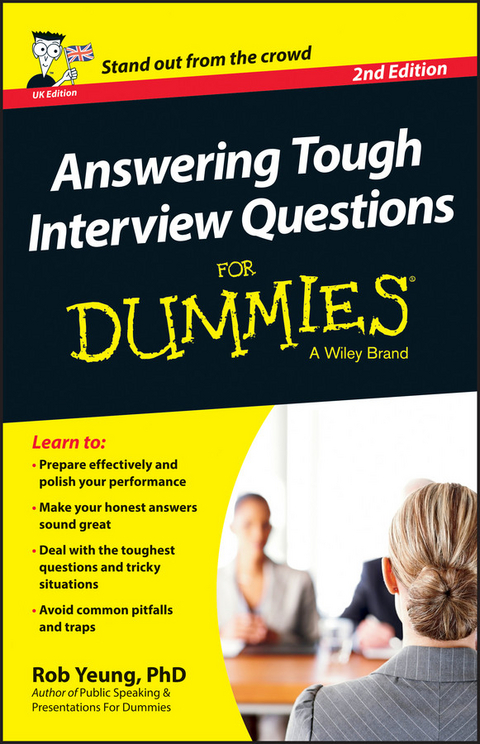
Answering Tough Interview Questions For Dummies, UK Edition (eBook)
John Wiley & Sons (Verlag)
978-1-118-67991-3 (ISBN)
In today's competitive job market, a stellar interview lends you an edge over the competition, which can make or break your chances at a new career. Answering Tough Interview Questions For Dummies, 2nd Edition teaches you how to perform professionally and productively under stressful interview conditions.
With this handy guide, you'll learn to breeze through tricky questions and accentuate your most impressive qualities. This updated second edition features a ten-step guide to having a great interview, ten tips for projecting confidence, ten techniques for trouble-shooting your job search, 200 tough sample interview questions with detailed advice and model answers, proven strategies to combat nerves, and guidelines for perfecting your social media presence and handling questions that may arise from an online search. There is no need to enter an interview feeling unprepared with this guide by your side.
- Rob Yeung's holistic approach helps you make a positive first impression
- Shows you how to prepare to answer questions regarding your online presences (and how to avoid embarrassing search results)
- Provides essential preparation so that you can familiarize yourself with tricky questions before embarking on the stressful interviewing process
Whether you're an entry-level worker or a mid-level professional, Answering Tough Interview Questions For Dummies prepares you to blow the competition away with your poised and professional responses.
Rob Yeung, PhD is a business psychologist specialising in research and consulting in the fields of high achievement and peak performance. He is the author of more than twenty books.
A guide to stunning your interviewer with perfect answers to stumping questions In today's competitive job market, a stellar interview lends you an edge over the competition, which can make or break your chances at a new career. Answering Tough Interview Questions For Dummies, 2nd Edition teaches you how to perform professionally and productively under stressful interview conditions. With this handy guide, you'll learn to breeze through tricky questions and accentuate your most impressive qualities. This updated second edition features a ten-step guide to having a great interview, ten tips for projecting confidence, ten techniques for trouble-shooting your job search, 200 tough sample interview questions with detailed advice and model answers, proven strategies to combat nerves, and guidelines for perfecting your social media presence and handling questions that may arise from an online search. There is no need to enter an interview feeling unprepared with this guide by your side. Rob Yeung's holistic approach helps you make a positive first impression Shows you how to prepare to answer questions regarding your online presences (and how to avoid embarrassing search results) Provides essential preparation so that you can familiarize yourself with tricky questions before embarking on the stressful interviewing process Whether you're an entry-level worker or a mid-level professional, Answering Tough Interview Questions For Dummies prepares you to blow the competition away with your poised and professional responses.
Rob Yeung, PhD is a business psychologist specialising in research and consulting in the fields of high achievement and peak performance. He is the author of more than twenty books.
Introduction 1
Part I: Getting Started with Answering Tough Interview Questions 5
Chapter 1: Understanding the Interviewing Game 7
Chapter 2: Doing Your Job Interview Homework 15
Chapter 3: Polishing Your Interview Performance 25
Part II: Making Sure You Shine in an Interview 33
Chapter 4: Talking About Yourself 35
Chapter 5: Talking about Problems, Perceptions and People 53
Chapter 6: Getting to Grips with Questions about Your Work 73
Chapter 7: Talking About Why You Want a New Job 89
Chapter 8: Thriving Under the Pressure Interview 113
Chapter 9: Succeeding at Competency-Based Interviewing 135
Part III: Dealing with Tricky Questions and Other Situations 157
Chapter 10: Responding to Questions for Graduates and School Leavers 159
Chapter 11: Handling Questions Aimed at Experienced Candidates 175
Chapter 12: Handling Hypothetical and Analytical Questions 195
Chapter 13: Coping with Illegal and Personal Questions 209
Chapter 14: Taking Control in Unusual Situations 229
Part IV: Securing the Job of Your Dreams 239
Chapter 15: Asking Great Questions 241
Chapter 16: Dotting 'I's and Crossing 'T's 249
Part V: The Part of Tens 259
Chapter 17: Ten Cardinal Sins of Interviewing 261
Chapter 18: Ten Steps to Delivering a Great Interview 267
Chapter 19: Ten Top Tips for Projecting a Confident You 275
Chapter 20: Ten Ways to Troubleshoot Your Job Search 281
Index 287
Chapter 1
Understanding the Interviewing Game
In This Chapter
Realising what interviewers want from job candidates
Understanding the skills and qualities sought by employers
The job market is increasingly competitive, and many interviewers are inundated with too many applications. In this chapter, I share with you the secrets of what interviewers are really looking for, and how to prepare the ammunition for your answers.
This book contains plenty of advice and loads of mock answers to tough interview questions. But simply reading through the book won't get you anywhere. What you need to do is figure out how you would answer different interview questions by using my answers for inspiration.
Recognising What Interviewers Are Looking For
At first glance, different job adverts seem to require a dazzling array of skills, experience and qualities. But in actuality, most employers are really looking for four basic factors to find the right person for the job. These four factors can be summarised as the four Cs of interviews:
- Competence: Interviewers look to recruit people who have the skills and personal qualities to do the job with minimal supervision.
- Confidence: Employers want to hire people who are at least reasonably composed and secure about themselves. They want people who can deal with new people and new situations without turning into a trembling wreck!
- Commitment: Interviewers want to give the job to someone who sticks at it. They want a self-motivated person who persists in the face of difficulties rather than gives up at the first sign of trouble.
- Chemistry: Interviewers want someone that they feel they can get on with. All employers feel they have a unique culture – and want to know that you can fit in with the rest of the team.
Demonstrate your competence and commitment by giving good answers to the many questions thrown at you. You can demonstrate confidence and create chemistry by using your tone of voice and body language to show that you're the kind of collected and likeable person who gets on with everyone. Be aware that the interviewers are not only evaluating what you say, but also how you say it. No matter what section of the book you turn to, be sure to keep the four Cs in mind.
Finding Out about Key Skills and Qualities
When interviewers say they're looking for ‘competent’ candidates, what exactly do they mean? Well, dozens of surveys have asked employers what they want from potential recruits. This section covers the top ten skills and personal qualities that employers look for. Parts II and III take you through how to answer these questions, but for now, make a mental note of these skills and then weigh up whether you possess them.
Interestingly, most of the surveys agree that these skills and characteristics tend to apply to employees at all levels of an organisation and across most industry sectors. So a high-street retailer looking for a shop assistant tends to want more or less the same skills and qualities as an international corporation looking for a senior manager – although obviously to differing degrees.
Communicating with people
Unless you are being hired to work in a sealed room with no contact with colleagues or customers (which I very much doubt!), you need to have good communication skills.
When discussing your communication skills with interviewers, think of examples of occasions when you:
- Listened to the needs of other people, such as colleagues or customers.
- Conveyed information to other people – perhaps speaking on a one-to-one basis or presenting to a group of people.
- Handled difficult situations, such as customer complaints, on the telephone.
- Used your written communication skills in preparing reports or documents for other people to read.
See Chapter 3 for more about communication skills.
Influencing others
Although communication skills are important, most employers want people who also have powers of persuasion – being able to win others over or change their minds. In preparing for your interviews, think of times when you have:
- Had a discussion with someone and helped him or her to see your point of view.
- Changed someone's mind.
- Persuaded someone to take a course of action that they were initially not in support of.
Persuasion skills are particularly prized when dealing with customers or clients – for example, in listening to their needs and then selling products or services to them.
See Chapters 4, 5 and 9 for more on influencing skills.
Analysing situations
Managers want to hire candidates who can research issues and assess situations. Make sure that you think about times when you:
- Gathered information about a topic or issue.
- Broke down a complex problem into a number of smaller issues.
- Weighed up the pros and cons of different options.
See Chapters 9 and 12 for more about analytical skills.
Solving problems and making decisions
Employers are looking for people who can assess situations and then work out the best course of action to take. Be ready to talk to interviewers about occasions when you:
- Made suggestions about how to tackle a problem.
- Initiated or participated in brainstorming sessions.
- Weighed up different options and chose a course of action to solve a problem or tackle an issue.
See Chapters 9 and 12 for more about problem-solving skills.
Demonstrating drive and determination
Organisations do not want to hire people who only work when given explicit instructions as to what to do; they want to hire candidates who are self-motivated and can demonstrate a bit of initiative. Think back to times when you:
- Suffered a setback or disappointment at work but got back on your feet and got on with a task.
- Had an original idea and used it to be more effective or productive at work.
- Overcame a difficulty or obstacle that was preventing you from achieving a goal.
Chapters 4, 5 and 9 contain more information on demonstrating drive and determination.
Teamworking with colleagues
Employers are constantly talking about the need for employees to work together more effectively as a team. Try to recall instances when you:
- Helped someone else in the team with their work or duties.
- Resolved conflict or disagreement between other team members.
- Provided a team member with a shoulder to cry on.
Effective teamworking is about putting the needs of the team above your own.
Chapters 5, 9 and 12 contain some examples of popular questions about teamworking.
Developing quickly
Employers want people who can develop quickly in the job, especially for entry-level jobs (including graduate entry roles). Managers don't want to hire people who need a lot of handholding! In preparing for interviews, try to think back to times when you:
- Became proficient at a task or duty more quickly than others expected.
- Gained knowledge about a topic or issue because of your hard work and dedication.
- Picked up a new skill with minimal supervision.
See Chapters 4, 6 and 9 for questions relating to your ability to pick up new skills and absorb information quickly.
Being flexible and adaptable
Employers want to hire people who are open-minded, accommodating and willing to help out when the need arises. Try to recall occasions when you:
- Offered to do overtime to help get a project or piece of work completed on time.
- Helped someone else even when it was not part of your job description.
- Changed your mind at work after listening to someone else's point of view.
Chapters 5 and 9 show examples of questions about how you may have demonstrated your flexibility and adaptability in different work situations.
Planning and organising
Employers are always on the lookout for candidates who can manage their own workload. In order to convince employers that you possess these skills, think about instances when you:
- Prioritised tasks to meet a tough deadline.
- Planned out and then completed a project.
- Organised other people to ensure that a piece of work got done.
Chapter 9 contains examples of typical questions about pieces of work you may have planned.
Being aware of the bigger picture
Employers complain that a lot of employees have a very narrow-minded view of their work. They don't see the bigger picture of what goes on outside of their team, department or organisation. Demonstrate that you are aware of the bigger picture by thinking back to occasions when you:
- Had to liaise with colleagues outside of your department.
- Found out some interesting information about a customer, supplier or competitor and then shared it with colleagues.
- Thought about the impact of your work or duties on people outside of your own team.
Chapters 2 and 7 give advice on demonstrating your awareness of the bigger picture.
Getting invited to interviews
The majority of this...
| Erscheint lt. Verlag | 22.11.2013 |
|---|---|
| Sprache | englisch |
| Themenwelt | Sachbuch/Ratgeber ► Beruf / Finanzen / Recht / Wirtschaft ► Bewerbung / Karriere |
| Sachbuch/Ratgeber ► Beruf / Finanzen / Recht / Wirtschaft ► Wirtschaft | |
| Wirtschaft ► Betriebswirtschaft / Management | |
| Schlagworte | ace the job interview • answering interview questions • best answers to interview questions • best answers to tough interview questions • Business & Management • common interview questions • give great interview • give killer interviews • how to answer interview questions • how to give a brilliant interview • how to talk to interviewers • impressive job interviews • interview answers • interview tips • job interview • job interview strategies • Job Search Guide • Job Search Help • Job seekers • Personal Career Development • Personalwesen • Vorstellungsgespräch • Vorstellungsgespräch • what interviewers are looking for • what to say to interviewers • what to tell interviewers • Wirtschaft u. Management |
| ISBN-10 | 1-118-67991-1 / 1118679911 |
| ISBN-13 | 978-1-118-67991-3 / 9781118679913 |
| Informationen gemäß Produktsicherheitsverordnung (GPSR) | |
| Haben Sie eine Frage zum Produkt? |
 PDF (Adobe DRM)
Kopierschutz: Adobe-DRM
Adobe-DRM ist ein Kopierschutz, der das eBook vor Mißbrauch schützen soll. Dabei wird das eBook bereits beim Download auf Ihre persönliche Adobe-ID autorisiert. Lesen können Sie das eBook dann nur auf den Geräten, welche ebenfalls auf Ihre Adobe-ID registriert sind.
Details zum Adobe-DRM
Dateiformat: PDF (Portable Document Format)
Mit einem festen Seitenlayout eignet sich die PDF besonders für Fachbücher mit Spalten, Tabellen und Abbildungen. Eine PDF kann auf fast allen Geräten angezeigt werden, ist aber für kleine Displays (Smartphone, eReader) nur eingeschränkt geeignet.
Systemvoraussetzungen:
PC/Mac: Mit einem PC oder Mac können Sie dieses eBook lesen. Sie benötigen eine
eReader: Dieses eBook kann mit (fast) allen eBook-Readern gelesen werden. Mit dem amazon-Kindle ist es aber nicht kompatibel.
Smartphone/Tablet: Egal ob Apple oder Android, dieses eBook können Sie lesen. Sie benötigen eine
Geräteliste und zusätzliche Hinweise
Buying eBooks from abroad
For tax law reasons we can sell eBooks just within Germany and Switzerland. Regrettably we cannot fulfill eBook-orders from other countries.
aus dem Bereich