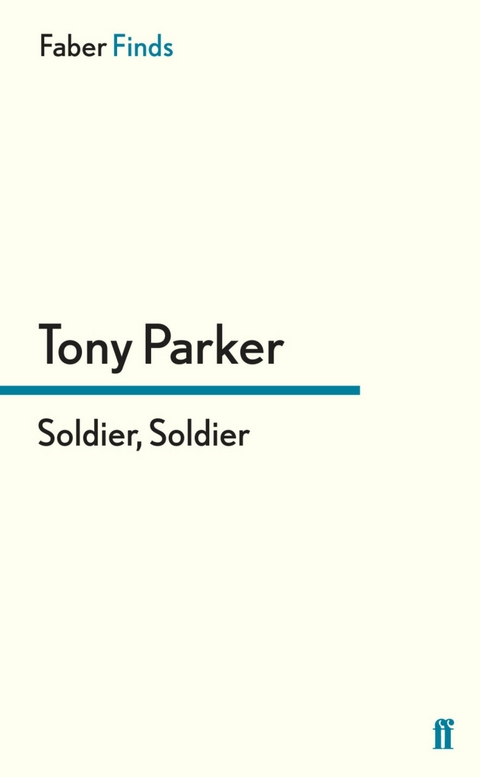
Soldier, Soldier (eBook)
320 Seiten
Faber & Faber (Verlag)
978-0-571-30443-1 (ISBN)
Tony Parker was born in Stockport on June 25 1923, the son of a bookseller. His mother died when he was 4. He began to write poems and plays in his late teens. Called up to military service early in the Second World War he declared himself a conscientious objector and, in lieu, was sent to work at a coal-mine in the North East, where he observed conditions and met people who influenced him hugely. After the war he began to work as a publisher's representative and, voluntarily, as a prison visitor - the latter another important stimulus to his subsequent writings. After Parker happened to make the acquaintance of a BBC radio producer and imparted his growing interest in the lives, opinions and self-perceptions of the prisoners he had met, he was given the opportunity to record an interview with a particular convict for broadcast on the BBC. The text of the interview was printed in the Listener, and spotted by the publishers Hutchinson as promising material for a book. This duly emerged as The Courage of His Convictions (1962), for which Parker and the career criminal 'Robert Allerton' (a pseudonym) were jointly credited as authors. Over the next 30 years Parker would publish 18 discrete works, most of them 'oral histories' based on discreetly edited but essentially verbatim interview transcripts. He died in 1996 (though one further work, a study of his great American counterpart Studs Terkel, appeared posthumously.)
For his twelfth book, first published in 1985, Tony Parker was given near-unlimited access by the Ministry of Defence and spent eighteen months interviewing the officers and soldiers of a single British Army infantry regiment - as well as their wives. Both a pacifist and a former conscientious objector, Parker brought his singular perspective to the questioning of fighting men on what it means to bear arms for one's country. 'A unique picture of a social institution which is an exaggerated microcosm of society and yet set apart from it.' Scotsman'A revealing glimpse into the lives and thoughts of the men in khaki.' Gerald Kaufman, Manchester Evening News'Captivating bedside reading.' Sunday Telegraph
They call it a brick. As they move slowly along the street of wrecked terraced houses, the two soldiers right and left at the front swing their automatic rifles threateningly from side to side. Their eyes scan the broken windows, the boarded doorways, the rooftops, each crossroad and street corner coming up ahead. The two other soldiers left and right at the rear do the same, walking backwards.
Between them in the middle on the left the tall young lieutenant strolls nonchalantly, as though to display his contempt for danger: he chats quietly in his public school drawl about the gusting cold wind and the increasingly heavy drizzle and what a frightfully lousy winter it’s been. His pistol stays in its holster, but he keeps his hand thumb-hooked in his camouflage field-jacket pocket near it. Behind him the sergeant’s eyes and rifle are swivelling ceaselessly forwards, sideways, upwards, backwards. ‘Christ, not Ipswich Town?’ he says out of the corner of his mouth with a mock-disbelieving laugh. ‘You don’t really support them do you, a bunch of wankers like that?’ A Norfolk man, must be.
Anyone watching through binoculars or a telescopic sight, seeing the small portly hatless civilian in a raincoat on the lieutenant’s right, would think surely he’s of at least some importance, so heavily guarded and protected like he is? Worth a pot shot, or perhaps even a lobbed grenade in the general direction of?
I’m not happy about it. What do I think I’m doing, I’m asking myself – an ageing pacifist, a conscientious objector in the 1939–45 war, walking surrounded by armed men like this down the middle of a derelict Londonderry street on a dark wet January afternoon?
‘Please Sam, don’t forget my principles,’ I say to the sergeant. ‘You know I don’t want anyone killed on my behalf.’ ‘Don’t you worry, mate,’ he says with a grin. ‘We won’t kill them on your behalf, we’ll do it on behalf of the British Army.’
(notebook)
Memo to Tony Parker re possible non-fiction book
We would like you to consider the idea of doing a book about the contemporary British Army. Who joins the Army and why? How does the Army work as a society? Is its system of values different from that of the rest of British society? Does it have any tacit or open political leanings? How does joining the Army affect soldiers’ domestic lives? These questions and many more might be explored in a book of tape-recorded interviews. The aim would be to find a particular regiment which would allow you the freedom of access to its members, from the colonel to raw recruits. Your own background as a conscientious objector would, we suggest, lead you to ask some significant questions, and perhaps see the answers in a different perspective from that of other writers.
(Charles Clark, publisher)
It has been suggested to me that since conscription no longer exists, most people have little idea what the British Army is now like in human terms – what sort of people become soldiers and why, how they see themselves, how in turn they look on society. And that the idea of a pacifist and World War II conscientious objector trying to interview them and find out might produce a result which could be unusual. That’s if the Army would even for one moment consider it.
I live in Suffolk, so it seems natural first to approach my ‘local’ regiment, the Royal Anglians: a traditional infantry regiment, a ‘regiment of the line’.
I’ve met and talked with some of the Royal Anglians’ senior officers and with Ministry of Defence officials in London, to explain what I hope to do and how. To my astonishment I was very rapidly given permission, and offered complete co-operation and widespread facilities by everyone. I made it clear what my own attitudes and prejudices were, and have repeatedly done so whoever I’ve talked to. I have to say I’ve never been treated by a single person with anything other than courtesy, helpfulness, and open friendliness.
(notebook)
The infantryman is generally of supreme importance because he holds the territory. The Royal Air Force may pound it to pulp, the Artillery may reduce it to ashes, the Royal Navy may fight tremendous battles at sea and transport troops to maintain the lifelines, but the infantry holds the ground or takes territory.
(Captain Edgar Letts: ‘Tracing the Regiments’)
On arrival, tea in the officers’ mess: a welcoming warm comfortably furnished room with big armchairs, lots of settees, military oil paintings, and mounted and framed medals and decorations all round the walls. About thirty officers. Toast, cake, chatter. ‘How do you do, how very nice to meet you, it’s good to have you with us. I am the commanding officer, I shall call you Tony and you must call me Julian. I do hope you enjoy your stay with us.’
(notebook)
– I hope your book won’t only contain interviews with highly motivated soldiers and no one else: that’d give a very false picture. But it’s going to be difficult to avoid it, because we have an all-volunteer Army. If a man’s really unhappy we don’t want to keep him, and he doesn’t have to stay. So nearly all the people you talk to are going to tell you they’re happy, the Army’s a wonderful organisation, and they want to go on and on being soldiers. By the mere fact of them still being in the Army, they mostly do think and feel that. So this’ll really be a big difficulty for you.
(L.M., commanding officer)
– I think it would be something worth doing if it contained a true account, or as near a true account as one could get, of how we live: it might be painful and embarrassing in parts, indeed I think it wouldn’t be honest or worth doing if it wasn’t. But perhaps you might show us as not entirely stereotypes, not just mechanical men who obey orders and don’t think.
(Eric C., lieutenant)
– Perhaps you could help people understand the amount of intellect that is necessary in the Army. A soldier has to be a counter-terrorist fighter in the streets of Northern Ireland, almost something of a guerrilla fighter: then out and out aggressive on some such occasion as the Falklands war, then a diplomat when he’s with the United Nations forces in Cyprus, and finally, just a member of a visiting Army – certainly not an ‘occupying’ army – when he’s in Germany. Equally he gets moved from one climate to another, from one country to another, and is expected to acclimatize both physically and mentally very quickly. Civilian life makes no such demands that are even comparable on people.
(Dennis B., major)
– I sometimes think, you know, that being a soldier is a kind of fate. But surely you can’t be picked out like that? I mean well I hope you can’t. Sometimes I think being a soldier isn’t really worthwhile at all – but I find it very hard to think what else I could do. You see I come from an Army family: and though neither my father nor anyone else ever put pressure on me, it was always taken for granted I was going in the Army. So – here I am at the age of twenty-six, in the Army. But sometimes I don’t think I’ve ever even been able to make a free choice for myself about it.
(Robert T., captain)
– The challenge of leadership, the responsibility of leadership: that’d be worth including. I mean if you’re a platoon commander you’re responsible for about 30 men, if you’re a company commander it’s about 100 men – and if you’re the commanding officer of a battalion, it’s 600 to 1,000 men. I mean, wow.
(Jonathan D., second lieutenant)
– As a commanding officer of one of the companies, there’re a lot of things I’d like to ask soldiers but can’t. I wonder to what extent Army life is a refuge to some, a sort of escape from the real world outside. What they really think about the life they have, that sort of thing. How they feel about what you might call the ‘servant master’ set-up between officers and other ranks … it’d be interesting to ask other ranks, and to ask officers.
Chat with everyone you can – some of the lads, some young officers and old ones, listen to their voices of experience – everyone you possibly can. And I do hope you end up with something which isn’t only about the glorification of the Army – in its own eyes, or what it thinks or hopes is the public’s eyes either. That’d be very dull. Try for a realistic cross-section giving all sides.
(Paul T., major)
– I’d say the strongest influence on whether a man is a good – in the sense of successful and happy – soldier is his marital situation. If he’s married a woman who is a soldier’s wife, in all the possible meanings of the phrase, then he’ll be OK. So your book shouldn’t ignore this, it’s a vitally important factor of Army life: in fact I’d say you should devote quite a lot of time to talking to wives, both happy ones and unhappy ones, and trying to get their views. Their views are very often overlooked, ignored as unimportant, and so something might be done to redress that balance.
(Peter W., captain)
– Your book might damage us if it contains too many of your own misperceptions. You perhaps might not interview enough people, or you could select and edit your interviews in such a way as to give a very unbalanced picture. You...
| Erscheint lt. Verlag | 15.10.2013 |
|---|---|
| Verlagsort | London |
| Sprache | englisch |
| Themenwelt | Sachbuch/Ratgeber ► Geschichte / Politik ► Allgemeines / Lexika |
| Geschichte ► Teilgebiete der Geschichte ► Militärgeschichte | |
| Sozialwissenschaften ► Politik / Verwaltung | |
| Sozialwissenschaften ► Soziologie | |
| ISBN-10 | 0-571-30443-5 / 0571304435 |
| ISBN-13 | 978-0-571-30443-1 / 9780571304431 |
| Informationen gemäß Produktsicherheitsverordnung (GPSR) | |
| Haben Sie eine Frage zum Produkt? |
 EPUB (Adobe DRM)
Kopierschutz: Adobe-DRM
Adobe-DRM ist ein Kopierschutz, der das eBook vor Mißbrauch schützen soll. Dabei wird das eBook bereits beim Download auf Ihre persönliche Adobe-ID autorisiert. Lesen können Sie das eBook dann nur auf den Geräten, welche ebenfalls auf Ihre Adobe-ID registriert sind.
Details zum Adobe-DRM
Dateiformat: EPUB (Electronic Publication)
EPUB ist ein offener Standard für eBooks und eignet sich besonders zur Darstellung von Belletristik und Sachbüchern. Der Fließtext wird dynamisch an die Display- und Schriftgröße angepasst. Auch für mobile Lesegeräte ist EPUB daher gut geeignet.
Systemvoraussetzungen:
PC/Mac: Mit einem PC oder Mac können Sie dieses eBook lesen. Sie benötigen eine
eReader: Dieses eBook kann mit (fast) allen eBook-Readern gelesen werden. Mit dem amazon-Kindle ist es aber nicht kompatibel.
Smartphone/Tablet: Egal ob Apple oder Android, dieses eBook können Sie lesen. Sie benötigen eine
Geräteliste und zusätzliche Hinweise
Buying eBooks from abroad
For tax law reasons we can sell eBooks just within Germany and Switzerland. Regrettably we cannot fulfill eBook-orders from other countries.
aus dem Bereich