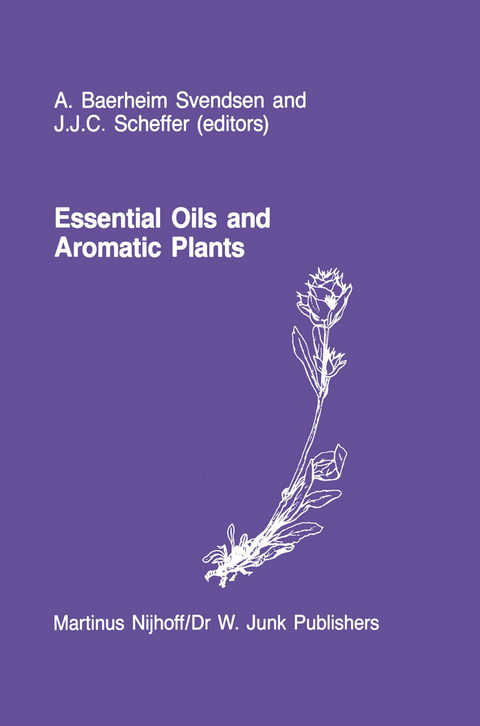
Essential Oils and Aromatic Plants
Springer (Verlag)
978-94-010-8772-8 (ISBN)
Quantitative aspects of flavour analysis by equilibrium and dynamic headspace gas chromatography with capillary columns.- Quantitative headspace gas chromatography in the analysis of volatile oils and aromatic plants.- Concentration of odorous headspace volatiles.- Sensory evaluation of flavour and fragrance compounds after headspace sampling, capillary chromatography and thermal conductivity detection.- GLC of the headspace after concentration on Tenax GC and of the essential oils of apples, fresh celery, fresh lovage, honeysuckle and ginger powder.- Headspace technique as a versatile complementary tool to increase knowledge about constituents of domestic or exotic flowers and fruits.- Handling, quick optimization and choice of column wall material in capillary gas chromatography.- Gas Chromatographic characterization of frequently occurring sesquiterpenes in essential oils.- Progress in isolation techniques for essential oil constituents.- The influence of isolation conditions on the composition of essential oils containing linalool and linalyl acetate.- Determination of the enantiomeric composition of natural flavouring agents by 1H-NMR spectroscopy.- Determination of the enantiomeric composition of synthetic flavouring agents by 1H-NMR spectroscopy.- Constituents of the essential oil of Salvia stenophylla — first identification of (+)-epi-?-bisabolol in nature.- GC-MS analysis of the essential oil of Meriandra benghalensis.- Essential oils of Israeli wild species of Labiatae.- Studies on the composition of essential oils of ‘cineolic eucalyptus’.- Biology and essential oil of Humulus lupulus var. neomexicanus.- Sesquiterpenes and other volatile metabolites from liquid cultures of ceratocystis populina (Ascomycota) — Essential oil compounds from fungi.-Effect of drying and freeze-drying on the aroma of dill — Anethum graveolens CV mammut.- Differences in the yield of plant material, essential oils and their main components during the life cycle of Origanum vulgare L..- Comparative studies on growth and volatile oil contents of some induced mutants of Origanum majorana.- Formation of essential oil in clary sage under different conditions.- Influence of ecological factors on the content and composition of the essential oil in Salvia officinalis.- Composition of the essential oil of Origanum majorana grown in different localities in Turkey.- Composition and antimicrobial activity of the essential oil of Ducrosia anethifolia.- Effects and side-effects of essential oils.- Arzneipflanzen im Spiegel niederländischer Malerei.
| Zusatzinfo | XIV, 246 p. |
|---|---|
| Verlagsort | Dordrecht |
| Sprache | englisch |
| Maße | 155 x 235 mm |
| Themenwelt | Sachbuch/Ratgeber ► Natur / Technik ► Garten |
| Naturwissenschaften ► Biologie ► Botanik | |
| Naturwissenschaften ► Chemie ► Organische Chemie | |
| Technik ► Lebensmitteltechnologie | |
| ISBN-10 | 94-010-8772-5 / 9401087725 |
| ISBN-13 | 978-94-010-8772-8 / 9789401087728 |
| Zustand | Neuware |
| Informationen gemäß Produktsicherheitsverordnung (GPSR) | |
| Haben Sie eine Frage zum Produkt? |
aus dem Bereich