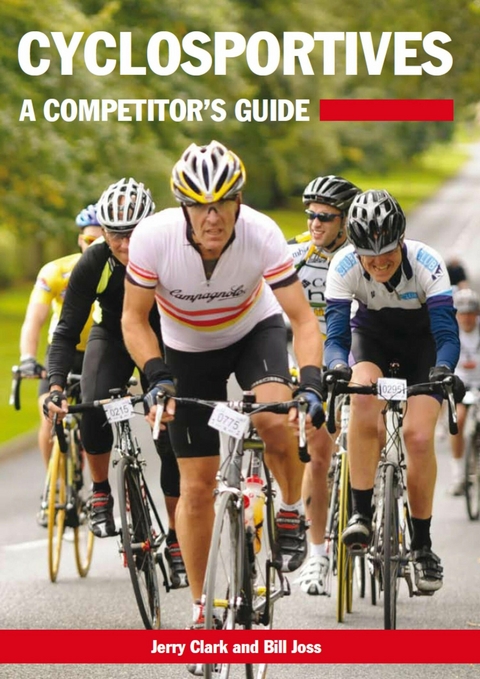
Cyclosportives (eBook)
144 Seiten
Crowood (Verlag)
978-1-84797-535-5 (ISBN)
Innocuously and incongruously located on a wall in what is now a TGI Friday’s restaurant on Boulevard Montmartre in Paris there is a small plaque commemorating a conversation that created the most famous event in cycling, and arguably in the world of sport:
A few months later in 1903, fifty or so intrepid individuals set off at 3:15am on a dark Paris night to ride the first Tour de France …
Of course the Tour is by no definition a cyclosportive; it is perhaps the most famous, most punishing race in all theatres of sport, but it is almost certainly true that the Étape du Tour, the spiritual descendant of that very first Tour de France stage, is to many minds the most prestigious sportive. It is certainly the most over-subscribed of all sportives, and most riders have this event in their sights as an event to ride at least once.
Many of the essential elements of the sportive are present – professional organization, a carefully selected route to challenge and bring out a range of capabilities, a package of logistic support along with the challenge of the clock, and the ever-present threat of the broom wagon (the dreaded truck which sweeps up the slower, struggling and injured riders who fall to the back of the field). Most of all there is the anticipation that comes from knowing that the greatest cyclists in the world will be covering the same kilometres just a few days later, albeit at a rather faster pace.
Cyclosportive – a Definition
The term ‘cyclosportive’ is derived from the French randonnée cyclosportive, and signifies a long-distance, mass participation, timed event in which riders race not against each other but challenge themselves against distance, terrain and the clock. So a sportive is part randonnée and also part road race: riders have numbers, and times are usually published by the organizers. The biggest and most prestigious events attract thousands of competitors; the biggest of them all, the Cape Argus Pick ’n’ Pay, sees up to 40,000 riders jostling for road space and battling fierce headwinds round a stunningly beautiful coastal route in South Africa.
There are now many thousands of sportives taking place around the world, offering a fantastic opportunity to experience cycling in every conceivable environment.
Arguably the first, and still to many one of the toughest, sportive is La Marmotte, first held in 1982. Taking in five of the most fearsome ascents of the Alps, it may not be the wisest choice for a first event as it will test the most dedicated and accomplished of riders. Like L’Étape du Tour, La Marmotte sees up to 25 per cent of its eager starters retire or swept up as the true extent of the challenge hits them, and the realization dawns that those missed winter extra training miles were, just as we say in this book, necessary after all.
This is real mass participation: the Trans Alp Challenge.
Whichever is the toughest, most scenic, longest or famous, and whatever the origins, the sportive is now the fastest growing mass participation cycling activity in the amateur rider’s calendar.
The Essential Ingredients
Distances, locations and course profiles vary, but all events will offer common ingredients: support and logistics, distance, location and profile.
Support and Logistics
A sportive should be well organized and easy to enter, and the basic essentials for rider safety, welfare and enjoyment will be covered, including:
- Changing facilities and toilets at the start and finish
- Pre-published guide times for gold, silver and bronze standards by age group category
- Timing chips to allow logging of progress and overall times
- A route card with comprehensive directions in case signs on the route have gone missing
- Multiple feed stations offering water, energy drinks and food (bananas, cakes, bread rolls, fruit)
- A pre-start briefing and some pointers on weather and road conditions, route changes, rider etiquette and other potential hazards specific to the course
- A minimum of basic mechanical assistance and rider support facilities at the event start and around the route
- An emergency telephone number
- First aid stations around the course
- A broom wagon(s) – a support vehicle(s) able to get you and your bike to the finish in the event of any accident or mechanical problem, or fatigue
- Post-event results.
Distance
Typically a long course will be around 160km (100 miles), with a ‘short’ route of 110km (70 miles) offered either as an alternative goal or as an escape route in the event of problems on the longer ride. It is worth bearing in mind when selecting a first event, or even when training towards a more ambitious sportive, that an event with multiple route options could be a sensible choice.
A perfect climb: good friends, traffic free.
The short route in a sportive is likely to miss out the toughest climbs, yet still deliver a varied and challenging outing, which is partly why the sportive has become so popular so quickly, as everyone can participate and find their level.
Location
A well-planned sportive will try to utilize safe, traffic-free roads wherever possible, and will incorporate scenic routes and well known landmarks such as major climbs, or ‘cols’ in European countries.
The route may use narrow roads, and the road surfaces may be rougher and more variable than usual. Consider these factors when choosing an event and when preparing your bike – tyre choice, inflation pressure, spares to be carried all need to be thought through carefully. It is possible, for example, that a sportive course such as the Exmoor Beast which takes place in late autumn will be accompanied by some pretty wild weather, and road surfaces will be strewn with gravel or thorns. At the other end of the scale, an event such as Quebrantahuesos in northern Spain includes many kilometres on beautifully smooth tarmac with long climbs and terrific descents.
Profile
All sportives are designed to present a challenge. Part of that challenge must be the act of hauling varying quantities of human body mass, machine and cycling gear up gradients against the force of gravity, otherwise known as ‘climbing’! Climbing is to some the absolute essence of cycling, yet to others the most feared and dreaded element of the sport. Look carefully at the route profile and the pattern of the climbs when selecting an event, and match the severity to your ability and ambition.
A ‘typical’ sportive of 160km is likely to feature several notable climbs of up to 10km or more, and will offer between 1,500 and 3,000 vertical metres of climbing across the course of the event. 1,500 to 3,000m in 160km doesn’t sound much, but then factor in gradients of between 5 and 25 per cent and you will probably find yourself grinding up a total of over 50km in a granny gear (the smallest cogs at the back of the bike) with a few minor lumps and bumps thrown in to unsettle your rhythm, and just for good measure 30°C to 40°C of summer sun. Be aware that any event showing over 2,500m of climbing is a warning sign for a tough sportive, and needs to be treated with respect: a training plan geared towards peaking for that event should be allowed for.
Profile of the Maratona Dles Dolomites in Italy in July.
So choose the right event with the right profile for your objectives, and think and plan for the specific conditions and roads. To illustrate the variation between events we have shown two ‘typical’ sportive course profiles below: the first is acknowledged as one of the toughest and best organized events on the European calendar, the Maratona Dles Dolomites held in Italy each July (www.maratona.it/en); and the second is the Shakespeare 100 sportive held in September in the UK, a challenging, scenic and enjoyable 100-mile (160km) sportive running from Stratford-on-Avon down into the Cotswolds and back (www.shakespeare100.org.uk). Both are challenging events, but the course profile demands a different level of preparation and strategy; more on that later.
The overall aim of our advice and therefore of this book is to help the reader finish an event without needing an oxygen tent and a stretcher, having given everything possible on the day without causing permanent physiological damage. With the right preparation any physically fit individual should be able to tackle a sportive with a little left ‘in the tank’ and with enough strength to celebrate their achievement at the finish line.
Preparation and Planning
Plan your event nutrition and ride strategies carefully to map on to the specifics of the event itself, and think through what and how much you need to carry on the bike. The rest – timing chips, massage points, mobile mechanics – may or may not be present, so again, plan your event strategy accordingly. You should ensure that you can deal with at least minor mechanicals yourself, and should carry enough basic nutrition to complete the event should a problem arise. Interestingly Mark Cavendish, the Tour de France sprinter, said recently that even he, with comprehensive and constant race support available, always carries...
| Erscheint lt. Verlag | 1.3.2013 |
|---|---|
| Verlagsort | London |
| Sprache | englisch |
| Themenwelt | Natur / Technik ► Fahrzeuge / Flugzeuge / Schiffe ► Fahrrad |
| Sachbuch/Ratgeber ► Sport ► Motor- / Rad- / Flugsport | |
| ISBN-10 | 1-84797-535-6 / 1847975356 |
| ISBN-13 | 978-1-84797-535-5 / 9781847975355 |
| Informationen gemäß Produktsicherheitsverordnung (GPSR) | |
| Haben Sie eine Frage zum Produkt? |
 EPUB (Wasserzeichen)
DRM: Digitales Wasserzeichen
Dieses eBook enthält ein digitales Wasserzeichen und ist damit für Sie personalisiert. Bei einer missbräuchlichen Weitergabe des eBooks an Dritte ist eine Rückverfolgung an die Quelle möglich.
Dateiformat: EPUB (Electronic Publication)
EPUB ist ein offener Standard für eBooks und eignet sich besonders zur Darstellung von Belletristik und Sachbüchern. Der Fließtext wird dynamisch an die Display- und Schriftgröße angepasst. Auch für mobile Lesegeräte ist EPUB daher gut geeignet.
Systemvoraussetzungen:
PC/Mac: Mit einem PC oder Mac können Sie dieses eBook lesen. Sie benötigen dafür die kostenlose Software Adobe Digital Editions.
eReader: Dieses eBook kann mit (fast) allen eBook-Readern gelesen werden. Mit dem amazon-Kindle ist es aber nicht kompatibel.
Smartphone/Tablet: Egal ob Apple oder Android, dieses eBook können Sie lesen. Sie benötigen dafür eine kostenlose App.
Geräteliste und zusätzliche Hinweise
Buying eBooks from abroad
For tax law reasons we can sell eBooks just within Germany and Switzerland. Regrettably we cannot fulfill eBook-orders from other countries.
aus dem Bereich