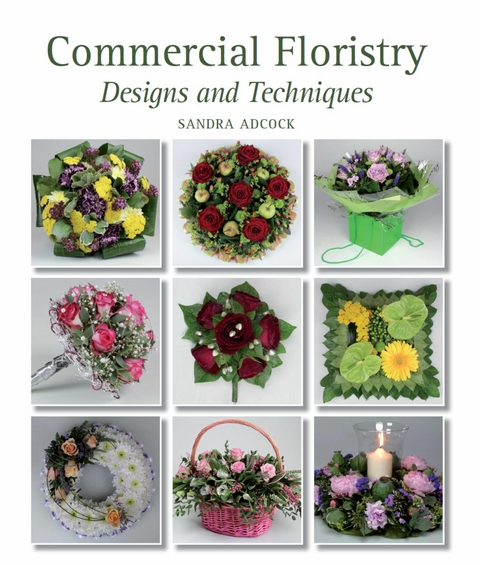
Commercial Floristry (eBook)
192 Seiten
Crowood (Verlag)
978-1-84797-534-8 (ISBN)
Sandra Adcock worked for many years in the creative indsutries, including running her own millinery company. However, she was drawn to floristry and embarked on a new and successful career. She is now an independent florist and lecturer, who teaches at a leading horticultural college. Sandra is a holder of the Society of Floristry's National Diploma in floristry and a fellow of the British Florist Association.
This lavish book covers the full range of commercial techniques for the florist. It introduces basic terms and equipment, advises on conditioning and care of fresh materials, and explains the elements and principles of design. Examining various celebrations and occasions, it demonstrates classic and contemporary designs with step-by-step instructions and over 600 full-colour photographs.
The cut flower often has a complex journey before it arrives safely in the hands of the florist. Flowers are grown and harvested across the world; the largest flower grower in the world is Holland. Other countries that specialize in particular flowers are Thailand and Malaysia, known for their orchids, Colombia for roses and carnations, and African countries for roses, to name but a few.
From the growers, the flowers are then transported over land or/and sea to their end destination. Many go via the large auctions in Holland. At auction the cut flowers are purchased by wholesalers and distributed to their wholesaler outlets across the world. In the next chapter we will further explore the use of flower food to enhance the transportation process, and the essential method of preparing flowers and foliages ready for commercial use called ‘conditioning’.
At auction, flower prices fluctuate according to demand on the day, and this can lead to dramatic price rises on some individual products. It is essential therefore that a florist becomes aware of ‘peak periods’, where demand for particular products is high and where correspondingly the price reflects this.
Another factor that affects the price of flowers is their seasonal availability: although in this ‘high tech’ scientific age it is possible to obtain flowers out of their natural growing season, you will pay a hefty premium for this. Knowledge of the seasonal availability of flowers will therefore save you and your customer money, and you will be able to obtain strong stems and good-sized blooms due to the fact that the flower is within its natural growing season.
An important factor to bear in mind in this age of environmental awareness is a flower’s carbon footprint, and a florist can research locally grown products or fair trade products that benefit either the environment or local communities. There are still English-grown flowers available, the most notable being freesia, iris, chrysanthemums, alstroemeria and roses.
This book will also cover the responsible disposal of waste, and where possible recycling.
PEAK PERIODS
In the UK there are several peak periods:
Valentine’s Day, 14 February: There is a high demand for all red flowers but especially red roses, and roses in general will be more expensive.
Mother’s Day, the third Sunday before Easter: Most flowers and plants have a premium price leading up to and over the weekend concerned, particularly in pastel colours, and roses and lilies remain universally popular.
The Jewish New Year (Rosh Hashana), in late September/ early October (if your shop services a Jewish community): Planted baskets and containers with long-lasting designs are very popular, as well as flowers.
Christmas: There are no deliveries on Christmas Day, but the month of December increases in activity and demand until Christmas Eve, with red and white flowers and gold and silver designs often requested together, and with a much increased use of ivy, holly and mistletoe. Plants such as cyclamen, poinsettia and azalea, and also advent designs, are popular at this time of year. However, be aware that the auction houses close over this period, so fresh flowers can be difficult to obtain between Christmas and the New Year.
The wedding season: Traditionally this runs from early June to late September, although with more venues besides houses of worship gaining their wedding licences this trend could change. White and cream roses and lilies, including calla lilies and hydrangeas, can become more expensive. Wholesalers should be able to advise on predicted prices, especially if a particular flower is required.
In addition to the UK peak and high demand periods, due to the global nature of auctions, be aware that prices fluctuate over European peak periods that are often not the same as the UK dates, but impact on the prices paid by UK wholesalers.
Plant and Flower Nomenclature
Plants and flowers can be referred to by both common and Latin names. The common name is the name by which a plant is commonly known, and often describes the appearance of the flower – for example snapdragon, or red hot poker. However, this can have two distinct disadvantages: firstly, common names can differ from one country to another, and there can even be national and/or regional variations; and secondly, the name does not specifically identify a particular colour. The botanical name overcomes this problem because it is recognized worldwide. It is broken down into two parts, genus and species, which are always in Latin, and may be further divided by cultivar (the name of any cultivated variety). For example:
Common name: lilac
Genus: Syringa
Species: vulgaris
Cultivar: ‘Dark Koster’
Common name: stock
Genus: Matthiola
Species: incana
Cultivar: ‘Carmen’
Buying Stock: Where and How
There are several ways that a florist can purchase their stock at wholesale prices, although be aware that wholesale outlets have minimum orders.
Via the Internet
A florist can set up an account with an internet florist wholesaler, or buy direct from the grower. Ordered stock can be delivered in a variety of ways, via postal courier or by lorry; sometimes by prior arrangement a shop can provide a key to the supplier who will deliver the order at any time of the day, and even during the night, so that the delivery is in the shop ready for the owner’s attention.
Through Wholesalers
A florist can apply initially for a business account with a wholesaler, and once this has been set up, can pre-order flowers (for weddings in particular) and collect them or have them delivered. In addition during opening hours the florist can visit the wholesaler and select what he wants from amongst a vast range of fresh products from the current delivery, and anything else he might need besides, such as vases, tools, foam frames, and drive them back to his shop.
Flying Dutchman/Visiting Salesperson
‘Flying Dutchman’ is the term applied to the large refrigerated lorries, owned by independent wholesalers, which drive directly to shops by prior arrangement on a daily/weekly/monthly basis. These provide an essential link for those florists who are not near a wholesaler.
Students wishing to purchase their own flowers would not be able just to pop into their local wholesaler, as these are exclusively for business owners. Students are advised to seek guidance from their college as to who could inform them about any special arrangements – for example they might be able to buy from the college itself, or take advantage of special agreements with their own wholesalers.
WHOLESALE AND RETAIL PRICES
The ‘wholesale price’ is the term used to describe the price that shops pay for their cut flowers/ foliages and other products. Prices are quoted excluding VAT.
The ‘retail price’ is the term used to describe the amount the shop charges the customer once they have added their percentage and VAT.
Ordering Flowers and Foliages
When ordering from their provider florists must be aware that there are certain commercial amounts in which specific flowers are generally ordered. Flowers are freighted in different ways – some are transported packed flat in boxes, some upright in water, and some in individual phials of water – but most are bundled into bunches or wraps of five, ten, twenty, twenty-five or fifty, depending on the variety, and in the main all contained in a cellophane sleeve. This is how they are sold; they can also be sold by weight (the table opposite is only a guide, since amounts could differ from one wholesaler to another).
Tools of the Trade
Professional floristry requires a set of relevant tools and equipment; these can be sourced through the college provider or a specialist wholesaler who supplies the trade (you may need to have a minimum spend). Your equipment can be stored in a small portable toolbox, which can be purchased from your local hardware shop. A few of these tools are essential to help condition fresh stock and to create professional designs. Much of the equipment is inexpensive, and you can build up your toolkit gradually over time.
| Fresh materials | Amounts |
| Alstroemeria | Tens |
| Anthurium | Various amounts depending on your wholesaler. Small bouquets of three Box of twelve – medium heads Box of sixteen – large heads |
| Antirrhinum | Tens |
| Arachniodes adiantiformis | Twenties |
| Bouvardia | Twenties |
| Brassica | Fives |
| Chrysanthemum – bloom | Tens |
| Chrysanthemum – spray | Fives |
| Cymbidium orchid | Single stems |
| Dendrobium | Tens |
| Dianthus | Twenty-fives |
| Dianthus spray | Fives |
| Delphinium | Tens |
| Eucalyptus | By... |
| Erscheint lt. Verlag | 1.3.2013 |
|---|---|
| Zusatzinfo | 597 colour photographs |
| Verlagsort | London |
| Sprache | englisch |
| Themenwelt | Sachbuch/Ratgeber ► Freizeit / Hobby ► Heimwerken / Do it yourself |
| Sachbuch/Ratgeber ► Freizeit / Hobby ► Kreatives Gestalten | |
| Schlagworte | floristry • flower arranging • Flowers • Stems • wiring |
| ISBN-10 | 1-84797-534-8 / 1847975348 |
| ISBN-13 | 978-1-84797-534-8 / 9781847975348 |
| Informationen gemäß Produktsicherheitsverordnung (GPSR) | |
| Haben Sie eine Frage zum Produkt? |
 EPUB (Wasserzeichen)
DRM: Digitales Wasserzeichen
Dieses eBook enthält ein digitales Wasserzeichen und ist damit für Sie personalisiert. Bei einer missbräuchlichen Weitergabe des eBooks an Dritte ist eine Rückverfolgung an die Quelle möglich.
Dateiformat: EPUB (Electronic Publication)
EPUB ist ein offener Standard für eBooks und eignet sich besonders zur Darstellung von Belletristik und Sachbüchern. Der Fließtext wird dynamisch an die Display- und Schriftgröße angepasst. Auch für mobile Lesegeräte ist EPUB daher gut geeignet.
Systemvoraussetzungen:
PC/Mac: Mit einem PC oder Mac können Sie dieses eBook lesen. Sie benötigen dafür die kostenlose Software Adobe Digital Editions.
eReader: Dieses eBook kann mit (fast) allen eBook-Readern gelesen werden. Mit dem amazon-Kindle ist es aber nicht kompatibel.
Smartphone/Tablet: Egal ob Apple oder Android, dieses eBook können Sie lesen. Sie benötigen dafür eine kostenlose App.
Geräteliste und zusätzliche Hinweise
Buying eBooks from abroad
For tax law reasons we can sell eBooks just within Germany and Switzerland. Regrettably we cannot fulfill eBook-orders from other countries.
aus dem Bereich