


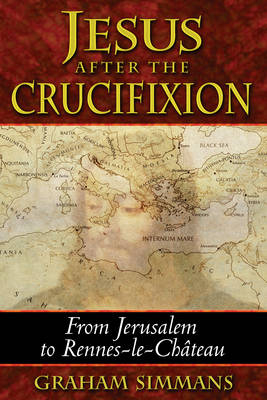
Jesus after the Crucifixion (eBook)
328 Seiten
Inner Traditions/Bear & Company (Verlag)
978-1-59143-910-3 (ISBN)
Suggests that Jesus survived the crucifixion, went to Egypt, then settled in France *; Reveals new discoveries that show the beginnings of Christianity in Egypt *; Presents historical and archaeological research that proves a connection between Jerusalem, Egypt, and Rennes-le-Chteau in the south of France *; Posits Rennes-le-Chteau as the actual location of Jesus Christ's tomb, and that writings by him will be found there Jesus did not die on the cross. He survived and went to southern France with his wife, Mary. This possibility is proposed by Graham Simmans, who spent many years on a quest to find the real beginnings of Christianity. Simmans believes that the spread of Christianity beyond Jerusalem was tied to Jesus's survival of the crucifixion and his subsequent emigration to Europe. Using Coptic and Jewish sources, including the Talmud, that allow a glimpse of the Christian philosophy espoused by Jesus, he contends that true Christianity was brought into France, Britain, and Spain from first century Egypt and Judea, not fourth- and fifth-century Rome. His investigation shows that after a time in Egypt, Jesus settled in Rennes-le-Chteau, a sophisticated and cosmopolitan center of spiritual diversity. It was a natural move for Jesus to settle in the Narbonne area of France--an area already heavily settled by Jewish and Gnostic groups. Here, safely outside the reach of the cultural dictatorship of the Roman Church, the Gnostic secrets he taught survived the centuries. Later, the Knights Templar centered their activity in the Languedoc region around Rennes-le-Chteau, where, within the Jewish communities, a well-connected and influential opposition to Rome already existed. This resistance to Rome gave rise to a religious culture that included elements of Gnostic, Pythagorean, and Kabbalistic teachings. Until the Crusades against the Cathar heretics reasserted the dominion of Rome, the culture that flourished around Rennes-le-Chteau embodied the true essence of Christ's message.
| Erscheint lt. Verlag | 21.2.2007 |
|---|---|
| Sprache | englisch |
| Themenwelt | Sachbuch/Ratgeber ► Gesundheit / Leben / Psychologie ► Esoterik / Spiritualität |
| Geschichte ► Teilgebiete der Geschichte ► Religionsgeschichte | |
| Religion / Theologie ► Christentum ► Kirchengeschichte | |
| ISBN-10 | 1-59143-910-8 / 1591439108 |
| ISBN-13 | 978-1-59143-910-3 / 9781591439103 |
| Informationen gemäß Produktsicherheitsverordnung (GPSR) | |
| Haben Sie eine Frage zum Produkt? |
 EPUB (Adobe DRM)
Kopierschutz: Adobe-DRM
Adobe-DRM ist ein Kopierschutz, der das eBook vor Mißbrauch schützen soll. Dabei wird das eBook bereits beim Download auf Ihre persönliche Adobe-ID autorisiert. Lesen können Sie das eBook dann nur auf den Geräten, welche ebenfalls auf Ihre Adobe-ID registriert sind.
Details zum Adobe-DRM
Dateiformat: EPUB (Electronic Publication)
EPUB ist ein offener Standard für eBooks und eignet sich besonders zur Darstellung von Belletristik und Sachbüchern. Der Fließtext wird dynamisch an die Display- und Schriftgröße angepasst. Auch für mobile Lesegeräte ist EPUB daher gut geeignet.
Systemvoraussetzungen:
PC/Mac: Mit einem PC oder Mac können Sie dieses eBook lesen. Sie benötigen eine
eReader: Dieses eBook kann mit (fast) allen eBook-Readern gelesen werden. Mit dem amazon-Kindle ist es aber nicht kompatibel.
Smartphone/Tablet: Egal ob Apple oder Android, dieses eBook können Sie lesen. Sie benötigen eine
Geräteliste und zusätzliche Hinweise
Buying eBooks from abroad
For tax law reasons we can sell eBooks just within Germany and Switzerland. Regrettably we cannot fulfill eBook-orders from other countries.


