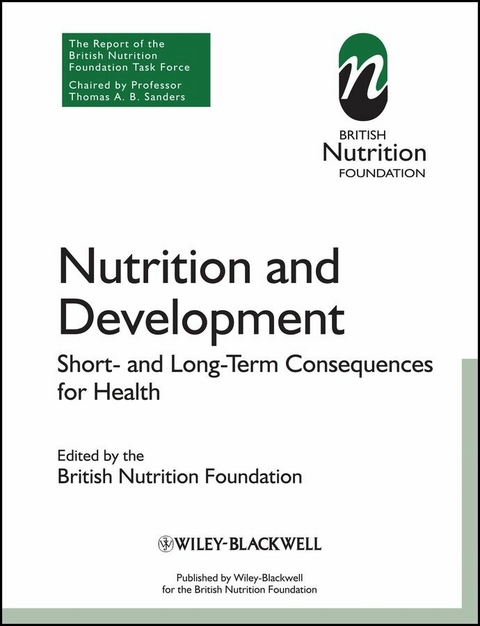
Nutrition and Development (eBook)
John Wiley & Sons (Verlag)
978-1-118-54123-4 (ISBN)
This Task Force report reviews the evidence that the seeds of many adult diseases are sown in utero and in infancy. The report, written by experts in the field, summarises current knowledge in this area. It illustrates how early life nutrition can bring about changes in organ development and function, thus programming risk of disease in adult life. It also considers what might be done in early life to reduce the burden of future ill health.
Nutrition and Development: Short- and Long-Term Consequences for Health includes chapters on the history of this topic area, normal growth and development, and current recommendations and practice in relation to nutrition and diet in early life. Chapters exploring the possible mechanisms and pathways of critical windows for development cover the effects of diet and nutrition in early life on organ and skeletal development, the role of sex hormones in programming disease susceptibility, the establishment of gastrointestinal microbiota, and the impact of early life nutrition on cognitive and neurological development.
This new report:
• describes how development occurs and explores how changes in the fetal and postnatal environment, such as over- or under-nutrition, can result in permanent alterations in function;
• explains how diet and nutrition in early life can affect risk of adult disease, with specific chapters on allergic disease and asthma, bone health, cancer, cardiovascular disease, cognitive function, diabetes and obesity;
• includes a summary of the key points, as well as recommendations in each chapter to help fill the gaps in our knowledge;
• provides an overview of the main messages in a practical question and answer format suitable for lay readers.
Nutrition and Development is an important information resource for those involved in research and teaching in the health sciences sector and is also of value to those involved in making decisions about health policy. It will be of interest to a broad range of health professionals, the food industry and those who write and broadcast about the effects of food on health.
The British Nutrition Foundation is a registered charity. It promotes the wellbeing of society through the impartial interpretation and effective dissemination of scientifically based knowledge and advice on the relationship between diet, physical activity and health.
This Task Force report reviews the evidence that the seeds of many adult diseases are sown in utero and in infancy. The report, written by experts in the field, summarises current knowledge in this area. It illustrates how early life nutrition can bring about changes in organ development and function, thus programming risk of disease in adult life. It also considers what might be done in early life to reduce the burden of future ill health. Nutrition and Development: Short- and Long-Term Consequences for Health includes chapters on the history of this topic area, normal growth and development, and current recommendations and practice in relation to nutrition and diet in early life. Chapters exploring the possible mechanisms and pathways of critical windows for development cover the effects of diet and nutrition in early life on organ and skeletal development, the role of sex hormones in programming disease susceptibility, the establishment of gastrointestinal microbiota, and the impact of early life nutrition on cognitive and neurological development. This new report: describes how development occurs and explores how changes in the fetal and postnatal environment, such as over- or under-nutrition, can result in permanent alterations in function; explains how diet and nutrition in early life can affect risk of adult disease, with specific chapters on allergic disease and asthma, bone health, cancer, cardiovascular disease, cognitive function, diabetes and obesity; includes a summary of the key points, as well as recommendations in each chapter to help fill the gaps in our knowledge; provides an overview of the main messages in a practical question and answer format suitable for lay readers. Nutrition and Development is an important information resource for those involved in research and teaching in the health sciences sector and is also of value to those involved in making decisions about health policy. It will be of interest to a broad range of health professionals, the food industry and those who write and broadcast about the effects of food on health.
The British Nutrition Foundation is a registered charity. It promotes the wellbeing of society through the impartial interpretation and effective dissemination of scientifically based knowledge and advice on the relationship between diet, physical activity and health.
Cover 1
Title page 5
Copyright page 6
Contents 7
Foreword 17
Terms of Reference 18
British Nutrition Foundation Nutrition and Development: Short- and Long-Term Consequences for Health Task Force Membership 19
1: Introduction to Early Life and Later Disease 23
1.1 Environmental influences on development 23
1.1.1 Nutrition and the early environment 23
1.1.2 Variations in growth and development 24
1.2 Links between early life and adult disease 25
1.2.1 Animal studies 25
1.2.2 Evidence from human populations 25
1.2.3 The interaction of fetal and postnatal experience and adult disease 27
1.2.4 Vulnerability to stressors acting in adult life 28
1.3 Biological mechanisms 29
1.3.1 Fetal programming 29
1.3.2 Developmental plasticity 30
1.4 Nutrition of mothers and children 30
1.4.1 Observational studies of maternal diet 31
1.4.2 Supplementation studies 31
1.4.3 Maternal body composition 32
1.4.4 Postnatal nutrition 32
1.5 Nutrition of young women today 33
1.6 Key points 33
1.7 Key references 34
2: Normal Growth and Development 35
2.1 Introduction 35
2.2 Prenatal development 35
2.2.1 Embryonic period 35
2.2.2 The placenta 38
2.3 Embryo development 38
2.4 Fetal development 38
2.4.1 Normal fetal growth 38
2.4.2 Vulnerable periods: ‘critical windows’ 39
2.4.3 Mobilisation of maternal stores to protect the fetus 39
2.4.4 Placental glucose transport 39
2.5 Fetal development overview 40
2.5.1 The heart 40
2.5.2 Brain development 40
2.5.3 The lungs 40
2.5.4 Bone 41
2.5.5 Muscle 42
2.5.6 The liver 42
2.5.7 The pancreas 42
2.5.8 The kidneys 43
2.5.9 Haematopoietic tissue 43
2.5.10 Adipose tissue 43
2.5.11 Sex hormone development 43
2.5.12 Immune system development 44
2.6 Birthweight 44
2.7 Postnatal growth and development 46
2.8 Growth monitoring (growth charts) 46
2.9 Secular growth trends 47
2.9.1 Secular change in birthweight 47
2.9.2 Secular change in height 47
2.10 Canalisation, catch-up and catch-down growth 47
2.11 Key points 48
2.12 Recommendations for future research 49
2.13 Key references 49
3: Maternal Nutrition and Infant Feeding: Current Practice and Recommendations 50
3.1 Introduction 50
3.2 Characteristics of pregnant women in the UK 50
3.2.1 Changing age profile of mothers 50
3.2.2 Birth spacing 53
3.2.3 Ethnic minority groups 54
3.3 Current practice and recommendations: pre-pregnancy 54
3.3.1 The importance of pre-pregnancy nutrient status and weight 54
3.3.2 Recommendations for pre-pregnancy 55
3.3.3 Current dietary practices among women prior to pregnancy 56
3.4 Current practice and recommendations: during pregnancy 57
3.4.1 Recommendations for pregnancy 57
3.4.2 Current practice during pregnancy 61
3.5 Current practice and recommendations: lactation 63
3.5.1 Recommendations for lactation 63
3.5.2 Current practice during lactation 63
3.6 Infant feeding: issues relating to evidence base 64
3.7 Current practice and recommendations: breastfeeding 65
3.7.1 Benefits of breastfeeding 65
3.7.2 Recommendations for breastfeeding: historical perspective and evidence base 65
3.7.3 Breastfeeding: current practice 67
3.8 Current practice and recommendations: formula feeding 72
3.8.1 Composition of infant formulas 72
3.8.2 Feeding infant formula 74
3.8.3 Formula feeding: current practice 75
3.9 Current practice and recommendations: weaning/complementary feeding 75
3.9.1 Recommendations: timing of introduction of complementary foods 75
3.9.2 Current practice of timing of introduction of complementary foods 77
3.9.3 Development of taste preferences and the importance of texture 80
3.9.4 Baby-led weaning 81
3.9.5 Recommendations: specific food types 82
3.9.6 Recommendations: important nutrients to include in the weaning diet 83
3.9.7 Current practice: types of food/drink introduced 84
3.9.8 Vegetarian diets 87
3.9.9 Vegan diets 88
3.9.10 Foods to avoid during introduction of solids 88
3.9.11 Current practice: foods avoided during introduction of solids 88
3.10 Allergy 89
3.10.1 Development of allergies 89
3.10.2 Peanut allergy 89
3.10.3 Coeliac disease 89
3.10.4 Cows’ milk protein allergy 90
3.11 Conclusions 90
3.12 Key points 91
3.13 Recommendations for future research 92
3.14 Key references 92
4: Mechanisms and Pathways of Critical Windows of Development 97
4.1 Introduction 97
4.2 Embryo stages 97
4.3 Development of placenta 97
4.4 Nutritional programming: the effect of nutrition on fetal development 99
4.4.1 Severe effects of micronutrient deprivation in pregnancy 99
4.4.2 The effect of famine on fetal development 100
4.4.3 Experimental models for the study of poor nutrition on fetal development 102
4.5 Potential mechanisms of nutritional programming 102
4.5.1 Disruption of organ development 103
4.5.2 Disruption of the endocrine environment 103
4.5.3 Epigenetics 105
4.5.4 Telomere length 106
4.5.5 The gatekeeper hypothesis 106
4.6 Conclusions 106
4.7 Key points 107
4.8 Recommendations for future research 107
4.9 Key references 107
5: Perinatal Effects of Sex Hormones in Programming of Susceptibility to Disease 108
5.1 Introduction 108
5.2 Timing of masculinisation and its body-wide effects 108
5.3 Disorders of masculinisation 109
5.4 Male–female differences in disease risk: the potential role of perinatal androgens 110
5.5 Fetal growth, susceptibility to intrauterine growth restriction and its long-term consequences, including timing of puberty 110
5.6 Growth hormone–insulin-like growth factor-I axis 112
5.7 Brain and behavioural effects 112
5.8 Sex differences in eating disorders, neuronal mechanisms and adipose tissue distribution 112
5.8.1 Eating disorders 112
5.8.2 Kisspeptin system 113
5.8.3 Dietary preferences 113
5.8.4 Body fat distribution 113
5.9 Cardiovascular disease/hypertension 114
5.10 Kidney disease/hypertension 114
5.11 The immune system 115
5.12 Lung development and disease risk 115
5.13 Effects of maternal diet/obesity and infant feeding choices 115
5.14 ‘Fetal programming’ and epigenetic mechanisms 117
5.15 Conclusions 117
5.16 Key points 117
5.17 Recommendations for future research 118
5.18 Key references 118
6: Neurological Development 119
6.1 Introduction 119
6.1.1 The vulnerability of the developing brain 119
6.1.2 Mechanistic studies in animal models 119
6.1.3 Levels of nutritional effect 120
6.1.4 Environments 120
6.2 The developing brain 121
6.2.1 Timing 121
6.2.2 Human brain development 121
6.2.3 Pregnancy outcome 122
6.3 Brain energy balance circuits and peripheral feedback signals 123
6.3.1 Background 123
6.3.2 Structures and development 123
6.3.3 Hormonal feedback 126
6.4 Nutritional influences on the developing brain 128
6.4.1 Risk factors 128
6.4.2 Global over-nutrition 129
6.4.3 Global under-nutrition 130
6.4.4 Micronutrient deficiency 131
6.4.5 Long-chain fatty acid deficiency 132
6.5 Programming mechanisms 132
6.5.1 Glucocorticoids 132
6.5.2 Epigenetics 133
6.6 Nutritional interventions 134
6.7 Conclusions 135
6.8 Key points 136
6.9 Recommendations for future research 137
6.10 Key references 137
7: Establishing of Gut Microbiota and Bacterial Colonisation of the Gut in Early Life 138
7.1 Introduction 138
7.1.1 Investigating gut microbiota 138
7.1.2 Human gut microbiota 139
7.2 Acquisition of the gut microbiota 139
7.3 Factors affecting the infant gut microbiota (acquisition and development) 140
7.3.1 Gestational age 140
7.3.2 Mode of delivery 141
7.3.3 Host genetics 141
7.3.4 Geography and/or lifestyles 141
7.3.5 Diet 142
7.4 The gut microbiota of exclusively milk-fed infants 142
7.5 The effects of weaning on the infant gut microbiota 145
7.6 Potential long-term effects: implications for obesity 150
7.7 Conclusions 150
7.8 Key points 150
7.9 Recommendations for future research 151
7.10 Key references 151
8: Nutrition and Development: Obesity 152
8.1 Introduction 152
8.2 Inadequate in utero nutrition: a risk factor for obesity in later life? 152
8.2.1 Evidence from human population studies 152
8.2.2 Early postnatal ‘catch-up’ growth and obesity risk 153
8.2.3 Exposure to famine during gestation 154
8.3 Breastfeeding and risk of obesity in later life 154
8.4 Maternal diabetes and obesity: early life determinants of offspring obesity? 154
8.4.1 Association of higher birthweight with offspring adiposity 155
8.4.2 Maternal diabetes 155
8.4.3 Maternal obesity: a determinant of offspring obesity? 156
8.4.4 Gestational weight gain and offspring adiposity 157
8.5 Interventions to reduce offspring obesity? 157
8.5.1 Reducing low birthweight 157
8.5.2 Reducing infant postnatal weight gain 157
8.5.3 Formula feed composition 158
8.6 Interventions in pregnant diabetic women 158
8.7 Interventions in obese pregnant women 159
8.7.1 Other modifiable factors which may contribute to offspring obesity 159
8.8 Mechanisms underlying the early life origins of obesity role of animal studies
8.8.1 Maternal under-nutrition 160
8.8.2 Maternal diabetes 160
8.8.3 Maternal obesity 161
8.8.4 Neonatal overfeeding 161
8.9 A central role for disturbance in pathways of appetite regulation 161
8.9.1 Fetal and neonatal hyperinsulinaemia 161
8.9.2 Fetal and neonatal hyperleptinaemia 162
8.9.3 Maternal obesity 162
8.9.4 Cellular pathways of energy metabolism 162
8.9.5 Mechanisms underlying persistent modification of gene expression 162
8.10 Conclusions 163
8.11 Key points 163
8.12 Recommendations for future research 164
8.13 Key references 164
9: Nutrition and Development: Type 2 Diabetes 165
9.1 Introduction 165
9.2 Relationships between birthweight and type 2 diabetes 166
9.2.1 Low birthweight and type 2 diabetes 166
9.2.2 High birthweight and type 2 diabetes 166
9.3 Postnatal growth 166
9.4 Evidence for the role of early nutrition in humans influencing type 2 diabetes risk 167
9.4.1 During pregnancy 167
9.4.2 During lactation 167
9.5 Evidence for the role of early nutrition in animal models influencing type 2 diabetes risk 167
9.5.1 Models of under-nutrition 167
9.5.2 Models of over-nutrition 168
9.5.3 Underlying mechanisms 169
9.6 Conclusions 170
9.7 Key points 170
9.8 Recommendations for future research 171
9.9 Key references 171
10: Nutrition and Development: Cardiovascular Disease 172
10.1 Introduction 172
10.2 Evidence-based on clinical endpoints 173
10.3 Postnatal growth 174
10.4 Programming of atherosclerosis 175
10.5 Programming of blood pressure 179
10.6 Animal models of nutritional manipulation in early life 180
10.6.1 Mechanisms of hypertension in animal models of under-nutrition 181
10.6.2 Cardiovascular dysfunction in animal models of over-nutrition 182
10.6.3 Developmental programming of cardiac function 183
10.7 Conclusions 184
10.8 Key points 184
10.9 Recommendations for future research 184
10.10 Key references 185
11: Nutrition and Development: Cancer 186
11.1 Cancer incidence and trends 186
11.2 Cancer biology 187
11.3 Evidence linking early nutrition to cancer 188
11.3.1 Interventions 188
11.3.2 Breast versus bottle feeding 189
11.3.3 Famine 189
11.3.4 Birth anthropometry 189
11.3.5 Childhood anthropometry and growth 190
11.3.6 Adult stature and body composition 190
11.4 Possible mechanisms linking early nutrition to cancer risk 190
11.4.1 Genotype 190
11.4.2 Epigenotype 192
11.4.3 Phenotype 194
11.5 Conclusions 196
11.6 Key points 197
11.7 Recommendations for future research 197
11.8 Key references 198
12: Nutrition and Development: Bone Health 199
12.1 Early life origins of osteoporosis 199
12.1.1 Osteoporosis epidemiology 199
12.1.2 Normal development of bone size and volumetric density 199
12.1.3 Tracking of growth 200
12.1.4 Peak bone mass and risk of fracture 202
12.1.5 Early influences on bone development 202
12.2 Maternal nutrition in pregnancy 202
12.2.1 The role of maternal vitamin D 202
12.2.2 Vitamin D intervention studies in pregnancy 203
12.2.3 Safety of vitamin D supplementation in pregnancy 204
12.2.4 Calcium nutrition in pregnancy 205
12.2.5 Polyunsaturated fatty acids and bone metabolism 206
12.3 Postnatal calcium and vitamin D nutrition 206
12.3.1 Calcium nutrition in infancy 206
12.3.2 Vitamin D nutrition in infancy 207
12.4 Calcium and vitamin D nutrition in older children 208
12.5 Vitamin D: problems with defining normality 208
12.6 Physical activity and bone health in childhood 210
12.7 Conclusions 211
12.8 Key points 211
12.9 Recommendations for future research 212
12.10 Key references 212
13: Nutrition and Development: Asthma and Allergic Disease 213
13.1 Introduction 213
13.2 Pathogenesis 213
13.3 Increasing prevalence of asthma and allergic disease 215
13.4 Impact of asthma and allergic disease 215
13.5 Importance of antenatal and early life influences on asthma and allergic disease 216
13.5.1 Birth anthropometry 216
13.5.2 Neonatal lung function and asthma 216
13.5.3 Neonatal immunology 217
13.6 Maternal dietary food allergen intake during pregnancy and breastfeeding 217
13.6.1 Fetal allergen exposure 218
13.6.2 Cord blood mononuclear cell responses and maternal exposure to allergen 218
13.6.3 Cord blood mononuclear cell responses and subsequent allergic disease 219
13.6.4 Observational and intervention studies of maternal diet during pregnancy and lactation 219
13.7 Breastfeeding and childhood atopic dermatitis and asthma 220
13.8 Infant dietary food allergen intake 220
13.9 Early life nutrient intake 221
13.9.1 Antioxidant hypothesis 221
13.9.2 Polyunsaturated fatty acids hypothesis 222
13.9.3 Vitamin D hypotheses 222
13.9.4 Maternal antioxidant status during pregnancy and childhood asthma and allergy 223
13.9.5 Early life polyunsaturated fatty acid status and childhood asthma and allergy 223
13.9.6 Early life vitamin D status and childhood asthma and allergy 224
13.9.7 Early life nutrient intake and childhood asthma and allergic disease 224
13.10 Obesity and childhood asthma and allergic disease 225
13.11 Conclusions 225
13.12 Key points 226
13.13 Recommendations for future research 226
13.14 Key references 227
14: Nutrition and Development: Early Nutrition, Mental Development and Mental Ageing 228
14.1 The importance of mental development and ageing 228
14.2 Maternal diet during pregnancy 229
14.3 Breastfeeding 231
14.3.1 Breastfeeding and cognitive development 231
14.3.2 Long-term cognitive effects of breastfeeding 232
14.3.3 Breastfeeding and cognitive development: a caveat 233
14.3.4 Infant feeding and the central nervous system 233
14.3.5 Breastfeeding and behavioural development 233
14.3.6 Optimal duration of breastfeeding 234
14.4 Post-weaning diet 234
14.4.1 Dietary patterns at the macro level 235
14.4.2 Iron status in childhood 235
14.4.3 Food intolerance and mental development: additives and preservatives 235
14.5 Conclusions 235
14.6 Key points 236
14.7 Recommendations for future research 237
14.8 Key references 237
15: Putting the Science into Practice: Public Health Implications 238
15.1 Introduction 238
15.1.1 Critical windows 238
15.1.2 Endocrine system development 239
15.1.3 Neurological development 239
15.1.4 Gut flora 240
15.2 Summary of the Task Force’s findings for various chronic conditions 240
15.2.1 Obesity 240
15.2.2 Type 2 diabetes 244
15.2.3 Cardiovascular disease 245
15.2.4 Cancer 246
15.2.5 Bone health 247
15.2.6 Allergic disease and asthma 248
15.2.7 Cognitive function/mental health and behaviour 249
15.3 Diet and lifestyle themes relevant to pregnancy and early life 250
15.3.1 Maternal body weight and energy balance 250
15.3.2 Macronutrients 251
15.3.3 Micronutrients 252
15.3.4 Alcohol 261
15.3.5 Caffeine 261
15.4 Diet and lifestyle themes relevant to early feeding and weaning 262
15.4.1 Breastfeeding and use of breast milk substitutes 262
15.4.2 Weaning onto a family diet 262
15.4.3 Catch-up growth and accelerated growth 263
15.5 Vulnerable groups 264
15.5.1 Women with poor diets 264
15.5.2 Pregnant adolescents 264
15.5.3 Ethnic minority groups 265
15.5.4 Lower socioeconomic groups 266
15.5.5 Smokers 266
15.5.6 Obese women 267
15.6 Diet and lifestyle recommendations 267
15.7 Role of health professionals 269
15.8 Recommendations 272
15.8.1 Recommendations to policy makers 272
15.8.2 Recommendations to health professionals and other educators 274
15.8.3 Recommendations to the food industry 276
15.8.4 Recommendations to researchers and funders 276
15.9 Key points 276
15.10 Key references 277
16: Conclusions of the Task Force 278
16.1 Chapter 1 279
16.2 Chapter 2 279
16.3 Chapter 3 280
16.4 Chapter 4 280
16.5 Chapter 5 281
16.6 Chapter 6 281
16.7 Chapter 7 282
16.8 Chapter 8 282
16.9 Chapter 9 282
16.10 Chapter 10 283
16.11 Chapter 11 283
16.12 Chapter 12 283
16.13 Chapter 13 284
16.14 Chapter 14 284
16.15 Chapter 15 285
17: Recommendations of the Task Force 287
17.1 Priorities for future research on current practice in relation to early life development 287
17.2 Priorities for future research on mechanisms and pathways of early life development 287
17.2.1 Normal growth and development 287
17.2.2 Mechanisms and pathways of critical windows of development 288
17.2.3 Perinatal effects of sex hormones in programming of disease susceptibility 288
17.2.4 Cognitive and neurological development 288
17.2.5 Establishing gut microbiota and bacterial colonisation of the gut in early life 288
17.3 Priorities for future research: specific diseases 289
17.3.1 Obesity 289
17.3.2 Diabetes 289
17.3.3 Cardiovascular disease 289
17.3.4 Cancer 289
17.3.5 Bone health 290
17.3.6 Allergic disease and asthma 290
17.3.7 Cognitive function 290
17.4 Recommendations to key stakeholders 290
17.4.1 Recommendations to policy makers 290
17.4.2 Recommendations to health professionals and other educators 292
17.4.3 Recommendations to the food industry 294
18: Nutrition and Development: Answers to Common Questions 295
18.1 Nutrition and development 295
Q1: How does nutrition during fetal life influence our long-term health? 295
Q2: At what age does nutrition begin to have an impact on health in later life? 295
18.2 Developmental programming hypotheses 295
Q1: What is developmental programming? 295
18.3 Normal growth 295
Q1: What is an ideal or optimal birthweight? 295
Q2: Has birthweight been increasing over the last few decades? 296
18.4 How development occurs and factors that can affect it 296
Q1: How much does the environment in which the fetus develops influence the growth of the fetus? 296
Q2: What is the role of the placenta? 296
Q3: At what stage of pregnancy do the organs begin their development? 296
Q4: Why are different organs affected differently in terms of growth and development at different stages in pregnancy? 296
Q5: How should pregnant women minimise the risk of fetal growth restriction during pregnancy? 297
18.5 Influences of perinatal sex hormone exposure on programming of disease susceptibility 297
Q1: At what stage of fetal development is sex determined? 297
Q2: How long does the process of masculinisation take? 297
Q3: If fetal androgens are so important for the future normality and general well-being of males, is there anything that a pregnant woman can do to ensure maximum androgen exposure for example, could she take androgens?
Q4: What role do hormones play in the development of chronic diseases where there are male–female differences in the risk of developing a particular disorder? 297
Q5: How does the sex of the fetus influence health in later life? 298
18.6 Cognitive and neurological development 298
Q1: When does the brain develop? 298
Q2: Can the mother’s diet make her offspring more intelligent? 298
18.7 Influences of gut microbiota on programming of disease susceptibility 298
Q1: Why is attaining a healthy gut flora (bacteria) important for health? 298
Q2: What are the major changes that occur in the gastrointestinal tract during birth and the first few years of life? 298
Q3: Are there differences in gut flora (bacteria) of breast-fed and formula-fed infants? 298
Q4: When do microbes first start to appear in the gastrointestinal tract? 299
Q5: What factors influence the numbers and diversity of bacteria present in the gastrointestinal tract of infants? 299
18.8 Obesity 299
Q1: How does what your mother eats during pregnancy influence your risk of obesity as an adult? 299
Q2: Does breastfeeding reduce the risk of the infant being overweight or obese later in life? 299
Q3: Is a child with a higher than average birthweight more likely to be overweight or obese in later life? 299
Q4: Are babies of obese mothers more likely to be obese themselves in later life? 300
Q5: If babies are born with a low birthweight is it beneficial for them to ‘catch up’ rapidly in weight in the first year? 300
18.9 Diabetes 300
Q1: Why does nutrition during fetal life influence our risk of developing type 2 diabetes? 300
Q2: What can I do if I had a low birthweight to stop myself developing diabetes? 300
18.10 Cardiovascular disease 300
Q1: Is birthweight linked to risk of cardiovascular disease in later life? 300
Q2: If a mother has high blood cholesterol does this affect her offspring’s blood cholesterol as an adult? 301
Q3: If a mother has high blood pressure in pregnancy, does this affect the blood pressure of her offspring later in life? 301
Q4: Are bottle-fed babies at greater risk of cardiovascular disease than breast-fed babies? 301
Q5: Why are babies who are small at birth and who become overweight as adults more at risk of cardiovascular disease? 301
Q6: What effects does maternal obesity have on the offspring’s risk of cardiovascular disease? 301
Q7: Children are taller nowadays than previous generations does this affect their risk of cardiovascular disease?
18.11 Cancer 301
Q1: Is birthweight linked to risk of cancer in later life? 301
Q2: How might nutrition lead to increased risk of cancer? 301
Q3: Does breastfeeding influence the risk of cancer in later life? 302
18.12 Bone health 302
Q1: What is the recommended dose of vitamin D supplements for pregnant and breastfeeding women? 302
Q2: Should we screen for vitamin D deficiency in pregnancy and/or infancy? 302
Q3: What aspects of child nutrition and lifestyle might influence their bone health? 302
Q4: Is there evidence that breast-fed babies are less likely to suffer from osteoporosis than formula-fed babies? 303
18.13 Allergic diseases and asthma 303
Q1: Why is there an increasing number of people with asthma and allergic disease? 303
Q2: Can maternal diet influence the risk of the offspring having an allergy or asthma? 303
Q3: Should pregnant women avoid eating peanuts? 303
Q4: Should the introduction of potential food allergens be delayed during weaning? 303
18.14 Mental health and cognitive behaviour 304
Q1: What is the difference between mental health and cognitive behaviour? 304
Q2: How common are mental health problems? 304
Q3: What should pregnant women be eating to ensure their offspring receive adequate nutrition for their brain development? 304
Q4: Does being breast-fed improve cognitive function in childhood? 304
Q5: Does the infant’s diet influence mental health in later life? 304
18.15 Dietary and lifestyle advice for early life 304
Q1: What advice can be followed before becoming pregnant to enhance the health of offspring? 304
Q2: What nutrients do pregnant women often have low intakes of? 305
Q3: Is there any specific nutritional advice for particular groups of the population? 305
Q4: Should pregnant women ‘eat for two’? 306
Q5: How much physical activity should pregnant women do? 306
Q6: Which nutrients are important for women who are breastfeeding? 306
Q7: How much fluid do pregnant and lactating women need? 306
Q8: When is the best time to wean babies on to solid foods? 307
Q9: What nutrients are most important to include in the weaning and infant diet? 307
Q10: How much physical activity should infants and young children do? 307
18.16 Policies relating to early life nutrition and development 308
Q1: Are current policies adequately addressing the increasing levels of obesity in pregnancy? 308
Q2: Are current policies relating to breastfeeding and bottle feeding adequate? 308
Glossary 309
References 316
Index 364
| Erscheint lt. Verlag | 16.4.2013 |
|---|---|
| Reihe/Serie | British Nutrition Foundation | British Nutrition Foundation |
| Sprache | englisch |
| Themenwelt | Sachbuch/Ratgeber ► Gesundheit / Leben / Psychologie |
| Medizin / Pharmazie ► Allgemeines / Lexika | |
| Medizin / Pharmazie ► Gesundheitsfachberufe ► Diätassistenz / Ernährungsberatung | |
| Schlagworte | bacterial colonisation of the gut • bacterial colonization of the gut • BNF task force report series • British Nutrition Foundation • Cardiovascular Disease • critical windows of development • Ernährungslehre • Ernährungslehre • Gesundheit, Ernährung u. Diät • Gesundheit, Ernährung u. Diät • Gesundheits- u. Sozialwesen • Gut Microbiota • Health & Social Care • Health, Diet & Nutrition • Infant feeding • Maternal nutrition • mental ageing • mental aging • normal development • Normal growth • Nutrition • Obesity • postnatal bone health • type 2 diabetes |
| ISBN-10 | 1-118-54123-5 / 1118541235 |
| ISBN-13 | 978-1-118-54123-4 / 9781118541234 |
| Informationen gemäß Produktsicherheitsverordnung (GPSR) | |
| Haben Sie eine Frage zum Produkt? |
 PDF (Adobe DRM)
Kopierschutz: Adobe-DRM
Adobe-DRM ist ein Kopierschutz, der das eBook vor Mißbrauch schützen soll. Dabei wird das eBook bereits beim Download auf Ihre persönliche Adobe-ID autorisiert. Lesen können Sie das eBook dann nur auf den Geräten, welche ebenfalls auf Ihre Adobe-ID registriert sind.
Details zum Adobe-DRM
Dateiformat: PDF (Portable Document Format)
Mit einem festen Seitenlayout eignet sich die PDF besonders für Fachbücher mit Spalten, Tabellen und Abbildungen. Eine PDF kann auf fast allen Geräten angezeigt werden, ist aber für kleine Displays (Smartphone, eReader) nur eingeschränkt geeignet.
Systemvoraussetzungen:
PC/Mac: Mit einem PC oder Mac können Sie dieses eBook lesen. Sie benötigen eine
eReader: Dieses eBook kann mit (fast) allen eBook-Readern gelesen werden. Mit dem amazon-Kindle ist es aber nicht kompatibel.
Smartphone/Tablet: Egal ob Apple oder Android, dieses eBook können Sie lesen. Sie benötigen eine
Geräteliste und zusätzliche Hinweise
Buying eBooks from abroad
For tax law reasons we can sell eBooks just within Germany and Switzerland. Regrettably we cannot fulfill eBook-orders from other countries.
aus dem Bereich