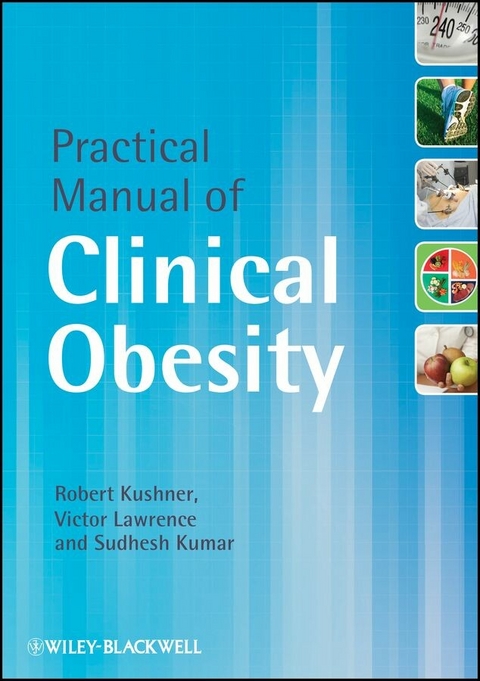
Practical Manual of Clinical Obesity (eBook)
John Wiley & Sons (Verlag)
978-1-118-64356-3 (ISBN)
Practical Manual of Clinical Obesity provides practical, accessible and expert advice on the clinical diagnosis and management of obesity and will be your perfect go-to tool in the management of your patients.
Information is clear, didactic and attractively presented, with every chapter containing plenty of engaging text features such as key points, pitfall boxes, management flowcharts and case studies to enable a rapid
understanding of obesity diagnosis and management. Key clinical trials and major international society guidelines are referred to throughout.
Topics covered include:
• Assessment of the patient, including patient history, examination and investigations
• Patterns, risks and benefits of weight loss
• Evaluation of management options: diet, exercise, drugs, psychological treatments, and surgery
• Management of obesity related co-morbidities
Practical Manual of Clinical Obesity is ideal reading for endocrinologists of all levels, as well as all other health professionals who manage obese patients such as specialist nurses, dieticians, and GP's with an interest in obesity management.
Robert Kushner, Professor of Medicine, Northwestern University Feinberg
School of Medicine, Chicago, USA
Victor Lawrence, Consultant Physician, Endocrinology and Diabetes,
St Mary's Hospital, Newport, Isle of Wight, UK
Sudhesh Kumar, Professor of Medicine, Warwick Medical School,
University of Warwick, UK
Practical Manual of Clinical Obesity provides practical, accessible and expert advice on the clinical diagnosis and management of obesity and will be your perfect go-to tool in the management of your patients. Information is clear, didactic and attractively presented, with every chapter containing plenty of engaging text features such as key points, pitfall boxes, management flowcharts and case studies to enable a rapid understanding of obesity diagnosis and management. Key clinical trials and major international society guidelines are referred to throughout. Topics covered include: Assessment of the patient, including patient history, examination and investigations Patterns, risks and benefits of weight loss Evaluation of management options: diet, exercise, drugs, psychological treatments, and surgery Management of obesity related co-morbidities Practical Manual of Clinical Obesity is ideal reading for endocrinologists of all levels, as well as all other health professionals who manage obese patients such as specialist nurses, dieticians, and GP s with an interest in obesity management.
Robert Kushner, Professor of Medicine, Northwestern University Feinberg School of Medicine, Chicago, USA Victor Lawrence, Consultant Physician, Endocrinology and Diabetes, St Mary's Hospital, Newport, Isle of Wight, UK Sudhesh Kumar, Professor of Medicine, Warwick Medical School, University of Warwick, UK
Practical Manual of Clinical Obesity 5
Copyright 6
Contents 7
Preface 9
Part I The Biology of Obesity—Why It Occurs 11
Chapter 1 Energy Balance and Body Weight Homeostasis 13
Introduction 14
Basic concepts and principles in human energetics 15
Components of energy expenditure 16
Mechanisms of thermogenesis 19
Inter-individual variability in metabolic adaptation 19
Key web links 21
Further reading 21
Chapter 2 The Genetic Basis of Obesity 23
Introduction 25
Evidence for the heritability of fat mass 25
Gene–environment interactions 26
Molecular mechanisms involved in energy homeostasis 27
Human monogenic obesity syndromes 28
Fat mass and obesity-associated gene (FTO) 30
Pleiotropic (“syndromic”) obesity 31
Summary 31
Key web links 33
Further reading 33
Chapter 3 Adipocyte Biology 35
Introduction 36
TAG storage and release 37
Secretory function of WAT 38
Brown adipose tissue (BAT) 40
Conclusion 41
Key web links 42
Further reading 42
Chapter 4 Fetal and Infant Origins of Obesity 43
Introduction 44
Measurement 45
Conceptual framework of early origins of obesity 45
Modifiable developmental disease determinants 46
Summary 47
Key web links 49
Further reading 49
Chapter 5 Metabolic Fuels and Obesity 51
Introduction 53
Physiological conditions in weight-stable individuals 53
Exercise 57
Summary 57
Key web links 58
Further reading 58
Part 2 Clinical Management of the Obese Individual 61
Chapter 6 Practical Guide to Clinical Assessment and Treatment Planning 63
Setting up a clinic 64
Broaching the topic of obesity 65
Taking an obesity-focused history 65
Physical examination of the obese patient 67
Identifying the high-risk obese patient 71
Key web links 71
Further reading 72
Chapter 7 Stages of Obesity and Weight Maintenance 73
Stages of obesity 74
Factors affecting weight loss maintenance 76
The successful weight maintainer 77
Further reading 79
Chapter 8 Dietary Management 81
Specific strategies to help patients reduce calories 85
Key web links 88
Further reading 89
Chapter 9 Physical Activity and Exercise 91
Exercise and weight reduction 92
Exercise and obesity-related CVD 92
Key web links 98
Reference 99
Further reading 99
Chapter 10 Behavior Therapy 101
Principles of behavior therapy 102
Components of behavioral treatment 103
Key web links 106
Further reading 107
Chapter 11 Pharmacotherapy 109
The legacy of anti-obesity medications 110
Drugs that reduce food intake primarily by acting on the CNS 111
Drugs that reduce fat absorption 115
Weight-gaining medications 116
Key web links 117
Further reading 117
Chapter 12 Surgery 119
Weight loss procedures 120
Weight loss and complications 123
Effect on co-morbid conditions 124
Changes in QOL after bariatric surgery 126
Patient selection and pre-operative management 126
Post-operative management 126
Key web links 128
References 128
Further reading 128
Part 3 Clinical Management of Obesity-Related Co-morbidities 131
Chapter 13 Diabetes and Metabolic Diseases 133
Principles guiding management 134
Management algorithm 138
Key web links 140
References 141
Further reading 141
Chapter 14 Obesity and Reproductive Health 143
Obesity and reproductive health 144
Managing PCOS 146
Obesity and assisted reproduction therapy (ART) 146
Managing the pregnant obese woman 146
Key societies 149
Key web links 149
Further reading 149
Chapter 15 Gastro-intestinal and Hepatobiliary Disease 151
Non-alcoholic fatty liver disease (NAFLD) 152
Gallbladder disease 155
Gastritis and GERD 156
Other GI disorders 157
Key web links 157
Further reading 158
Chapter 16 Respiratory Disease 159
Obesity and lung function 160
Common respiratory diseases associated with obesity 160
Obstructive sleep apnea (OSA) 161
Obesity hypoventilation syndrome (OHS) 164
Management algorithm for OSA 164
Key web links 166
Further reading 166
Chapter 17 Obesity and Cardiovascular Disease 167
Introduction 168
Obesity and CVD risk 169
Physical fitness and cardiovascular risk in obesity 170
Obesity and hypertension 171
Obesity and stroke 171
Obesity and CHF 172
Obesity and sudden death 172
Management of cardiovascular risk in obesity 173
Key web links 175
Reference 175
Further reading 175
Chapter 18 Obesity: Mental Health and Social Consequences 177
Principles for management 178
Obesity and mental illness 179
Obesity and major psychiatric diseases 182
Obesity and mental well-being in children 182
Management 183
Key web link 184
Further reading 184
Chapter 19 Obesity and Musculo-skeletal Disease 185
Obesity and musculo-skeletal disease 186
Obesity and osteoarthritis 187
Obesity and gout 187
Obesity and low back pain 188
Management algorithms 188
Key web link 190
Further reading 190
Chapter 20 The Obese Patient in Hospital 191
Specialist equipment for the morbidly obese 192
Emergency care 194
Managing the severely obese in hospital 194
Key web links 195
Further reading 195
Conversion Table 197
Index 199
"Written by experts in the field of obesity, this book covers an
extremely important topic and all clinicians would benefit from
reading it. Many health conditions can be linked to obesity, and
many diseases are worsened by obesity. Teaching medical
students, residents, and clinicians to treat and manage obesity is
essential to the health of the world."
(Doody's, 25 April 2014)
| Erscheint lt. Verlag | 1.4.2013 |
|---|---|
| Sprache | englisch |
| Themenwelt | Sachbuch/Ratgeber ► Gesundheit / Leben / Psychologie |
| Medizin / Pharmazie ► Gesundheitsfachberufe | |
| Medizinische Fachgebiete ► Innere Medizin ► Endokrinologie | |
| Studium ► 1. Studienabschnitt (Vorklinik) ► Biochemie / Molekularbiologie | |
| Schlagworte | accessible • Adipositas • Allg. Public Health • clear • Clinical • Clinical Diagnosis • containing plenty • endocrinology • Endokrinologie • engaging • every • Expert • features • Fettleibigkeit • Gesundheits- u. Sozialwesen • Goto • Health & Social Care • Information • Key • Medical Science • Medizin • Obesity • perfect • Points • practical manual • provides • Public Health General • Rapid • Studies • Tool |
| ISBN-10 | 1-118-64356-9 / 1118643569 |
| ISBN-13 | 978-1-118-64356-3 / 9781118643563 |
| Informationen gemäß Produktsicherheitsverordnung (GPSR) | |
| Haben Sie eine Frage zum Produkt? |
 PDF (Adobe DRM)
Kopierschutz: Adobe-DRM
Adobe-DRM ist ein Kopierschutz, der das eBook vor Mißbrauch schützen soll. Dabei wird das eBook bereits beim Download auf Ihre persönliche Adobe-ID autorisiert. Lesen können Sie das eBook dann nur auf den Geräten, welche ebenfalls auf Ihre Adobe-ID registriert sind.
Details zum Adobe-DRM
Dateiformat: PDF (Portable Document Format)
Mit einem festen Seitenlayout eignet sich die PDF besonders für Fachbücher mit Spalten, Tabellen und Abbildungen. Eine PDF kann auf fast allen Geräten angezeigt werden, ist aber für kleine Displays (Smartphone, eReader) nur eingeschränkt geeignet.
Systemvoraussetzungen:
PC/Mac: Mit einem PC oder Mac können Sie dieses eBook lesen. Sie benötigen eine
eReader: Dieses eBook kann mit (fast) allen eBook-Readern gelesen werden. Mit dem amazon-Kindle ist es aber nicht kompatibel.
Smartphone/Tablet: Egal ob Apple oder Android, dieses eBook können Sie lesen. Sie benötigen eine
Geräteliste und zusätzliche Hinweise
Buying eBooks from abroad
For tax law reasons we can sell eBooks just within Germany and Switzerland. Regrettably we cannot fulfill eBook-orders from other countries.
aus dem Bereich