Zum Hauptinhalt springen
Nicht aus der Schweiz? Besuchen Sie lehmanns.de
Vision Revolution -  Mark Changizi

Vision Revolution (eBook)

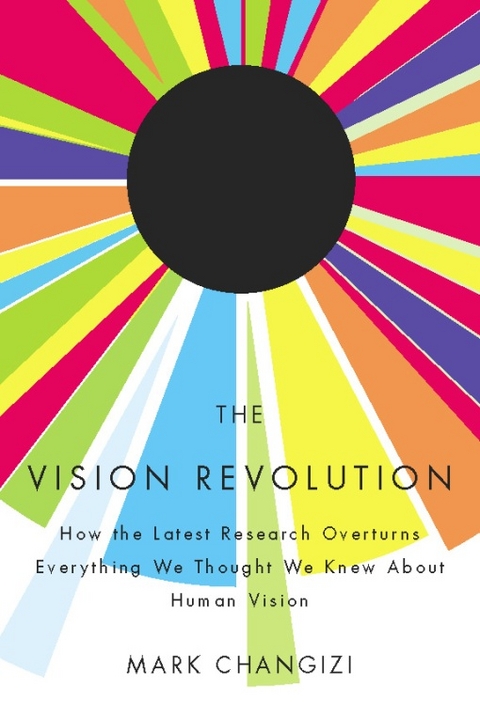
How the Latest Research Overturns Everything We Thought We Knew About Human Vision
eBook Download: EPUB
2010
240 Seiten
BenBella Books, Inc. (Verlag)
978-1-935251-21-7 (ISBN)
Systemvoraussetzungen
8,14 inkl. MwSt
(CHF 7,95)
Der eBook-Verkauf erfolgt durch die Lehmanns Media GmbH (Berlin) zum Preis in Euro inkl. MwSt.
  • Download sofort lieferbar
  • Zahlungsarten anzeigen
In The Vision Revolution: How the Latest Research Overturns Everything We Thought We Knew About Human Vision, Mark Changizi, prominent neuroscientist and vision expert, addresses four areas of human vision and provides explanations for why we have those particular abilities, complete with a number of full-color illustrations to demonstrate his conclusions and to engage the reader. Written for both the casual reader and the science buff hungry for new information, The Vision Revolution is a resource that dispels commonly believed perceptions about sight and offers answers drawn from the field's most recent research. Changizi focuses on four ';why"e; questions: 1. Why do we see in color? 2. Why do our eyes face forward? 3. Why do we see illusions? 4. Why does reading come so naturally to us? Why Do We See in Color? It was commonly believed that color vision evolved to help our primitive ancestors identify ripe fruit. Changizi says we should look closer to home: ourselves. Human color vision evolved to give us greater insights into the mental states and health of other people. People who can see color changes in skin have an advantage over their color-blind counterparts; they can see when people are blushing with embarrassment, purple-faced with exertion or the reddening of rashes. Changizi's research reveals that the cones in our eyes that allow us to see color are exquisitely designed exactly for seeing color changes in the skin. And it's no coincidence that the primates with color vision are the ones with bare spots on their faces and other body parts; Changizi shows that the development of color vision in higher primates closely parallels the loss of facial hair, culminating in the near hairlessness and highly developed color vision of humans. Why Do Our Eyes Face Forward? Forward-facing eyes set us apart from most mammals, and there is much dispute as to why we have them. While some speculate that we evolved this feature to give us depth perception available through stereo vision, this type of vision only allows us to see short distances, and we already have other mechanisms that help us to estimate distance. Changizi's research shows that with two forward-facing eyes, primates and humans have an x-ray ability. Specifically, we're able to see through the cluttered leaves of the forest environment in which we evolved. This feature helps primates see their targets in a crowded, encroached environment. To see how this works, hold a finger in front of your eyes. You'll find that you're able to look ';through"e; it, at what is beyond your finger. One of the most amazing feats of two forward-facing eyes? Our views aren't blocked by our noses, beaks, etc. Why Do We See Illusions? We evolved to see moving objects, not where they are, but where they are going to be. Without this ability, we couldn't catch a ball because the brain's ability to process visual information isn't fast enough to allow us to put our hands in the right place to intersect for a rapidly approaching baseball. ';If our brains simply created a perception of the way the world was at the time light hit the eye, then by the time that perception was elicitedwhich takes about a tenth of a second for the brain to dotime would have marched on, and the perception would be of the recent past,"e; Changizi explains. Simply put, illusions occur when our brain is tricked into thinking that a stationary two-dimensional picture has an element that is moving. Our brains project the ';moving"e; element into the future and, as a result, we don't see what's on the page, but what our brain thinks will be the case a fraction of a second into the future. Why Does Reading Come So Naturally to Us? We can read faster than we can hear, which is odd, considering that reading is relatively recent,
Erscheint lt. Verlag 8.6.2010
Sprache englisch
Themenwelt Sachbuch/Ratgeber Natur / Technik
Naturwissenschaften Biologie Evolution
ISBN-10 1-935251-21-X / 193525121X
ISBN-13 978-1-935251-21-7 / 9781935251217
Informationen gemäß Produktsicherheitsverordnung (GPSR)
Haben Sie eine Frage zum Produkt?
EPUBEPUB (Adobe DRM)

Kopierschutz: Adobe-DRM
Adobe-DRM ist ein Kopierschutz, der das eBook vor Mißbrauch schützen soll. Dabei wird das eBook bereits beim Download auf Ihre persönliche Adobe-ID autorisiert. Lesen können Sie das eBook dann nur auf den Geräten, welche ebenfalls auf Ihre Adobe-ID registriert sind.
Details zum Adobe-DRM

Dateiformat: EPUB (Electronic Publication)
EPUB ist ein offener Standard für eBooks und eignet sich besonders zur Darstellung von Belle­tristik und Sach­büchern. Der Fließ­text wird dynamisch an die Display- und Schrift­größe ange­passt. Auch für mobile Lese­geräte ist EPUB daher gut geeignet.

Systemvoraussetzungen:
PC/Mac: Mit einem PC oder Mac können Sie dieses eBook lesen. Sie benötigen eine Adobe-ID und die Software Adobe Digital Editions (kostenlos). Von der Benutzung der OverDrive Media Console raten wir Ihnen ab. Erfahrungsgemäß treten hier gehäuft Probleme mit dem Adobe DRM auf.
eReader: Dieses eBook kann mit (fast) allen eBook-Readern gelesen werden. Mit dem amazon-Kindle ist es aber nicht kompatibel.
Smartphone/Tablet: Egal ob Apple oder Android, dieses eBook können Sie lesen. Sie benötigen eine Adobe-ID sowie eine kostenlose App.
Geräteliste und zusätzliche Hinweise

Buying eBooks from abroad
For tax law reasons we can sell eBooks just within Germany and Switzerland. Regrettably we cannot fulfill eBook-orders from other countries.

Mehr entdecken
aus dem Bereich
Traits, Interactions, and Applications

von Michal Segoli; Eric Wajnberg

eBook Download (2024)
Wiley (Verlag)
CHF 84,95