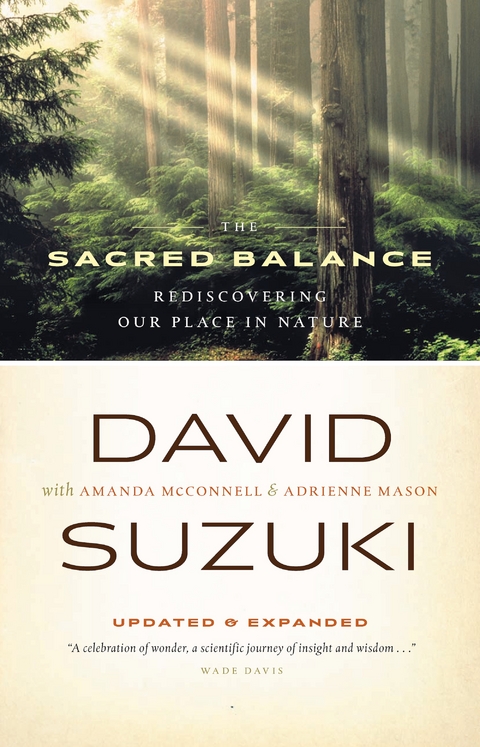
The Sacred Balance (eBook)
304 Seiten
Greystone Books (Verlag)
978-1-926685-49-6 (ISBN)
David Suzuki is an acclaimed geneticist and environmentalist, the host of The Nature of Things, and the founder and chair of the David Suzuki Foundation . He is the author of more than forty books, including Good News for a Change, From Naked Ape to Superspecies (both co-authored with Holly Dressel), The Sacred Balance (co-authored with Amanda McConnell and Adrienne Mason), and David Suzuki: The Autobiography. He is the recipient of the Unesco Kalinga Prize for Science, the United Nations Environmental Medal, the UNEP’s Global 500 award, and has been named a Companion of the Order of Canada. In addition, he holds eighteen honorary degrees and he has been adopted into three First Nations clans. Suzuki lives in Vancouver, British Columbia.Amanda McConnell has written more than 100 documentary films, many of them for The Nature of Things. She has a Ph.D. in English Literature, and she writes and gardens in Toronto, Ontario.Adrienne Mason has lived on Vancouver Island all her life and spent twenty years on the west coast, first in Bamfield and then Tofino. As well as writing a local history column for Tofino Time, she is the author of numerous books and magazine articles about science, nature, and west coast history. Her most recent titles include West Coast Adventures, The Green Classroom, and The Nature of Spiders. In the course of writing Long Beach: A Storied Stretch of Sand, Mason searched for cougar tracks with her children, found the remains of old trails and homesteads in the area, and spent many hours interviewing the people who arrived at Long Beach and never left.
Annotated with new materialChapter 1: Homo sapiens: Born of the Earth New information on brain plasticity. Updated information on total number of species on Earth and examples of how little we actually know when discussing life on Earth Addition of information on the Human Genome Project. Expansion of section on consumerism and the societal and environmental effects.Chapter 2: The Breath of All Green Things New section on how humans and other mammals cope in low-oxygen environments Revised section on how, 2.5 billion years ago, bacteria developed a way to capture light energy and convert it into energy/food photosynthesis New section on how atmospheric pollutants "jump" to regions far from their source (e.g., contamination of Arctic mammals, including humans, from pollutants that original thousands of kilometres away).Chapter 3: The Oceans Flowing through Our Veins New information on the idea of "Hypersea" proposed by Mark and Dianna McMenamin Addition of information on the influence of the Amazon Forest in driving world climate and weather patterns. Addition of information on water on other planets, including Mars, Saturn, and some Jovian moons. New section on the environmental consequences of bottled water.Chapter 4: Made from the Soil Update on the incredible diversity of life in the soilas many as one billion individual bacteria, split amongst 40,000 species, in a teaspoon of forest soil New section on life forms distinct from anything that has been discovered before. New section on the abundance and importance of fungi. Update of section on human agriculture. New section on the tragic desertification of the Aral Sea, which, up until the 1950s, was the world's fourth largest lake. New section: Feeding Ourselves Susatainably. Discusses the constraints of industrial agriculture and ways in which communities around the world are trying to reverse the effects through local sustainable agriculture projects.Chapter 5: The Divine Fire New section on medically-induced hypothermia and how it can help the body heal in certain situations, such as after brain injury or brain surgery. New section on animal thermoregulation. New section on preliminary experimentation creating fuel from photosynthesis (hydrogen gas). New sections on peak oil and climate change, including examples of how some communities are making positive changes to reduce greenhouse gas emissions.Chapter 6: Protected by Our Kin New section on gene transfer technology, and the risks of tinkering with lifeforms when our basic knowledge about how cells, organisms and ecosystems work is too limited to allow us to anticipate the repercussions of manipulating genes. New section on the "salmon forests" of the west coast of North America. A wonderful example that illustrates the interconnectedness of life. Update information on biodiversity of life as well as repercussions over rates of extinction.Chapter 7: The Law of Love New section on the chemistry of love; the changes our bodies go through when we give and receive love. New section on the power of touch, with examples of how humans and other animals can fail to thrive without the emotional nourishment of touch. Update to section, Lessons Learned from Tragedy, on how institutionalization as babies and toddlers affected Romanian orphans. New section on the social relationships of non-humans, particularly other primates. Updates to section on biophilia. Introduction to ecopsychology, and how reconnecting with others and the nature can help people heal.Chapter 8: Sacred Matter New section on consciousness and self-awareness in humans and other animal species. New section discussing ideas as to why we have religion.Chapter 9: Restoring the Balance Updating ideas for positive action, including the Suzuki Foundation's Nature Challenge. Update to section on The Natural Step, including examples of communities and companies adopting ideas from this philosophy. Update to information on Grameen Bank.
| Erscheint lt. Verlag | 1.5.2009 |
|---|---|
| Reihe/Serie | David Suzuki Institute |
| Co-Autor | Amanda McConnell, Adrienne Mason |
| Sprache | englisch |
| Themenwelt | Sachbuch/Ratgeber ► Natur / Technik |
| Naturwissenschaften ► Biologie ► Ökologie / Naturschutz | |
| Naturwissenschaften ► Geowissenschaften | |
| Technik | |
| ISBN-10 | 1-926685-49-0 / 1926685490 |
| ISBN-13 | 978-1-926685-49-6 / 9781926685496 |
| Informationen gemäß Produktsicherheitsverordnung (GPSR) | |
| Haben Sie eine Frage zum Produkt? |
 EPUB (Adobe DRM)
Kopierschutz: Adobe-DRM
Adobe-DRM ist ein Kopierschutz, der das eBook vor Mißbrauch schützen soll. Dabei wird das eBook bereits beim Download auf Ihre persönliche Adobe-ID autorisiert. Lesen können Sie das eBook dann nur auf den Geräten, welche ebenfalls auf Ihre Adobe-ID registriert sind.
Details zum Adobe-DRM
Dateiformat: EPUB (Electronic Publication)
EPUB ist ein offener Standard für eBooks und eignet sich besonders zur Darstellung von Belletristik und Sachbüchern. Der Fließtext wird dynamisch an die Display- und Schriftgröße angepasst. Auch für mobile Lesegeräte ist EPUB daher gut geeignet.
Systemvoraussetzungen:
PC/Mac: Mit einem PC oder Mac können Sie dieses eBook lesen. Sie benötigen eine
eReader: Dieses eBook kann mit (fast) allen eBook-Readern gelesen werden. Mit dem amazon-Kindle ist es aber nicht kompatibel.
Smartphone/Tablet: Egal ob Apple oder Android, dieses eBook können Sie lesen. Sie benötigen eine
Geräteliste und zusätzliche Hinweise
Buying eBooks from abroad
For tax law reasons we can sell eBooks just within Germany and Switzerland. Regrettably we cannot fulfill eBook-orders from other countries.
aus dem Bereich