


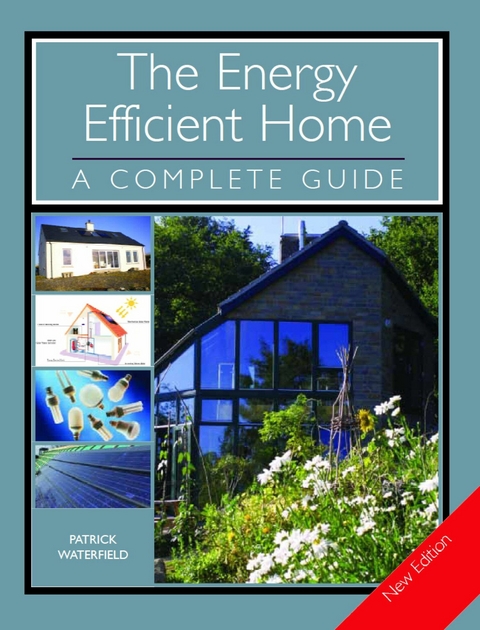
The ENERGY EFFICIENT HOME (eBook)
176 Seiten
Crowood (Verlag)
978-1-84797-437-2 (ISBN)
MICROCLIMATE
The term ‘microclimate’, as it sounds, refers to such climatic factors as solar gains, and wind speed and direction immediately around a building. With an existing building, as well as with a new one, several measures may be taken to reduce the negative aspects of our climate and to enhance the positive ones. The orientation of your house is a key one in creating a microclimate around the building. Think of your house responding to the climate in much the same way as a plant, opening up to the sun while avoiding excessive heat, seeking shelter from cold winds and being open to favourable winds, being able to ‘close up’ at night (in practice, this might mean shutters or even simply good, thick, well-lined curtains). This practice is embodied in vernacular styles of architecture all around the world and which vary according to climate. Many of such simple principles are also embodied in the ancient Chinese practice of feng shui. The recommendation may be phrased something like ‘place your house in the belly of a sleeping dragon’, but the actual meaning is ‘seek a sheltered spot’.
Optimum size and position of a shelter belt (for instance, coniferous trees) relative to a proposed or existing dwelling.
Shelter
This is one of the primary functions of a house – to provide that basic need for shelter from the elements. Fortunately, in a European maritime location such as Britain and Ireland have, the summer prevailing wind is from the south-west, with harsher, winter winds coming from the north and the east. This means that a south-facing house can not only embrace solar gains but also turn its back on the unwanted cold winds. Reducing the impact of wind, particularly cold winds, can reduce the heat loss from your house, especially in exposed sites. The movement of air along the outside walls of a building reduces the surface temperature of the walls and increases heat flow from the inside. This is even more true if the wall is wet. In an exposed site, planting or earthworks can significantly improve the heat retention of the dwelling, as well as protecting it from the possibility of water ingress from driving rain. Look for land forms and vegetation that provide shelter and shade where needed. If none such exist, consider how they might be introduced.
Coniferous species should be used for shelter since these will retain their foliage in the winter when the cold winds are at their fiercest. You might think that the best form of planting would be that with the densest foliage. In fact, experience has shown that foliage of medium density, or trees planted not too close together, is actually more effective, absorbing the wind rather than deflecting it, which can cause eddies and vortices. The correct sizing of the shelter belt or planting (when fully mature) will also provide a sheltered area on the leeward side, which can again be beneficial in exposed sites (see the illustration on page 13). A shelter belt of H (height) positioned with at least 5 × H of open space on the windward side, can provide up to 10–15 × H of sheltered space on the leeward side.
Evergreen hedges, rows of coniferous trees or even high fencing can be used to good effect to attract, deflect or accelerate winds in the vicinity of the building (see the illustration below). Generally, you should be wary of channelling winds towards your building. However, for a very sheltered site you might wish to enhance favourable south-westerly winds for summer ventilative cooling. This aspect is also addressed in the section on natural ventilation in Chapter 8.
Even if it is not possible to shelter the house from cold winds, you can use the form of the building itself to provide a sheltered outside area. The longer the leading edge of the roof on the windward side, the greater the extent of the sheltered area on the leeward side (see the illustration on top of page 15).
This plan view shows how evergreen hedges, rows of coniferous trees or high fencing can be used to good effect to attract, deflect or even accelerate winds in the vicinity of the building.
The longer the leading edge of a roof on the windward side, the greater the extent of the sheltered area on the leeward side.
Shading
There may be times when shading is an advantage, for example, in more southerly latitudes in the summertime or perhaps to prevent a conservatory from overheating in midsummer. Deciduous trees to the south (not too close to the house) can provide some shade to the house and/or garden areas in summer while allowing the sun’s rays to pass through in winter (see the illustration on bottom of page 15), when solar gains are most useful. Unless such planting already exists, however, it will take many years to become effective. Other means of shading, by the building itself (for instance, roof overhangs) or specific shading devices, are addressed in the section on passive solar design.
Deciduous trees to the south can provide shading in summer while allowing useful solar gains in winter.
The Sun-Trap
We have all experienced the phenomenon of the ‘sun-trap’, whether in our own home, that of friends or on visits to the gardens of stately homes, for example. A sun-trap is a south-facing area which traps the heat of the sun and protects from the wind. The shelter may come from natural features such as surrounding higher ground or planting (hedges, rows of trees) or from man-made structures such as walls. The effect can be heightened by the provision of masonry elements in the form of walls and paving which soak up the sun’s heat and reradiate it back later in the day. With the appropriate orientation and sheltering, the house, or indeed the whole site, can become a sun-trap.
Miscellaneous Factors Concerning Planting
Much has been said in recent years on the subject of fast-growing conifers, planted in order to provide shelter quickly (or, more often, privacy). These can then become a nuisance for owners and neighbours alike, by either blocking the sun and views or requiring frequent maintenance. Feuds and even lawsuits have resulted. Consider instead slow-growing, lower-lying shrubs – and live at peace with your neighbours. As far as possible, indigenous species should be used as these will be better suited to the climate, soil conditions and exposure levels. Indigenous species will also provide a habitat for insect and animal life, which will enhance your garden. If possible, leave at least one corner of your garden semi-wild – the natural habitats of many delightful creatures such as butterflies and birds are being lost through the development and over-cultivation of gardens.
On another planting subject, use slow-growing grass when sowing new lawns. While it will take longer for the lawn to become established, you will save energy – your own as well as that of your lawn-mowerin not having to cut the grass as often.
PASSIVE SOLAR DESIGN
There are two basic approaches to energy efficient design, as characterized by interaction with the outside environment. These are the ‘selective’ approach and the ‘exclusive’ approach. The first makes use of natural solar heating, natural ventilation and day-lighting to offset the energy otherwise used in providing a comfortable internal environment – in other words, ‘passive solar design’. The term indicates that use is made of the sun ‘passively’, by virtue of the design of the building, without ‘active’ systems such as solar collectors. Passive solar design may involve increasing the area of your south façade and of the external surfaces of the building as a whole, since single-storey structures are more easily accessed by natural means.
With the exclusive approach the emphasis is on reducing the external surface area for a given volume (that is, achieving a compact form) and using high levels of insulation and advanced glazing systems, for instance – in other words ‘super-insulation’. Passive solar design is the subject of this section, while super-insulation is addressed in Chapter 3.
The two approaches are not entirely mutually exclusive and can be combined in a single building. Elements of passive solar design can be incorporated in the south façade of a super-insulated building, while the super-insulated approach would be a feature of the north side of a passive solar house. However, it may be easier to regard them as separate methods in order to examine the pros and cons of each.
Orientation and Solar Gain
A word here in case this book should ever get as far as the Southern Hemisphere – for ‘south’ read ‘north’ and vice versa. I remember a visiting academic from Australia who kept referring to passive solar houses being ‘north-facing’ – which was right where he came from, but very confusing for us.
Orientation, the direction your house faces, is something you will be able to influence only if you are building from scratch. Even then you will be limited by constraints such as planning permission, access and the position of adjacent dwellings. There may also be other considerations such as privacy and views which you wish to take into account. Such competing factors need to be reconciled to arrive at an optimum design.
Ideally, to make best use of heat and light from the sun your house...
| Erscheint lt. Verlag | 1.8.2012 |
|---|---|
| Verlagsort | London |
| Sprache | englisch |
| Themenwelt | Sachbuch/Ratgeber ► Freizeit / Hobby ► Hausbau / Einrichten / Renovieren |
| Sachbuch/Ratgeber ► Freizeit / Hobby ► Heimwerken / Do it yourself | |
| Naturwissenschaften ► Biologie ► Ökologie / Naturschutz | |
| Technik ► Architektur | |
| ISBN-10 | 1-84797-437-6 / 1847974376 |
| ISBN-13 | 978-1-84797-437-2 / 9781847974372 |
| Informationen gemäß Produktsicherheitsverordnung (GPSR) | |
| Haben Sie eine Frage zum Produkt? |
 EPUB (Wasserzeichen)
DRM: Digitales Wasserzeichen
Dieses eBook enthält ein digitales Wasserzeichen und ist damit für Sie personalisiert. Bei einer missbräuchlichen Weitergabe des eBooks an Dritte ist eine Rückverfolgung an die Quelle möglich.
Dateiformat: EPUB (Electronic Publication)
EPUB ist ein offener Standard für eBooks und eignet sich besonders zur Darstellung von Belletristik und Sachbüchern. Der Fließtext wird dynamisch an die Display- und Schriftgröße angepasst. Auch für mobile Lesegeräte ist EPUB daher gut geeignet.
Systemvoraussetzungen:
PC/Mac: Mit einem PC oder Mac können Sie dieses eBook lesen. Sie benötigen dafür die kostenlose Software Adobe Digital Editions.
eReader: Dieses eBook kann mit (fast) allen eBook-Readern gelesen werden. Mit dem amazon-Kindle ist es aber nicht kompatibel.
Smartphone/Tablet: Egal ob Apple oder Android, dieses eBook können Sie lesen. Sie benötigen dafür eine kostenlose App.
Geräteliste und zusätzliche Hinweise
Buying eBooks from abroad
For tax law reasons we can sell eBooks just within Germany and Switzerland. Regrettably we cannot fulfill eBook-orders from other countries.
aus dem Bereich


