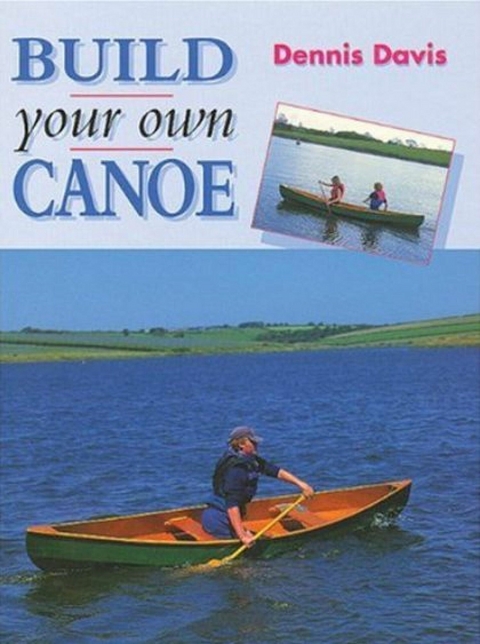
Build Your Own Canoe (eBook)
245 Seiten
Crowood (Verlag)
978-1-84797-366-5 (ISBN)
Build Your Own Canoe is a comprehensive, clearly structured and uncomplicated manual that guides the reader through the various stages of constructing an inexpensive, lightweight and versatile plywood canoe.
1 History of the Canoe
Both the canoe and the kayak originated as working boats and our European leisure craft have come to us via the decked skin-kayak of the Eskimo (Inuit) and the dugout and birch-bark canoe of the North American Indian. In addition to these there are, in many parts of the world, a number of craft loosely referred to as canoes, ranging from reed boats to beautifully constructed dug-outs. Those that developed in the northern hemisphere - from Greenland westward to the Baffin Islands, taking in the northern half of North America on the way, including Canada and Alaska – are the types that bear greatest resemblance to the ones that we see and use today.
The Inuit built the skin-covered, fully decked kayak as a vessel for hunting sea mammals. It made efficient use of the materials available and provided the adept solo paddler with a secure hunting platform. For transporting goods and families a larger, open-skin boat called the umiak was used. In this respect the umiak has more in common with the canoe, which was primarily a means of transporting people and goods through the waterways of the North American forests. Even today in parts of North America the canoe is seen as more of a working craft than as a means of recreation, and we must return to Britain to find the roots of the canoe/kayak as a recreational craft.
John MacGregor, an evangelical barrister, is reputed to have been the first recreational kayaker. He had seen both dug-out and birch-bark canoes, and skin-kayaks, while travelling in North America, and on his return to London he had made a relatively short, beamy kayak which he called Rob Roy. The first Rob Roy (there were several later versions), was about 4,570mm long × 710mm beam × 230mm deep, weighing 36.3kg, just small enough to fit into German railway wagons. She was built of oak using clinker, or lapstrake, construction, where the planks overlap each other (the same method as used for Thames skiffs,) and was fitted with a thin cedar deck. This original Rob Roy, though no longer seaworthy, has survived and is in a private collection. At least two other of MacGregor’s boats are in museum collections. MacGregor used a double paddle supplemented by a small lug sail as his means of propulsion, and in 1865 he paddled down the Thames at the start of a journey that he would recount in A Thousand Miles in the Rob Roy Canoe, which describes his adventures on the lakes and rivers of Europe. First published in 1866, the book has since run to many editions. MacGregor’s other two books of interest to canoeists are Rob Roy on the Baltic and Rob Roy on the Jordan, both of which again ran to a number of editions.
Fig 1 Greenland-type skin kayak.
Fig 2 An Algonquin type birch-bark canoe.
Thus was recreational kayaking/canoeing launched, and it soon became something of a craze among the leisured classes. Several of MacGregor’s contemporaries and fellow founder members of the Canoe Club wrote of their canoeing exploits; fine copies of these titles may now cost more than the materials for a plywood canoe, even assuming you can find one! The new sport was accorded its ultimate accolade when the Prince of Wales became Commodore of the Canoe Club and Queen Victoria granted its Royal designation in 1873. The Royal Canoe Club still exists with its club house on the banks of the Thames.
Fig 3 Section showing clinker (lapstrake) planking.
The wooden kayak of the Rob Roy type continued to be one of the most popular recreational small boats in England, and was taken up as a leisure craft in North America, especially in the north-east region. However, it must be said that boating as a leisure pursuit – even in such small craft as kayaks – was limited, as in Britain, to those business and professional men with both time and money to spare.
By the late 1800s, on both sides of the Atlantic, the Rob Roy type paddling kayak had metamorphosed into much more of a specialized sailing craft with a centreboard and a quite large sail area with (in Britain at least) often considerable ballast. This ultimately developed into the current International 10sq.-metre Canoe, one of the fastest sailing monohulls excluding sailboards. In Britain the paddling kayak then fell into decline and the sport was not revived until the birth of the folding kayak in Germany in the early twentieth century. By the 1930s the folding kayak was ubiquitous, being used even by the competitors in the 1936 Olympic Games. Folding kayaks were relatively costly but the less well-off could get afloat in home-made, or commercially constructed, rigid kayaks made of lath and canvas, but of a similar shape and size to the folding kayaks.
In the North America of the 1800s, the canoe was developing too but still as a work boat. The birch-bark had been made in a variety of sizes from the Montreal (canot du maître), about 11m long × 1.5m beam, to the solo Indian canoe which might be a mere 3.5m long × 700mm beam. At the height of the fur trade, when the Montreal canoes were being used to transport furs from Grand Portage on Lake Superior to Montreal, the numbers of paper birch trees (Betula papyrifera) being killed by having their bark removed must have been large indeed.
The bark canoe had reached its zenith in the canoe building of the North Eastern tribes, in particular the eastern Abenaki Indians. However, as the north woods continued to be opened up by lumbermen, surveyors and prospectors, and the availability of large birch trees decreased, an alternative skin material had to be found. A geographer and map-maker, David Thompson, records making a cedar-wood canoe in 1811 with its planks ‘sewn’ together with split pine root. There is no record as to whether this was clinker (overlapping lapstrake) construction but it seems that this is most likely since caulking thin planks successfully is almost impossible – the first stitch and glue canoe perhaps? In New York and Pennsylvania craftsmen were building all-wood canoes of clinker or smooth bevel-lapped construction; notable among these builders was J. Henry Rushton working in Canton, New York. Rushton was building lapstrake canoes commercially in 1876, and from 1887 he offered the canoes with bevel-edge planks which gave a smooth skin. Unfortunately, while these canoes were beautifully built they were relatively expensive, did not stand up to the rough handling of less experienced owners and were less easily repaired than the bark canoe. Further north in Maine and Canada, a solution closer to the bark canoe had evolved. The wood and canvas canoe had been developed and was being built by such famous companies as E.M. White, Old Town, B.N. Morris and Chestnut. It was not until 1902 that Rushton began building his Indian and Indian Girl wood-canvas canoes, mainly in response to public demand for canoes less expensive than the all-wood types.
Fig 4 Section showing smooth bevel-lapped planking.
It may seem but a short step from building in the Indian way – constructing the wooden framework inside the bark skin -to building on a male mould or form from the inside-out, but it seems to have developed over a longish period. Initially canvas was used as a repair material; the first builders to utilize it as a skin continued to use the Indian method of starting with the shaped skin. Nobody seems quite sure who took the first step to building on a male mould, or form, but it appears likely to have been Evan (Eve) H. Gerrish of Bangor, Maine, who was building wood-canvas canoes commercially by 1878. B.N. Morris started in 1882, and E.M. White in 1888.
The wood-canvas canoe was thus a direct development of the birch-bark canoe. The latter is built by first arranging the bark skin on the building plot and constructing the framework of planking and ribs within this, each canoe being individually built to suit the bark skin available, or the size required. The wood-canvas canoe is built by bending the ribs over a mould, then nailing the thin cedar planking to them so that every canoe from that mould will be the same shape within a certain tolerance. Instead of birch-bark the external skin is canvas, stretched over the planking and ribs and finished with filler and paint. Such craft are still being built today, as indeed is the birch-bark (albeit on a very small scale), but they are expensive when compared with modern plastic or aluminium canoes.
A wood-canvas canoe based on a Peterborough design.
Fig 5 Building a birch-bark canoe.
At the same time as the wood-canvas canoe was being developed in the USA, the all-wood canoe was being built in various forms just across the border in Canada, in particular around the Peterborough region. A number of builders were experimenting with rib and batten construction; double skin; tongued and grooved longitudinal planks, and tongued and grooved ribs only, the latter types of construction must have required extremely good work manship. I have seen a racing canoe made from longitudinal planks joined on brass T-shaped strips running between the planks. Experimentation was rife at this time, and by about 1870 the Canadian canoe was recognized as a type distinct from the American. In fact from the start of recreational canoeing in Britain and North America, both the decked canoes (kayaks) and the open type were referred to as canoes; it was not until the modern kayak was introduced in America after about 1945 that the kayak was distinguished from the canoe in that country. In...
| Erscheint lt. Verlag | 1.12.2011 |
|---|---|
| Verlagsort | London |
| Sprache | englisch |
| Themenwelt | Sachbuch/Ratgeber ► Freizeit / Hobby ► Heimwerken / Do it yourself |
| Sachbuch/Ratgeber ► Freizeit / Hobby ► Kreatives Gestalten | |
| Natur / Technik ► Fahrzeuge / Flugzeuge / Schiffe ► Schiffe | |
| Sachbuch/Ratgeber ► Sport ► Segeln / Tauchen / Wassersport | |
| Technik ► Fahrzeugbau / Schiffbau | |
| ISBN-10 | 1-84797-366-3 / 1847973663 |
| ISBN-13 | 978-1-84797-366-5 / 9781847973665 |
| Informationen gemäß Produktsicherheitsverordnung (GPSR) | |
| Haben Sie eine Frage zum Produkt? |
 EPUB (Adobe DRM)
Kopierschutz: Adobe-DRM
Adobe-DRM ist ein Kopierschutz, der das eBook vor Mißbrauch schützen soll. Dabei wird das eBook bereits beim Download auf Ihre persönliche Adobe-ID autorisiert. Lesen können Sie das eBook dann nur auf den Geräten, welche ebenfalls auf Ihre Adobe-ID registriert sind.
Details zum Adobe-DRM
Dateiformat: EPUB (Electronic Publication)
EPUB ist ein offener Standard für eBooks und eignet sich besonders zur Darstellung von Belletristik und Sachbüchern. Der Fließtext wird dynamisch an die Display- und Schriftgröße angepasst. Auch für mobile Lesegeräte ist EPUB daher gut geeignet.
Systemvoraussetzungen:
PC/Mac: Mit einem PC oder Mac können Sie dieses eBook lesen. Sie benötigen eine
eReader: Dieses eBook kann mit (fast) allen eBook-Readern gelesen werden. Mit dem amazon-Kindle ist es aber nicht kompatibel.
Smartphone/Tablet: Egal ob Apple oder Android, dieses eBook können Sie lesen. Sie benötigen eine
Geräteliste und zusätzliche Hinweise
Buying eBooks from abroad
For tax law reasons we can sell eBooks just within Germany and Switzerland. Regrettably we cannot fulfill eBook-orders from other countries.
aus dem Bereich