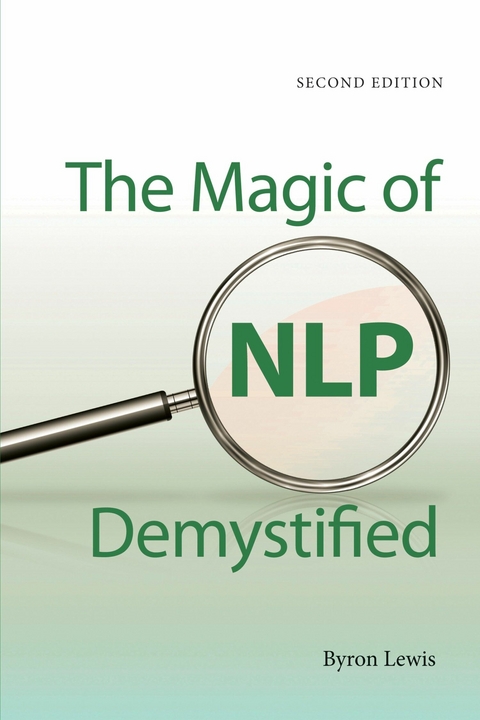
Magic of NLP Demystified (eBook)
216 Seiten
Crown House Publishing (Verlag)
978-1-84590-818-8 (ISBN)
Byron Lewis, M.A., studied under Dr. John Grinder, participating in the original research that laid the foundations for NLP. During the 1980s he was the director of the Meta Training Institute, conducting seminars and workshops in the field of NLP. He then specialized in the field of addictions and worked as a drug and alcohol abuse counselor, an outpatient clinical director (supervisory counselling psychologist), a county alcohol and drug abuse outpatient program director and a county health department senior analyst. He also authored Sobriety Demystified: Getting clean and sober with NLP and CBT.
Byron A Lewis MA is the director of the Meta Training Institute, a Northwest Educational and Consulting firm specialising in the techniques of Neuro-Linguistic Programming. Frank Pucelik PhD is widely recognised as one of the world's finest trainers in interpersonal communication and success strategies for change.
It has been over thirty years since I penned the words in the Foreword to the original Magic Demystified: A Pragmatic Guide to Communication and Change. It astounds me that after all these years, the book continues to be read, continues to be sold and traded, and used by individuals all over the world. It has even been translated into a number of different languages. And it is now to be reborn through the efforts of our friends at Crown House Publishing.*
In that time, a great deal of attention has been focused on Neuro-Linguistic Programming (NLP), and not all of it has been positive. Some have justifiably complained that observations of a few of the early writers in the field did not stand up to the scrutiny of rigorous scientific research. Others have been critical of the more flamboyant claims – especially of some of the earlier writers and practitioners – as to exactly what NLP can do.1 It is my hope that in revising this work, we can direct readers to some of the research that has been done over the last few decades as well as the numerous writings showing the depth and breadth of applications of NLP. Like Tosey and Mathison (2009), I want this book to reflect and support “an approach to NLP that is enquiring, research-based and critical” (p. 4).
The formation of organizations such as the Association for NLP2 and the NLP Research Conferences3 that started just a few years ago are very exciting developments for the growing field of inquiry into NLP. As an example, the call for papers for the 2012 NLP Research Conference includes a request for “empirical research into the application of NLP to people development and change, across fields such as business and management, coaching, education, health and psychotherapy,” among other topics.4 Another popular forum for exchange of innovative ideas and research in NLP, the Institute for the Advanced Studies of Health, in their call for proposals for their 2012 World Health Conference, asks for “presentations or workshops supporting the theme ‘Emerging Fields of NLP: Modeling NLP for the Future.’”
For those new to the field, it is important to understand the fact that NLP was not created in a vacuum or formed without research. Tosey and Mathison (2009) go so far as to state: “there is a case for saying that the development of the meta-model, indeed the groundwork behind much of NLP in the 1970s, was strongly research-based. Bandler and Grinder engaged in a form of empirical research through observation, analysis, experimentation and continuous testing” (p. 52).
I was fortunate to have been part of that early research. As an undergraduate student at University of California, Santa Cruz when Richard and John were writing their premier works The Structure of Magic, Vol. I and Vol. II, I was occasionally called to join them at their home on Alba Road to “work” with someone. Once there, I was provided with an outline of what had been done and instructions for continuing the process. I was to “report back” on what was working and what wasn’t as I interacted with the individual over the next hour or so. This would go on until one of them was convinced the “client” had accomplished what he or she had asked for, and they had “tested” the results to confirm that change had occurred.
I had always thought I was being invited simply because of my student status. While this was true, it wasn’t the only reason. It was much later that I discovered they were actually conducting a form of research to test the patterns they had observed being used by therapists such as Virginia Satir, Fritz Perls, and Milton Erickson. However, they were concerned that their own unconscious use “of non-verbal patterns of influence with our clients constituted an obstacle to sorting out the impact of the verbal patterns we were modeling. We were inadvertently influencing our clients in ways that were confounding the research we were engaged in. The three of us (Bandler, Pucelik, and Grinder) attempted to eliminate such variables in order to appreciate solely the effects of the set of verbal patterns we were testing” (Bostic St. Clair and Grinder, 2001, p. 148).
The above authors go on to describe how, in order to address this issue, they would send in “one or more of our students into the room, well rehearsed and strictly instructed to limit their interactions with the client to the set of verbal patterns we were exploring and then to report back to us the results of the work. They would then be instructed by us to return and execute some intervention we determined to be relevant” (p. 148). I was in essence part of a “blind test” experimental procedure!
Another aspect of their early work that in retrospect was very important to me was that the founders and early developers of NLP, including Richard, John, and Frank, all had huge personalities. I agree with the observation made by Terrence McClendon in his book The Wild Days: NLP 1972–1981 that “NLP is as much an attitude as anything else” (p. 12). Their enthusiasm and apparent lack of fear to try new things, especially in those early days, gave me the confidence to take chances, try different approaches, and push out my own limits and boundaries, keeping what worked and discarding what didn’t. This was a significant change from my earlier experience of “psychology.”
My father was a Jungian psychologist, and many of my early memories are of my father’s references to one or another of Jung’s themes during family discussions. It was not unusual for him to actually pull out one of Jung’s books and read aloud a passage to emphasize a point he was trying to make. Even the priests in the church we went to were often Jungian psychologists as well as theologians, and their sermons were generously peppered with references to Jungian archetypes such as the persona, the anima and animas, and the shadow. I came to NLP already primed with an appreciation of the importance of the “unconscious mind!” However, as young adult, I also remember hearing my mother recounting her experience of psychoanalysis: “After 14 years of psychoanalytic therapy,” she said, “I could tell you why I had my problems, but not what to do about them!”5
This may explain in part my early attraction to NLP. My profound encounter with Frank’s almost “magical” use of language to invoke the imagery, feelings, and voices in my head, and to orchestrate the experience in such a way that I was able to break self-imposed boundaries that were defeating my ability to “move on” with my life, had nothing whatsoever to do with any intellectual “understanding” of my problems. The experience simply worked to help me shift ways of thinking and responding that were less effective in achieving what I wanted. I used to wonder what this approach to “therapy” might have done for my mother. This book is the result of another question Frank and I both had: How else can we share this magic with others?
I hope those readers who are new to NLP enjoy this basic introduction to the field. For readers who are taking a second look at this work, I hope you find that it stimulates as many questions as answers and inspires you to continue your own research in the field!
Byron Lewis
December 27, 2011
A PRAGMATIC GUIDE TO COMMUNICATION AND CHANGE
Notes to the Preface
* This revised edition is the first that actually involved the authors. Previous “revised” editions were created by the previous publisher without any input whatsoever from me or Frank, and as far as we can tell, the only actual revision made was to the title which now includes the words “of NLP” after Magic.
1. I visit this problem in my second book Sobriety Demystified. In my discussion of “the estrangement of NLP” from mainstream psychology, I observe: “Marilyn Darling (1988), who studied NLP during its formative years, noted that many NLPers tended to overstate their case when describing the applications of NLP. She writes, ‘They have made bold and unsubstantiated claims – phobia cures in 10 minutes, lifelong perfect pitch, etc. And they repeat mythic tales of power and wonder’ (p. 38). In her article written in defense of NLP, Darling points out that NLP simply hasn’t lived up to many of its claims” (Lewis, 1996, p. xvi). However, this may be because NLP, like many of the rapid therapies developed during the same era, does not lend itself well to empirical research, although Tosey and Mathison (2007) acknowledge: “What it does have is accumulated case evidence that has been reviewed over many years through critical dialogue” (p. 139).
2. See http://www.anlp.org.
3. See http://nlpresearchconference.squarespace.com.
4. The call for papers at (http://nlpresearchconference.squarespace. com/call-for-papers includes the following guidelines for contributions:
• Empirical research into the application of NLP to people development and change, across fields such as business and management, coaching, education, health, and psychotherapy.
• Practice-based research, including pilot studies and case studies, exploring the use and impact of NLP in a practice setting.
• Critical evaluations and scholarly appraisals of NLP, including historical, social, and...
| Erscheint lt. Verlag | 20.9.2012 |
|---|---|
| Verlagsort | London |
| Sprache | englisch |
| Themenwelt | Sachbuch/Ratgeber ► Gesundheit / Leben / Psychologie ► Lebenshilfe / Lebensführung |
| Sachbuch/Ratgeber ► Gesundheit / Leben / Psychologie ► Psychologie | |
| Geisteswissenschaften ► Psychologie ► Allgemeine Psychologie | |
| Medizin / Pharmazie ► Gesundheitsfachberufe | |
| Medizin / Pharmazie ► Medizinische Fachgebiete ► Psychiatrie / Psychotherapie | |
| ISBN-10 | 1-84590-818-X / 184590818X |
| ISBN-13 | 978-1-84590-818-8 / 9781845908188 |
| Informationen gemäß Produktsicherheitsverordnung (GPSR) | |
| Haben Sie eine Frage zum Produkt? |
 EPUB (Wasserzeichen)
DRM: Digitales Wasserzeichen
Dieses eBook enthält ein digitales Wasserzeichen und ist damit für Sie personalisiert. Bei einer missbräuchlichen Weitergabe des eBooks an Dritte ist eine Rückverfolgung an die Quelle möglich.
Dateiformat: EPUB (Electronic Publication)
EPUB ist ein offener Standard für eBooks und eignet sich besonders zur Darstellung von Belletristik und Sachbüchern. Der Fließtext wird dynamisch an die Display- und Schriftgröße angepasst. Auch für mobile Lesegeräte ist EPUB daher gut geeignet.
Systemvoraussetzungen:
PC/Mac: Mit einem PC oder Mac können Sie dieses eBook lesen. Sie benötigen dafür die kostenlose Software Adobe Digital Editions.
eReader: Dieses eBook kann mit (fast) allen eBook-Readern gelesen werden. Mit dem amazon-Kindle ist es aber nicht kompatibel.
Smartphone/Tablet: Egal ob Apple oder Android, dieses eBook können Sie lesen. Sie benötigen dafür eine kostenlose App.
Geräteliste und zusätzliche Hinweise
Buying eBooks from abroad
For tax law reasons we can sell eBooks just within Germany and Switzerland. Regrettably we cannot fulfill eBook-orders from other countries.
aus dem Bereich