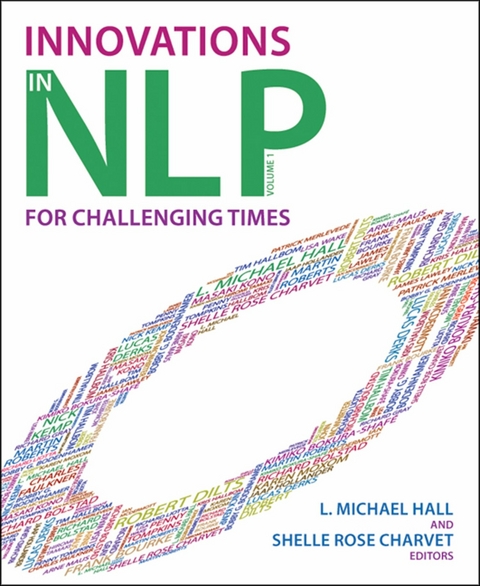
Innovations in NLP (eBook)
384 Seiten
Crown House Publishing (Verlag)
978-1-84590-775-4 (ISBN)
This long awaited book brings together some of the most recent innovations and applications of the traditional NLP model. Each chapter describes a new model or application and contains step by step instructions or a case study on how and when to apply it. For NLP Practitioners it provides an outstanding collection of new tools and ideas to take their practice forward.
We live in a world where there are a great many challenges! Writing this in early 2011 it seems to both of us that life on planet earth today offers us tremendous challenges. What are we talking about? We are talking about climatic catastrophes, the rise of violent extremism in so many forms, incompetent or corrupt governments, widespread economic volatility that directly affects many millions of people, millions of people unemployed (the estimate is 200 million worldwide in February, 2011), entrenched armed conflict, along with the issues that continue to plague our planet—hungry people, oppression, and lack of access to basic necessities, including education.
And that’s just the beginning. So with all of these troubles and challenges, many of us are wondering: What can I do? What can we together do? What can anyone do? Are there solutions at the individual level? Are there solutions at the community level? How can we in the field of neurolinguistic programming offer some answers and resources to these challenges?
As we all know, when NLP was first developed in the 1970s, it was created in a therapeutic context and the purpose was to help people overcome personal issues, to communicate more effectively, and to access further personal resources. Since that time, the field has been changing and evolving. It has been expanding the original modeling strategies to areas such as education, health, business applications, and sports achievement. And many contributors have developed new ways of thinking, new models, new applications, and new tools.
Over the past thirty-eight years, through the skillful and ethical efforts of practitioners, NLP has made a dramatic difference to the way in which many people lead their lives and their achievement of success. If there is anything that connects and unifies the worldwide NLP community, it is the singular desire of tens of thousands of people to make a difference in our world and to respond to the challenges before us.
NLP has also been moving out beyond dealing only with individuals. As it has moved into areas such as business, education, marketing, and sales, it has been developing models for groups, for communities, for leadership, for management. NLP has been expanding its realm of influence to empower the movers and shakers of our world. And NLP, as a model of subjective experiences, has been modeling organizations, cultures, and the variables that make a community of people operate effectively. As modelers, NLP thinkers and trainers have taken the foundational work of people modeling “good to great companies,” self-actualizing leaders and companies, as well as the “tipping point” phenomena of how societies grow, develop, change, and transform. The result? We now know a whole lot more about how to influence our world for good.
Making a Difference in a Troubled World
As the editors of this book we believe that now is the time to truly make a difference that makes a difference. That’s one of the reasons why we have collaborated to create this unique book—Innovations in NLP, Volume 1. This book is premised upon the idea that the new things happening in NLP are valuable for solving important problems in our world and that the resources for creativity and innovation that we have in NLP ought to be applied more broadly to the challenges before us.
In this volume we have collaborated to bring together many of the key people in the field of NLP who share this passion and vision. The contributors not only believe in applying the rich and powerful tools in NLP to make a difference in our world, but they have created models, patterns, and tools to enable that to happen. The result is that we have a unique opportunity for collaboration, creativity, and innovation in the NLP community with the specific aim of looking at how what we do can help the world.
What is this book about? We have a three-fold focus:
First, it is about what’s new in NLP as effective innovations for communication, change, and leadership in our world. If you are interested in the ongoing development of the NLP model, you will discover many of the new contributions to the field in this book. Some of these innovations go back to the 1990s and others began after 2000.
Second, and more important, it is about applying these new innovations in NLP to the problems and challenges that trouble our world so that they can help solve the problems that confront all of us. If you have an interest in how to make the planet a better place and to know about models, applications, and new ways of thinking for doing precisely that, this is the book for you. Obviously, we have not addressed every challenge, but this is a beginning and subsequent volumes will address other problems.
Third, to offer an inspirational and educational look at the ongoing creativity and innovation in the field of NLP. One of our aims is to let those in the field of NLP know what’s been developed, what’s being developed, and to encourage more people to engage in cultivating solutions that will give us new models, patterns, and tools for making a difference.
Innovating New Things in NLP
What’s new in NLP? How often we ask or have heard that question! Many of us ask it because we truly want to know what’s new. We ask it also because NLP people tend to be curious individuals interested in what’s being developed in this field and interested in what needs to be developed. We ask it because we are an optimistic people who believe in possibilities and in inventing new things to create more resourcefulness in individuals and organizations. And sometimes we ask it wondering if anything actually is new or just rehashed from things already developed.
If you have asked the question about what’s new in NLP, this book will give you some solid answers. We have searched for practitioners who have created and innovated new techniques and have collected models, patterns, tools, and information about communities that are indeed new in the field of NLP.
A challenge in this field is that of communication; that is, the challenge of keeping people informed about what is happening in this sphere, who is developing new things, what they have developed, and what results they have obtained. Yes, it’s paradoxical—NLP is a field that came into being as first and foremost a communication model, and yet we have difficulty communicating! We also are collaboratively challenged—as a field we do not have a good record of collaborating as colleagues.
To address these challenges we have invited two dozen people who have been contributing to the field, developing new things, and advancing NLP in the twenty-first century. There were others we invited and who will appear in subsequent volumes. And there are undoubtedly people who we should have invited, but we just didn’t know who they were, where they were, or how to get in touch with them. Our hope is that with this publication, we will be able to identify other developers who are contributing to this field.
In this sphere, the problem is not creativity. Not at all! If we were to ask everybody with inspirational creative ideas to contribute, this would be a 3,000 page book. As a model and field, NLP inherently attracts creative people, especially highly individualist people who want to do it by themselves.
If there is a problem in NLP, the problem is one of innovation. One of the fathers of creativity, Abraham Maslow, who was a leading business expert in creativity in the 1950s and 1960s and who wrote extensively on creativity said, “Creative inspirations are a dime a dozen.” The second part of creativity is innovation and, as Thomas Edison said, this is only 1% inspiration and 99% perspiration. It is innovation that is required for working out structure, procedures, details, testing the process, redesigning, testing again, and so on, until a model, pattern, process, or instrument is developed to the point that it is ready to be rolled out as an effective contribution. So it is exciting to gather actual innovations in this field and present them here.
The Innovative Vision
The vision that we shared that has inspired this work is to create a book, and possibly a series of books, on innovations in NLP. Our desire is to provide communication worldwide about what is happening in this field, to collaborate with those who are developing new things, and to encourage more collaboration, creativity, and innovation.
The original inspiration that brought us together was the book that Robert Dilts, Judith DeLozier and Deborah Dilts published at the end of 2010, NLP II: The Next Generation. In it, the co-authors did an excellent job in describing the new developments that they have been creating and contributing to NLP. Then, after a book review by Michael of that book, Shelle suggested that we collaborate and bring together contributions from all of those that we know about who are working in a similar vein in the field of NLP so that we could supplement what Robert, Deborah, and Judith began.
Criteria for Determining “What’s New in NLP”
Our first challenge in creating this book was deciding what to include. That led us to set out some criteria for guiding our decisions and making them as objective as possible. From the beginning we knew that...
| Erscheint lt. Verlag | 16.2.2012 |
|---|---|
| Verlagsort | London |
| Sprache | englisch |
| Themenwelt | Sachbuch/Ratgeber ► Gesundheit / Leben / Psychologie ► Lebenshilfe / Lebensführung |
| Sachbuch/Ratgeber ► Gesundheit / Leben / Psychologie ► Psychologie | |
| Geisteswissenschaften ► Psychologie ► Allgemeine Psychologie | |
| Medizin / Pharmazie ► Gesundheitsfachberufe | |
| Medizin / Pharmazie ► Medizinische Fachgebiete ► Psychiatrie / Psychotherapie | |
| ISBN-10 | 1-84590-775-2 / 1845907752 |
| ISBN-13 | 978-1-84590-775-4 / 9781845907754 |
| Informationen gemäß Produktsicherheitsverordnung (GPSR) | |
| Haben Sie eine Frage zum Produkt? |
 EPUB (Wasserzeichen)
DRM: Digitales Wasserzeichen
Dieses eBook enthält ein digitales Wasserzeichen und ist damit für Sie personalisiert. Bei einer missbräuchlichen Weitergabe des eBooks an Dritte ist eine Rückverfolgung an die Quelle möglich.
Dateiformat: EPUB (Electronic Publication)
EPUB ist ein offener Standard für eBooks und eignet sich besonders zur Darstellung von Belletristik und Sachbüchern. Der Fließtext wird dynamisch an die Display- und Schriftgröße angepasst. Auch für mobile Lesegeräte ist EPUB daher gut geeignet.
Systemvoraussetzungen:
PC/Mac: Mit einem PC oder Mac können Sie dieses eBook lesen. Sie benötigen dafür die kostenlose Software Adobe Digital Editions.
eReader: Dieses eBook kann mit (fast) allen eBook-Readern gelesen werden. Mit dem amazon-Kindle ist es aber nicht kompatibel.
Smartphone/Tablet: Egal ob Apple oder Android, dieses eBook können Sie lesen. Sie benötigen dafür eine kostenlose App.
Geräteliste und zusätzliche Hinweise
Buying eBooks from abroad
For tax law reasons we can sell eBooks just within Germany and Switzerland. Regrettably we cannot fulfill eBook-orders from other countries.
aus dem Bereich