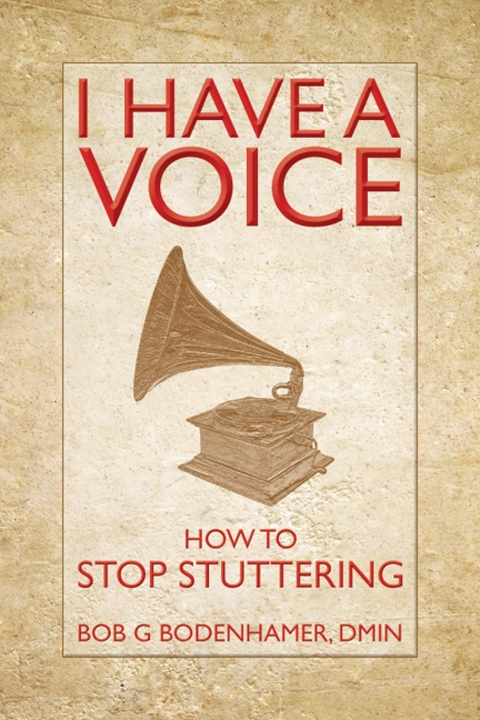
I Have a Voice (eBook)
208 Seiten
Crown House Publishing (Verlag)
978-1-84590-753-2 (ISBN)
Dr. Bodenhamer's under-graduate degree (BA) is from Appalachian State University in Boone, NC (1972). His major at Appalachian State University was Philosophy and Religion with a minor in Psychology. He received the Master of Divinity (1976) and the Doctor of Ministry Degree (1978) from Southeastern Baptist Theological Seminary in Wake Forest, NC. The Master of Divinity Degree included training in Pastoral Care with both classroom and clinical work. Dr. Bodenhamer received one unit of Clinical Pastoral Education from Wake Medical Center in Raleigh, N. C. while working on his doctorate. His marriage to Linda now spans 43 years.His NLP Practitioner's Certification comes from L.E.A.D.'s Consultants in Reynoldsburg, OH, Dr. Gene Rooney, Trainer. Dr. Bodenhamer's NLP Master Certification and Master Time Line TherapyTMPractitioner Certification came from Tad James, Ph.D. of Advanced Neuro-Dynamics of Honolulu, HI. Additional training has been received from NLP conferences. Dr. Bodenhamer has approximately 1500 hours of formal NLP training. He taught NLP for 10 years in the Corporate/Community Education program at Gaston College. Dr. Bodenhamer received his certification as a Trainer of NLP from Tad James, Ph.D., Advance Neuro Dynamics, Honolulu, Hawaii and Wyatt Woodsmall, Ph.D. of Advanced Behavioral Modeling, Inc., Arlington, VA.As an International Master NLP Trainer, he offers both certified training for Practitioners and Master Practitioners of NLP. He has a private NLP Therapy practice. Dr. Bodenhamer has served four Southern Baptist churches as pastor. He is presently serving as pastor of a mission church called Christ Fellowship Community Church. His time in the pastorate spans 44 years. All of his pastorates have been in North Carolina. Bob has had the privilege of being married to Linda for the past 45 years (10/17/1965).He has co-authored 10 NLP books and is the sole author of I Have a Voice: How to Stop Stuttering.The NLP in Healthcare Award was presented to Bob G Bodenhamer at the NLP award ceremony 2017.
Have you ever wondered why most people who block and stutter do not do so every time they speak? Now the puzzle has finally been solved by this outstanding new book which details a completely new approach to treating this debilitating condition. Bob Bodenhamer explains that this phenomenon results from the thinking (cognition) of the stutterer as he or she associates speaking with a lot of fear and anxiety about blocking. This book both explains the structure of blocking and provides the tools for gaining more fluency.
One evening a while ago I received an email from my friend Professor Judith Kuster, who is webmaster for the Stuttering Home Page at Mankato State University.
“I have a challenging little puzzle for you,” she wrote. “See if you can solve it. Here are ten numbers. Can you tell me why they’re in the order they’re in? The numbers are 8549176320.”
There was no way I could pass up this challenge. I dropped everything and started wrestling with the puzzle. Now, I pride myself on having a mind that can grasp numbers, even if I can never get my checkbook to balance. I tried everything to make it work. I looked for hidden numerical sequences. I tried dividing numbers by other numbers. I tried multiplying them. I looked for exotic progressions. I wrestled with this conundrum on and off for the better part of two days. No luck. I just couldn’t get those numbers to unlock their secret.
Finally, in utter frustration, I wrote back to Judy. “I give up,” said. “I need to get a good night’s sleep. Tell me the answer.”
A little later came her reply. “They’re in alphabetical order.”
It was so simple. Why couldn’t I think of that?
I couldn’t think of it because I was stuck in a traditional way of approaching number puzzles. I had made certain unconscious assumptions about how the problem needed to be addressed. I did not know that I had limited my solutions. But the model within which I was working automatically ruled out non-numerical solutions.
This same habit of thinking “inside the box” explains why for the 80 years since the birth of speech pathology, most people have not been able to solve the mystery of stuttering. Our paradigm, or model, of stuttering has forced us to look at the problem through a set of filters that have masked out relevant information and issues. In short, for 80 years, stuttering has been incorrectly characterized, and as a result, most of us have been trying to solve the wrong problem.
I was lucky in that I never went through traditional speech therapy. So my vision was not colored by other people’s ideas of what stuttering was all about. Consequently, I ended up foraging on my own for answers, and by the age of 30, I had a different picture of stuttering than virtually anybody else I knew. I had also fully recovered, and this recovery has held for more than 35 years.
What I discovered during my recovery process was that my stuttering was not a speech problem per se, but a problem with my experience of communicating to others. That was why I never stuttered when I was alone. I was not communicating with anyone. I also learned that my stuttering not only involved my speech, but all of me, and that included my emotions, perceptions, beliefs, intentions, and physiological responses. These elements were joined together in a spider-like web of interconnections, where a change at any point caused a change at all the other points. In short, I had to look at stuttering as an interactive, dynamic, self-sustaining system. If I wanted to achieve a lasting recovery, I had to address, not just my speech, but the entire system.
Forces that shaped my thinking
An important part of this system was the way I thought about stuttering and about myself. Early in the recovery process, I began to question my way of seeing things. Was the world really such a threatening place, at least on a social level? Or was I creating it that way? Why didn’t everyone tense in the presence of authorities? Why didn’t other people panic when they had to give their name, or when they had to speak on the telephone to strangers? How was I managing to frame the world in such a negative way?
I eventually discovered that when I blocked, I did so to prevent myself from experiencing things I didn’t want to experience. But if it was I who created my speech blocks, then I needed to understand why I held myself back and blocked. What was I afraid of? What didn’t I want to see? What might happen if I let go? And how could I make my world less threatening?
There were two books back in the early 60s that provided me with a novel way to approach these issues. Both had to do with the running of my mind.
The first was a book called Psycho-Cybernetics by a plastic surgeon named Maxwell Maltz. Maltz makes a compelling case for the fact that your unconscious mind accomplishes whatever your conscious mind puts before it – similar to the way a technician programs a computer.
He points out that when confronting a performance fear – such as whether you can make the two-foot putt that wins the golf tournament – if you mentally image only what you’re afraid might happen, you’ll probably miss the putt. You need to focus all your attention on the desired positive outcome.
The problem is, my mind is also programmed to keep me safe by focusing on any imminent danger, such as the black widow spider on the ceiling or the footsteps behind me as I walk alone at night down a dark street. Not to think about the danger is counter-intuitive. Yet, I must do just that when dealing with a performance fear such as stuttering. The book offered some simple but compelling rules for how my mind worked.
The second book, S. I. Hayakawa’s Language in Thought and Action, was a simplified presentation of general semantics, developed in the 30s by Alfred Korzybski, one of the brilliant minds of the day. General semantics looks at how our habits of thinking color our experiences, and how the structure of language itself forces us to see things in a particular way. Thanks to general semantics, I had a platform from which I could step outside my normal frames of reference and observe and reframe my day-to-day experiences, thus making my world more manageable and less stressful.
Now fast forward 35 years. In early 2002 I received an email from Linda Rounds, a 38-year-old human resources director of a company in Indiana whom I had met over the Internet. Linda wrote to tell me that thanks to my book plus several telephone sessions with a remarkable individual named Bobby Bodenhamer, she had abruptly put an end to a lifelong stuttering problem.
I quickly got in touch with Bob to find out more. It appeared that Bob was a practitioner and teacher of something called neuro-semantics (NS). I discovered that NS is a further development of neuro-linguistic programming (NLP) which, in turn, is a further development of general semantics, the discipline I had found so helpful back in the 60s. Now my interest was really piqued.
It was apparent from the first emails and later, through several phone conversations that Bob Bodenhamer and I were on the same wavelength. Although he had never stuttered himself, Bob had an intuitive understanding of issues that are central to stuttering. This is in part because neuro-semantics, which Bob teaches, addresses the very challenges that I had wrestled with when I was trying to overcome my own stuttering.
I was especially interested in what Bob had to say because, as a person who recovered from stuttering, I have frequently been asked how I got over it. After I tell my story, people naturally ask what they can do to follow in the same path.
Until very recently, I didn’t have much to offer when it came to the mind management aspect of stuttering. Maltz’s book is still relevant in a general way, but many people want guidance on specific steps they can take to address their blocking. And general semantics, though still valid in its precepts, also does not directly offer specific approaches and exercises on how to address the issues associated with stuttering.
All that has changed with the publication of this book.
A new resource
I Have a Voice is a compendium of concepts and tools that use the principles of Neuro-Semantics to reframe the mindset that leads to speech blocks. Several groups of people will directly benefit from this book.
Therapists and speech-language pathologists who work with those who stutter will find the various neuro-semantic processes and tools extremely helpful. As a practitioner, you’ll not only have resources for addressing the physical behaviors of your clients that are counter-productive to fluent speech, but for the first time, you’ll have tools for addressing the habits of thought that shape their negative mind state. This is a major resource that has been lacking in the therapist’s toolkit. Processes such as those for redefining self, altering states, reframing the meaning of stuttering, and remodeling behavior will now allow you to follow a multi-dimensional approach.
If you’re someone who stutters and are motivated to experiment with and explore your own stuttering, you’ll also find this book a great resource. You’ll acquire workable tools for modifying your mind and emotional states. This, in turn, will help you to counter the feelings of helplessness which are so disempowering and which can make speaking such a troubling experience.
Enterprising individuals who wish to run their own self-therapy program using neuro-semantics resources can be reassured they do not have to go it alone. Thanks to Linda Rounds, who serves as moderator, there is an Internet discussion group on Yahoowhere you can share your personal experiences using the principles and precepts described in this book. If you want to participate, you can register at...
| Erscheint lt. Verlag | 17.11.2011 |
|---|---|
| Verlagsort | London |
| Sprache | englisch |
| Themenwelt | Sachbuch/Ratgeber ► Gesundheit / Leben / Psychologie ► Lebenshilfe / Lebensführung |
| Sachbuch/Ratgeber ► Gesundheit / Leben / Psychologie ► Psychologie | |
| Geisteswissenschaften ► Psychologie ► Allgemeine Psychologie | |
| Geisteswissenschaften ► Psychologie ► Angst / Depression / Zwang | |
| Medizin / Pharmazie ► Gesundheitsfachberufe ► Logopädie | |
| Medizin / Pharmazie ► Medizinische Fachgebiete ► Psychiatrie / Psychotherapie | |
| ISBN-10 | 1-84590-753-1 / 1845907531 |
| ISBN-13 | 978-1-84590-753-2 / 9781845907532 |
| Informationen gemäß Produktsicherheitsverordnung (GPSR) | |
| Haben Sie eine Frage zum Produkt? |
 EPUB (Wasserzeichen)
DRM: Digitales Wasserzeichen
Dieses eBook enthält ein digitales Wasserzeichen und ist damit für Sie personalisiert. Bei einer missbräuchlichen Weitergabe des eBooks an Dritte ist eine Rückverfolgung an die Quelle möglich.
Dateiformat: EPUB (Electronic Publication)
EPUB ist ein offener Standard für eBooks und eignet sich besonders zur Darstellung von Belletristik und Sachbüchern. Der Fließtext wird dynamisch an die Display- und Schriftgröße angepasst. Auch für mobile Lesegeräte ist EPUB daher gut geeignet.
Systemvoraussetzungen:
PC/Mac: Mit einem PC oder Mac können Sie dieses eBook lesen. Sie benötigen dafür die kostenlose Software Adobe Digital Editions.
eReader: Dieses eBook kann mit (fast) allen eBook-Readern gelesen werden. Mit dem amazon-Kindle ist es aber nicht kompatibel.
Smartphone/Tablet: Egal ob Apple oder Android, dieses eBook können Sie lesen. Sie benötigen dafür eine kostenlose App.
Geräteliste und zusätzliche Hinweise
Buying eBooks from abroad
For tax law reasons we can sell eBooks just within Germany and Switzerland. Regrettably we cannot fulfill eBook-orders from other countries.
aus dem Bereich