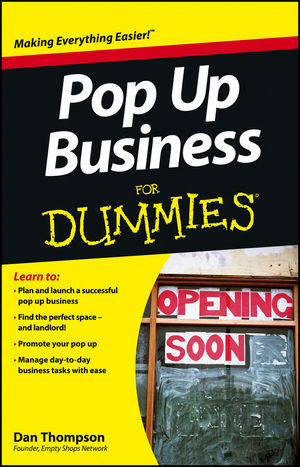
Whether you’re just starting out and want to test the viability of your business, or you’re an established business looking to expand your reach, pop-ups offer an exciting and flexible opportunity. They’re a great way to try new business ideas, experiment with a new product, location or market, gain exposure, and learn about your customers - all with limited risk and financial outlay.
Inside Pop-Up Business For Dummies, you’ll find:
- Planning your pop-up venture - whether it’s a shop, studio, gallery, or community hub.
- Finding the right space for you.
- Negotiating with the landlord and sorting out the legalities.
- Fixing up and fitting out your space on a budget.
- Pulling in the punters - advertising and marketing your pop-up.
- Managing a successful pop-up business day-to-day.
- Closing up shop efficiently.
- Lots of case studies, checklists, tips and hints from experienced pop-up people!
Dan Thompson is an artist, writer and founder of the Empty Shops Network. An expert in the creative use of empty shops, Dan has pioneered the use of shops as community hubs and has written about the problems facing town centres for The Independent and The Guardian.
Whether you re just starting out and want to test the viability of your business, or you re an established business looking to expand your reach, pop-ups offer an exciting and flexible opportunity. They re a great way to try new business ideas, experiment with a new product, location or market, gain exposure, and learn about your customers - all with limited risk and financial outlay. Inside Pop-Up Business For Dummies, you ll find: Planning your pop-up venture - whether it s a shop, studio, gallery, or community hub. Finding the right space for you. Negotiating with the landlord and sorting out the legalities. Fixing up and fitting out your space on a budget. Pulling in the punters - advertising and marketing your pop-up. Managing a successful pop-up business day-to-day. Closing up shop efficiently. Lots of case studies, checklists, tips and hints from experienced pop-up people!
Dan Thompson is an artist, writer and founder of the Empty Shops Network. An expert in the creative use of empty shops, Dan has pioneered the use of shops as community hubs and has written about the problems facing town centres for The Independent and The Guardian.
Introduction 1
Part I: Planning to Pop Up 7
Chapter 1: Welcome to the World of Pop Ups 9
Chapter 2: Developing Your Pop Up Plan 19
Part II: Building on Your Pop Up Foundations 35
Chapter 3: Building Your Team 37
Chapter 4: Funding Your Project 57
Chapter 5: Finding Your Space and Your Landlord 73
Part III: Filling Your Pop Up with People 89
Chapter 6: Making an Impression: Branding and Marketing 91
Chapter 7: Producing and Distributing Leaflets and Posters
107
Chapter 8: Making the Most of Social Media 121
Chapter 9: Cooking Up a Media Storm for Your Pop Up 139
Part IV: Running Your Pop Up 153
Chapter 10: Designing and Kitting Out Your Space 155
Chapter 11: Managing Your Shop and Staff 173
Chapter 12: Meeting Your Customers 185
Part V: Looking to the Future 197
Chapter 13: Measuring the Success of Your Pop Up 199
Chapter 14: Packing Up and Moving On 213
Part VI: The Part of Tens 223
Chapter 15: Ten Useful Items to Have in Your Pop Up 225
Chapter 16: Ten Reasons Why Your Pop Up is Good for Business
231
Index 237
Introduction
Right now, towns and cities are filling up with pop up shops, pop up cinemas, pop up restaurants, pop up parks and pop up allotments. It seems like everything’s a pop up now, and nothing’s permanent.
Of course, pop up has become a buzzword and is being applied to all sorts of things that aren’t really pop ups at all. So to be clear, a pop up is any project tailor-made to a specific space, which opens for a defined period of time, with a clear start and end date. More importantly, pop ups do something different, unusual and interesting; they’re not about the everyday way of doing things.
Pop ups have been around for a long time. We only have high streets because markets, the original pop ups, became permanent fixtures in town centres. And since the happenings and arts labs of the 1960s, seeing work by artists, actors and musicians in unlikely venues has become common practice.
So if it’s so old and so common, why is the term ‘pop up’ everywhere right now, and why are people so interested?
People have realised that pop ups are a great way to do business. They’re ideal if you want to test a new venture. They’re perfect if you run a home-based business or sell on the Internet and want some extra exposure. They deliver magnificent results as part of a marketing or promotional campaign. And they help brands build real, lasting relationships with customers.
They’re also far easier to do than ever before. People have moved to do their shopping online, at out-of-town centres where parking is easier and in supermarkets that stock everything. With more empty shops comes more opportunities to strike deals for short-term lets.
So pop ups meet the needs of a wide range of businesses, and the opportunities are there for people who want to take them. Pop ups are becoming normal, and part of the way businesses work.
But until now, nobody has provided a comprehensive guide to how to devise and deliver a pop up. It’s been assumed that the people organising a pop up will muddle along, with a mix of skills in marketing, design, project management, retail and customer service. But pop up people need more than that; they need a specific way of working that embraces the temporary nature of what they’re doing and is agile and adaptable. This book is for those pop up people.
About This Book
This book is about creating, planning and delivering a pop up. If you’ve never opened a pop up before, this book helps you focus, keep on track and avoid mistakes. I show you how to gather the right people to help you and how to make them into a team that works together. And I help you with the more complicated issues, such as the legal aspects of a pop up and how to find funding.
You can also use this book as a reference, for subsequent pop ups. You’ll find it useful if you’ve already opened some pop ups and want to make the process a little easier. And if you’re thinking of making a pop up into a permanent shop, you’ll also find this book helpful as it covers some skills you need to make that transformation a success.
Beyond the loose definition I use in the previous section, this book doesn’t define exactly what a pop up is, by the way. Think of ‘pop up’ as a set of skills that you can apply to lots of different types of activity that can take place in lots of different spaces. Be as creative with your project as you can.
Conventions Used in This Book
This book is a jargon-free zone, because nothing’s complicated about pop ups. I avoid the technical terms used in business books, the arts world and in planning and regeneration circles and instead opt for using plain English. When I do introduce a new term, I italicise and define it.
The only jargon I can’t avoid is the term pop up, of course! For this book, a pop up is any project in an empty shop or other empty space that is limited by time, with a clear start and end date. A pop up shop in a department store is not a pop up shop. A market is not a pop up market. Pop up shops are always temporary.
I use the word business throughout the book, to keep the writing concise; whenever I say business, I mean business, community group, social enterprise, arts organisation or even individual!
I also use the word shop, but I mean any space where you choose to pop up.
Foolish Assumptions
I assume that you want to start a pop up and have a good reason to do so. This book helps you by giving you lots of tips, tools and techniques to use.
I assume that a wide range of people will read this book, including:
Small business owners
Marketing staff in larger businesses
Specialists in marketing
Community organisations
Arts groups, organisations and individual artists
Self-employed people
Local government employees
That’s quite a diverse audience, with a range of different levels of experience, skill and understanding. So I’ve made the assumption that you’ll use the bits of the book that are most suited to your level of experience and won’t read it from start to finish.
I don’t assume that you have any pop up experience. I aim to give you enough working knowledge of each area to make a pop up happen successfully.
Most importantly, I’ve assumed that you’re the kind of person who wants to get stuck in, is willing to have a go and enjoys learning new skills. If that’s you, you’ll find this book is both a good starting point and a handy reference that you can keep coming back to as you pop up, again and again.
How This Book Is Organised
This book is divided into six parts, each covering a broad subject area.
Part I: Planning to Pop Up
You need to lay good foundations before you can build a pop up, so in the first part, I look at what pop ups are all about and at how to carry out research to help you understand your pop up and the wider market it will operate in. I look at how to define your aims and objectives as you write a pop up plan and at how to create simple risk assessments to make sure that your pop up is safe.
Part II: Building on Your Pop Up Foundations
The second part of the book is where popping up all starts to feel real, as I discuss building a team to make your plans come to life. I look at the practical help you can get alongside more strategic partners. I talk about local authorities and the role they have to play. I also offer networking tips and techniques to help you make friends and influence people.
In addition, I talk about how to develop budgets and where you can find funding. And I also walk you through finding and securing the types of spaces that may be suitable for your pop up.
Part III: Filling Your Pop Up with People
As your pop up is taking shape, you need to think about how to fill it with the right kind of people. Part III looks at creating a strong brand that people will recognise. I also discuss the range of marketing materials you can produce and how to make sure that they’re efficient and effective. Social media is the most efficient and effective tool available, so I talk about how to use it – and examine how to work with more traditional media, too.
Part IV: Running Your Pop Up
Part IV looks at the physical space, outside and inside. I offer you tips for fitting out your space and look at the techniques used to design and lay out shops. I then explore how you can staff that space, to make sure that it’s effective for your business and inspiring, interesting and entertaining for your customers.
Part V: Looking to the Future
Your pop up isn’t over as soon as the doors close. In Part V, I show you how to measure the impact of your pop up. I look at how success and failure can impact your wider business and the work of your partners. I also talk about how to make sure that your pop up comes to a good end and how to tidy up not only your shop but also your assets, without leaving any loose ends.
Part VI: The Part of Tens
Every For Dummies book has this bite-sized bit at the end, full of handy tips, tools and techniques. In this part, you find some inspirational things to do in your pop up and discover some very practical bits of equipment you’ll need.
Icons Used in This Book
The small icons in the left margins of the book alert you to special information and highlight some key things you need to know. In this book, you find these icons:
The target highlights something that you can use to improve the planning, delivery and experience of your pop up.
If I give a real or occasionally hypothetical example that illustrates a point in the main text, you’ll find this icon next to it.
This icon draws your attention to an important point to keep in mind as you apply the tips, tools and techniques you’re learning.
This icon highlights where things could easily go wrong and is a sign of pitfalls and dangers ahead.
Where to Go from Here
You can read this book in many different ways, based on your own knowledge and experience, but also on the finer details of the individual pop up you’re planning. However, it’s worth starting with the table of contents and the parts pages inside the book that feature a cartoon and a short introduction.
If you’re new to pop ups, start with Chapter 1, which explains what pop ups are and why they’re...
| Erscheint lt. Verlag | 27.9.2012 |
|---|---|
| Sprache | englisch |
| Themenwelt | Sachbuch/Ratgeber ► Beruf / Finanzen / Recht / Wirtschaft ► Wirtschaft |
| Wirtschaft ► Betriebswirtschaft / Management ► Unternehmensführung / Management | |
| Schlagworte | artists • bandwagon • bigname • Book • business • Business & Management • Customers • Designers • Experiment • Fashion • Financial • Great • Guide • Handson • Idea • International brands • Klein- u. mittelständische Unternehmen u. Existenzgründung • Klein- u. mittelständische Unternehmen u. Existenzgründung • Klein- und Mittelbetrieb • New • Pop • pop ups • Product • Shops • Small Business & Entrepreneurship • Studies • Successful • things • Total • Venture • Way • Wirtschaft u. Management |
| ISBN-10 | 1-118-44347-0 / 1118443470 |
| ISBN-13 | 978-1-118-44347-7 / 9781118443477 |
| Informationen gemäß Produktsicherheitsverordnung (GPSR) | |
| Haben Sie eine Frage zum Produkt? |
 EPUB (Adobe DRM)
Kopierschutz: Adobe-DRM
Adobe-DRM ist ein Kopierschutz, der das eBook vor Mißbrauch schützen soll. Dabei wird das eBook bereits beim Download auf Ihre persönliche Adobe-ID autorisiert. Lesen können Sie das eBook dann nur auf den Geräten, welche ebenfalls auf Ihre Adobe-ID registriert sind.
Details zum Adobe-DRM
Dateiformat: EPUB (Electronic Publication)
EPUB ist ein offener Standard für eBooks und eignet sich besonders zur Darstellung von Belletristik und Sachbüchern. Der Fließtext wird dynamisch an die Display- und Schriftgröße angepasst. Auch für mobile Lesegeräte ist EPUB daher gut geeignet.
Systemvoraussetzungen:
PC/Mac: Mit einem PC oder Mac können Sie dieses eBook lesen. Sie benötigen eine
eReader: Dieses eBook kann mit (fast) allen eBook-Readern gelesen werden. Mit dem amazon-Kindle ist es aber nicht kompatibel.
Smartphone/Tablet: Egal ob Apple oder Android, dieses eBook können Sie lesen. Sie benötigen eine
Geräteliste und zusätzliche Hinweise
Buying eBooks from abroad
For tax law reasons we can sell eBooks just within Germany and Switzerland. Regrettably we cannot fulfill eBook-orders from other countries.
aus dem Bereich