


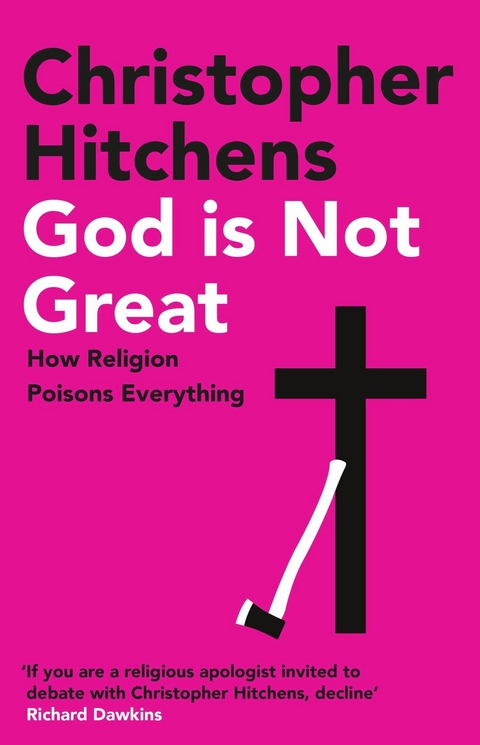
God Is Not Great (eBook)
320 Seiten
Atlantic Books (Verlag)
978-0-85789-715-2 (ISBN)
Christopher Hitchens is a contributing editor to Vanity Fair and Visiting Professor in liberal studies at the New School in New York. He was named one of the world's 'Top 100 Public Intellectuals' by Foreign Policy and Prospect. His books include Love, Poverty & War and Blood, Class & Empire. Thomas Paine's Rights of Man and God Is Not Great were published by Atlantic Books.
In god is Not Great Hitchens turned his formidable eloquence and rhetorical energy to the most controversial issue in the world: God and religion. The result is a devastating critique of religious faithgod Is Not Great is the ultimate case against religion. In a series of acute readings of the major religious texts, Christopher Hitchens demonstrates the ways in which religion is man-made, dangerously sexually repressive and distorts the very origins of the cosmos. Above all, Hitchens argues that the concept of an omniscient God has profoundly damaged humanity, and proposes that the world might be a great deal better off without 'him'.
Christopher Hitchens (1949-2011) was a contributing editor to Vanity Fair and Visiting Professor in liberal studies at the New School in New York. He was the author of numerous books, including works on Thomas Jefferson, Thomas Paine, George Orwell, Mother Theresa, Henry Kissinger and Bill and Hillary Clinton, as well as the international bestseller and National Book Award nominee, god Is Not Great.
Chapter Two
Religion Kills
His aversion to religion, in the sense usually attached to the term, was of the same kind with that of Lucretius: he regarded it with the feelings due not to a mere mental delusion, but to a great moral evil. He looked upon it as the greatest enemy of morality: first, by setting up factitious excellencies—belief in creeds, devotional feelings, and ceremonies, not connected with the good of human kind—and causing these to be accepted as substitutes for genuine virtue: but above all, by radically vitiating the standard of morals; making it consist in doing the will of a being, on whom it lavishes indeed all the phrases of adulation, but whom in sober truth it depicts as eminently hateful.
—JOHN STUART MILL ON HIS FATHER, IN THE AUTOBIOGRAPHY
Tantum religio potuit suadere malorum.
(To such heights of evil are men driven by religion.)
—LUCRETIUS, DE RERUM NATURA
Imagine that you can perform a feat of which I am incapable. Imagine, in other words, that you can picture an infinitely benign and all-powerful creator, who conceived of you, then made and shaped you, brought you into the world he had made for you, and now supervises and cares for you even while you sleep. Imagine, further, that if you obey the rules and commandments that he has lovingly prescribed, you will qualify for an eternity of bliss and repose. I do not say that I envy you this belief (because to me it seems like the wish for a horrible form of benevolent and unalterable dictatorship), but I do have a sincere question. Why does such a belief not make its adherents happy? It must seem to them that they have come into possession of a marvelous secret, of the sort that they could cling to in moments of even the most extreme adversity.
Superficially, it does sometimes seem as if this is the case. I have been to evangelical services, in black and in white communities, where the whole event was one long whoop of exaltation at being saved, loved, and so forth. Many services, in all denominations and among almost all pagans, are exactly designed to evoke celebration and communal fiesta, which is precisely why I suspect them. There are more restrained and sober and elegant moments, also. When I was a member of the Greek Orthodox Church, I could feel, even if I could not believe, the joyous words that are exchanged between believers on Easter morning: “Christos anesti!” (Christ is risen!) “Alethos anesti!” (He is risen indeed!) I was a member of the Greek Orthodox Church, I might add, for a reason that explains why very many people profess an outward allegiance. I joined it to please my Greek parents-in-law. The archbishop who received me into his communion on the same day that he officiated at my wedding, thereby trousering two fees instead of the usual one, later became an enthusiastic cheerleader and fund-raiser for his fellow Orthodox Serbian mass murderers Radovan Karadzic and Ratko Mladic, who filled countless mass graves all over Bosnia. The next time I got married, which was by a Reform Jewish rabbi with an Einsteinian and Shakespearean bent, I had something a little more in common with the officiating person. But even he was aware that his lifelong homosexuality was, in principle, condemned as a capital offense, punishable by the founders of his religion by stoning. As to the Anglican Church into which I was originally baptized, it may look like a pathetic bleating sheep today, but as the descendant of a church that has always enjoyed a state subsidy and an intimate relationship with hereditary monarchy, it has a historic responsibility for the Crusades, for persecution of Catholics, Jews, and Dissenters, and for combat against science and reason.
The level of intensity fluctuates according to time and place, but it can be stated as a truth that religion does not, and in the long run cannot, be content with its own marvelous claims and sublime assurances. It must seek to interfere with the lives of nonbelievers, or heretics, or adherents of other faiths. It may speak about the bliss of the next world, but it wants power in this one. This is only to be expected. It is, after all, wholly man-made. And it does not have the confidence in its own various preachings even to allow coexistence between different faiths.
Take a single example, from one of the most revered figures that modern religion has produced. In 1996, the Irish Republic held a referendum on one question: whether its state constitution should still prohibit divorce. Most of the political parties, in an increasingly secular country, urged voters to approve of a change in the law. They did so for two excellent reasons. It was no longer thought right that the Roman Catholic Church should legislate its morality for all citizens, and it was obviously impossible even to hope for eventual Irish reunification if the large Protestant minority in the North was continually repelled by the possibility of clerical rule. Mother Teresa flew all the way from Calcutta to help campaign, along with the church and its hard-liners, for a “no” vote. In other words, an Irish woman married to a wife-beating and incestuous drunk should never expect anything better, and might endanger her soul if she begged for a fresh start, while as for the Protestants, they could either choose the blessings of Rome or stay out altogether. There was not even the suggestion that Catholics could follow their own church’s commandments while not imposing them on all other citizens. And this in the British Isles, in the last decade of the twentieth century. The referendum eventually amended the constitution, though by the narrowest of majorities. (Mother Teresa in the same year gave an interview saying that she hoped her friend Princess Diana would be happier after she had escaped from what was an obviously miserable marriage, but it’s less of a surprise to find the church applying sterner laws to the poor, or offering indulgences to the rich.)
A week before the events of September 11, 2001, I was on a panel with Dennis Prager, who is one of America’s better-known religious broadcasters. He challenged me in public to answer what he called a “straight yes/no question,” and I happily agreed. Very well, he said. I was to imagine myself in a strange city as the evening was coming on. Toward me I was to imagine that I saw a large group of men approaching. Now—would I feel safer, or less safe, if I was to learn that they were just coming from a prayer meeting? As the reader will see, this is not a question to which a yes/no answer can be given. But I was able to answer it as if it were not hypothetical. “Just to stay within the letter ‘B,’ I have actually had that experience in Belfast, Beirut, Bombay, Belgrade, Bethlehem, and Baghdad. In each case I can say absolutely, and can give my reasons, why I would feel immediately threatened if I thought that the group of men approaching me in the dusk were coming from a religious observance.”
Here, then, is a very brief summary of the religiously inspired cruelty I witnessed in these six places. In Belfast, I have seen whole streets burned out by sectarian warfare between different sects of Christianity, and interviewed people whose relatives and friends have been kidnapped and killed or tortured by rival religious death squads, often for no other reason than membership of another confession. There is an old Belfast joke about the man stopped at a roadblock and asked his religion. When he replies that he is an atheist he is asked, “Protestant or Catholic atheist?” I think this shows how the obsession has rotted even the legendary local sense of humor. In any case, this did actually happen to a friend of mine and the experience was decidedly not an amusing one. The ostensible pretext for this mayhem is rival nationalisms, but the street language used by opposing rival tribes consists of terms insulting to the other confession (“Prods” and “Teagues”). For many years, the Protestant establishment wanted Catholics to be both segregated and suppressed. Indeed, in the days when the Ulster state was founded, its slogan was: “A Protestant Parliament for a Protestant People.” Sectarianism is conveniently self-generating and can always be counted upon to evoke a reciprocal sectarianism. On the main point, the Catholic leadership was in agreement. It desired clerical-dominated schools and segregated neighborhoods, the better to exert its control. So, in the name of god, the old hatreds were drilled into new generations of schoolchildren, and are still being drilled. (Even the word “drill” makes me queasy: a power tool of that kind was often used to destroy the kneecaps of those who fell foul of the religious gangs.)
When I first saw Beirut, in the summer of 1975, it was still recognizable as “the Paris of the Orient.” Yet this apparent Eden was infested with a wide selection of serpents. It suffered from a positive surplus of religions, all of them “accommodated” by a sectarian state constitution. The president by law had to be a Christian, usually a Maronite Catholic, the speaker of the parliament a Muslim, and so on. This never worked well, because it institutionalized differences of belief as well as of caste and ethnicity (the Shia Muslims were at the bottom of the social scale, the Kurds were disenfranchised altogether).
The main Christian party was actually a Catholic militia called the Phalange, or “Phalanx,” and had been founded by a Maronite Lebanese named Pierre Gemayel who had been very impressed by his visit to...
| Erscheint lt. Verlag | 1.11.2011 |
|---|---|
| Verlagsort | London |
| Sprache | englisch |
| Themenwelt | Sachbuch/Ratgeber ► Gesundheit / Leben / Psychologie ► Esoterik / Spiritualität |
| Geschichte ► Teilgebiete der Geschichte ► Religionsgeschichte | |
| Geisteswissenschaften ► Religion / Theologie ► Weitere Religionen | |
| Recht / Steuern ► Öffentliches Recht | |
| Sozialwissenschaften ► Politik / Verwaltung | |
| Schlagworte | abolition of liberty • AC Grayling • agnosticism • And Yet • AN Wilson • Arguably • Atheism • Atheist • Atlantic • Atlantic Monthly • barack obama • Belief • biblical cristism • blood class and empire • Che Guevara • Christianity • christoper hitchens books • clive james • Cultural Amnesia • Daniel Dennett • darwins dangerous idea • Dawkins • dickensl • Essay • George Orwell • Gertrude Bell • god is Not Great • Gore Vidal • Hezbollah • Hillary Clinton • History • Hitch-22 • hitchens • Humour • Ian Fleming • Iran • Islam • Judaism • Literature • love poverty and war • Makeover • Martin Amis • Michel Onfray • missionary position • Mortality • new atheism • New Statesman • No One Left to Lie to • Orhan Pamuk • Orwell • Patriotism • political books • Politics • politics books • poltics • Religion • religion for athiests • religion poltics • religious books • Richard Dawkins • Salman Rushdie • Sam Harris • secular humanism • self-improvement • slate • The Four Horsemen • the god argument • the god debate • the god delusion • Theology • Thomas Paine's Rights of Man • trial of henry kissinger • United States Essays 1952-92 • VICE • war against cliche |
| ISBN-10 | 0-85789-715-2 / 0857897152 |
| ISBN-13 | 978-0-85789-715-2 / 9780857897152 |
| Informationen gemäß Produktsicherheitsverordnung (GPSR) | |
| Haben Sie eine Frage zum Produkt? |
 EPUB (Wasserzeichen)
DRM: Digitales Wasserzeichen
Dieses eBook enthält ein digitales Wasserzeichen und ist damit für Sie personalisiert. Bei einer missbräuchlichen Weitergabe des eBooks an Dritte ist eine Rückverfolgung an die Quelle möglich.
Dateiformat: EPUB (Electronic Publication)
EPUB ist ein offener Standard für eBooks und eignet sich besonders zur Darstellung von Belletristik und Sachbüchern. Der Fließtext wird dynamisch an die Display- und Schriftgröße angepasst. Auch für mobile Lesegeräte ist EPUB daher gut geeignet.
Systemvoraussetzungen:
PC/Mac: Mit einem PC oder Mac können Sie dieses eBook lesen. Sie benötigen dafür die kostenlose Software Adobe Digital Editions.
eReader: Dieses eBook kann mit (fast) allen eBook-Readern gelesen werden. Mit dem amazon-Kindle ist es aber nicht kompatibel.
Smartphone/Tablet: Egal ob Apple oder Android, dieses eBook können Sie lesen. Sie benötigen dafür eine kostenlose App.
Geräteliste und zusätzliche Hinweise
Buying eBooks from abroad
For tax law reasons we can sell eBooks just within Germany and Switzerland. Regrettably we cannot fulfill eBook-orders from other countries.


