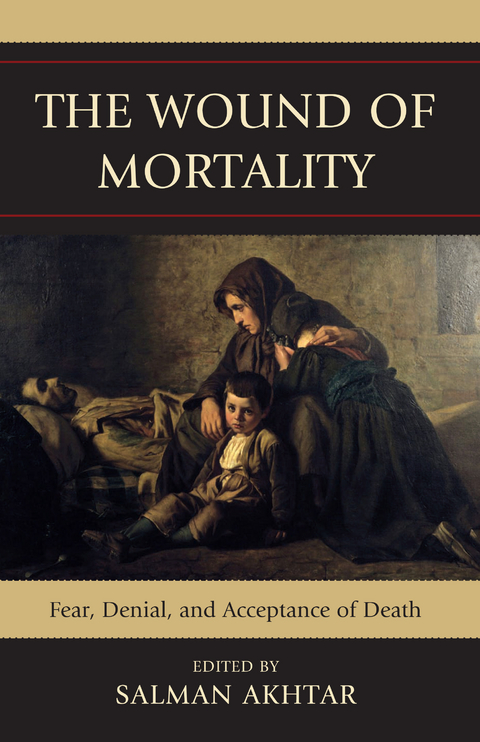
Wound of Mortality (eBook)
216 Seiten
Jason Aronson, Inc. (Verlag)
978-0-7657-0701-7 (ISBN)

Death is a much avoided topic. Literature on mourning exists, but it focuses chiefly upon the death of others. The inevitable psychic impact of one's own mortality is not optimally covered either in this literature on mourning or elsewhere in psychiatry and psychoanalysis. The Wound of Mortality brings together contributions from distinguished psychoanalysts to fill this gap by addressing the issue of death in a comprehensive manner. Among questions the contributors raise and seek to answer are: Do children understand the idea of death? How is adolescent bravado related to deeper anxieties about death? Is it normal and even psychologically healthy to think about one's own death during middle age? Does culture-at-large play a role in how individuals conceptualize the role of death in human life? Is death "e;apart"e; from or "e;a part"e; of life? Enhanced understanding of such matters will help mental health clinicians treat patients struggling with death-related concerns with greater empathy.
Salman Akhtar is professor of psychiatry at Jefferson Medical College and Training and Supervising Analyst at the Psychoanalytic Center of Philadelphia.
Chapter 1. Freud's Todesangst and Ghalib's Ishrat-e-Qatra: Two Perspectives on DeathChapter 2. What Happens When You Die: Three to Four Year Olds Chatting About DeathChapter 3. Children's Understanding of DeathChapter 4. Symbolic Death: East and WestChapter 5. It Is Not Over When It's Over: Reflections on Death and MourningChapter 6. Fear of Death: Analyst and Patient in the Same BoatChapter 7. The Dead Self Must Be RebornChapter 8. Living to Die and Dying to Live: Normal and Pathological Considerations of Death AnxietyChapter 9. Facing Death: Intrapsychic Conflict and Intergenerational PassageChapter 10. Eastern Intersubjectivity: Relational Homes for Frailty and DeathChapter 11. Demise and IllusionChapter 12. Is That All There Is?: A Concluding Commentary on Psychoanalysis and Death
| Erscheint lt. Verlag | 22.1.2010 |
|---|---|
| Reihe/Serie | Margaret S. Mahler |
| Co-Autor | Ira Brenner, Albert Kaplan, Ilany Kogan, Tooraj Moradi, Henri Parens, Josephine Wright, Stanley J. Coen, Calvin A. Colarusso, Hossein M. Etezady, Michelle Foster, Ruth Garfield, Jaswant Guzder, Leon Hoffman, Eileen Johnson |
| Sprache | englisch |
| Themenwelt | Sachbuch/Ratgeber ► Gesundheit / Leben / Psychologie ► Psychologie |
| Sonstiges ► Geschenkbücher | |
| Geisteswissenschaften ► Psychologie ► Allgemeine Psychologie | |
| Geisteswissenschaften ► Psychologie ► Trennung / Trauer | |
| Medizin / Pharmazie ► Medizinische Fachgebiete ► Psychiatrie / Psychotherapie | |
| Sozialwissenschaften ► Soziologie | |
| ISBN-10 | 0-7657-0701-2 / 0765707012 |
| ISBN-13 | 978-0-7657-0701-7 / 9780765707017 |
| Informationen gemäß Produktsicherheitsverordnung (GPSR) | |
| Haben Sie eine Frage zum Produkt? |
 EPUB (Adobe DRM)
Kopierschutz: Adobe-DRM
Adobe-DRM ist ein Kopierschutz, der das eBook vor Mißbrauch schützen soll. Dabei wird das eBook bereits beim Download auf Ihre persönliche Adobe-ID autorisiert. Lesen können Sie das eBook dann nur auf den Geräten, welche ebenfalls auf Ihre Adobe-ID registriert sind.
Details zum Adobe-DRM
Dateiformat: EPUB (Electronic Publication)
EPUB ist ein offener Standard für eBooks und eignet sich besonders zur Darstellung von Belletristik und Sachbüchern. Der Fließtext wird dynamisch an die Display- und Schriftgröße angepasst. Auch für mobile Lesegeräte ist EPUB daher gut geeignet.
Systemvoraussetzungen:
PC/Mac: Mit einem PC oder Mac können Sie dieses eBook lesen. Sie benötigen eine
eReader: Dieses eBook kann mit (fast) allen eBook-Readern gelesen werden. Mit dem amazon-Kindle ist es aber nicht kompatibel.
Smartphone/Tablet: Egal ob Apple oder Android, dieses eBook können Sie lesen. Sie benötigen eine
Geräteliste und zusätzliche Hinweise
Buying eBooks from abroad
For tax law reasons we can sell eBooks just within Germany and Switzerland. Regrettably we cannot fulfill eBook-orders from other countries.
aus dem Bereich