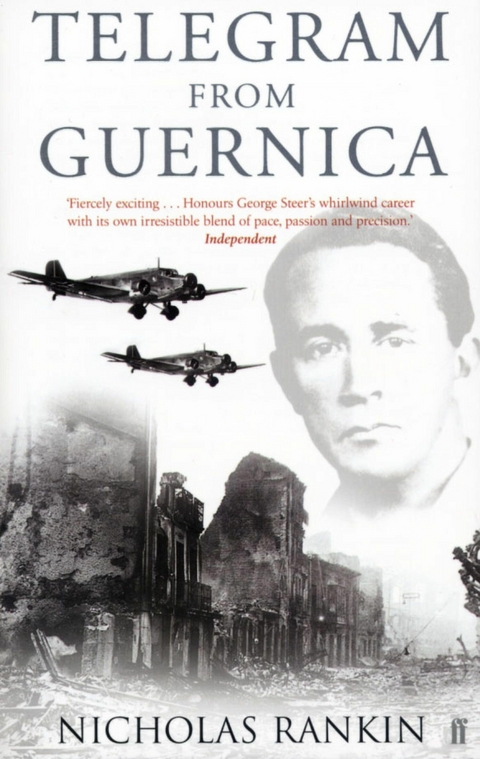
Telegram from Guernica (eBook)
416 Seiten
Faber & Faber (Verlag)
978-0-571-29804-4 (ISBN)
Nicholas Rankin worked 20 years for BBC World Service, winning two UN awards and ending up as Chief Producer. His previous books include biographies of Robert Louis Stevenson and the war-correspondent George Steer, Churchill's Wizards, a study of camouflage, deception and black propaganda in both world wars, and Ian Fleming's Commandos, the history of a WW2 naval intelligence unit. He is a Fellow of the Royal Society of Literature and lives in London and Kent.
On 26 April 1937, in the rubble of the bombed city of Guernica, the world's press scrambled to submit their stories. But one journalist held back, and spent an extra day exploring the scene. His report pointed the finger at secret Nazi involvement in the devastating aerial attack. It was the lead story in both The Times and the New York Times, and became the most controversial dispatch of the Spanish Civil War. Who was this Special Correspondent, whose report inspired Picasso's black-and-white painting Guernica - the most enduring single image of the twentieth century - and earned him a place on the Gestapo Special Wanted List?George Steer, a 27-year-old adventurer, was a friend and supporter of the Ethiopian emperor Haile Selassie I. He foresaw and alerted others to the fascist game-plan in Africa and all over Europe; initiated new techniques of propaganda and psychological warfare; saw military action in Ethiopia, Spain, Finland, Libya, Egypt, Madagascar and Burma; married twice and wrote eight books. Without Steer, the true facts about Guernica's destruction might never have been known. In this exhilarating biography, Nicholas Rankin brilliantly evokes all the passion, excitement and danger of an extraordinary life, right up to Steer's premature death in the jungle on Christmas Day 1944.
Nicholas Rankin spent twenty years broadcasting for BBC World Service where he was Chief Producer and won two UN awards. He is the author of Dead Man's Chest, Telegram from Guernica and the bestselling Churchill's Wizards, the story of British intelligence in the two World Wars.
Five foreign correspondents covering the civil war in Spain drove out to see the atrocity. Beyond the Basque hills the night sky glowed fleshy pink. As they drew closer, the clouds seemed obscenely alive, wobbly red bellies of billowing smoke. Then Gernika came into view: a meccano framework with flames at every hole. It was Monday night, 26 April 1937, and the town had been fire-bombed.
Dusty survivors told the journalists about the three-and-a-half-hour air raid: how aeroplanes with a black cross on the tail had dropped blast bombs on market-day afternoon, slaughtering people and animals; how fighter planes had dived to machine-gun others fleeing into the fields or along the roads; then how more planes had tumbled out thousands of shiny incendiary bombs, as long as forearms, that fizzled and spurted fire, making a conflagration of the historic town. In the hot rubble of Gernika’s collapsed streets there was now a gagging smell of charred meat. Hundreds were dead. ‘The Most Appalling Air Raid Ever Known’ was the Evening News headline on the Reuters dispatch printed in London on Tuesday afternoon.
One of the reporters, an intense twenty-seven-year-old called George Lowther Steer, held back for a day. He questioned more Basque refugees who had reached Bilbao, and drove out again to see the destroyed town by daylight before sending a long cable with his copy. George Steer’s story appeared on Wednesday, 28 April 1937 on the foreign news page of The Times of London and the front page of the New York Times, the most important newspapers on either side of the Atlantic.
George Steer identified the aeroplanes as German. He revealed to the world the dirty secret that Nazi Germany was deeply embroiled in the Spanish Civil War, hugger-mugger with General Franco’s ‘insurgents’.
Times correspondents were not named then, so few in England knew who told them about the destruction of the town that the Basques spell ‘Gernika’ and the Spanish ‘Guernica’.
THE TRAGEDY OF GUERNICA
TOWN DESTROYED IN AIR ATTACK
EYE-WITNESS’S ACCOUNT
From our Special Correspondent. BILBAO, April 27
Guernica, the most ancient town of the Basques and the centre of their cultural tradition, was completely destroyed yesterday afternoon by insurgent air raiders. The bombardment of this open town far behind the lines occupied precisely three hours and a quarter, during which a powerful fleet of aeroplanes consisting of three German types, Junkers and Heinkel bombers, did not cease unloading on the town bombs weighing from 1,000 lbs. downwards and, it is calculated, more than 3,000 two-pounder aluminium incendiary projectiles. The fighters, meanwhile, plunged low from above the centre of the town to machine-gun those of the civilian population who had taken refuge in the fields.
The whole town of Guernica was soon in flames except the historic Casa de Juntas with its rich archives of the Basque race, where the ancient Basque Parliament used to sit. The famous oak of Guernica, the dried old stump of 600 years and the young new shoots of this century, was also untouched …
At 2 a.m. to-day when I visited the town the whole of it was a horrible sight, flaming from end to end. The reflection of the flames could be seen in the clouds of smoke above the mountains from 10 miles away. Throughout the night houses were falling until the streets became long heaps of red impenetrable debris …
CHURCH BELL ALARM
In the form of its execution and the scale of the destruction it wrought … the raid on Guernica is unparalleled in military history. Guernica was not a military objective … The object of the bombardment was seemingly the demoralization of the civil population and the destruction of the cradle of the Basque race….
One reader would make the story immortal.
*
In Paris, Pablo Picasso was already appalled by the Civil War in his homeland. The fifty-five-year-old artist supported the Spanish Republic and loathed Franco and his followers, who had murdered so many when they took over his birthplace, Malaga, two months before. This new massacre from the air was a horror that rivalled anything in Goya’s Disasters of War. The fascist planes had attacked the town on market day, when it was full of campesinos with their animals, and local women and housewives come to sell and buy food.
Stocky, bullish, his grey hair combed over his bald patch, Picasso angrily read the newspapers and was galvanized into work. ‘Painting is not just done to decorate apartments,’ Picasso later said. ‘It is an instrument of war … against brutality and darkness.’ Since January he had had a commission to fulfil for the Spanish Republic, and now the subject found him. Picasso imagined the town’s agony, its weeping women and wounded animals. As the left-wing May Day parades through Paris chanted ‘Guernica! Guernica!’, the Spaniard began charcoal-sketching in his high-windowed studio on the top floor of 7 rue des Grands Agustins.
On 11 May Picasso started to draw the outlines on his giant canvas. Only his current mistress, the Surrealist Dora Maar, was allowed to photograph the work in progress. On 4 June the enormous painting – 12 feet high, 25 feet long – went to the Spanish Pavilion of the Exposition Internationale des Arts et Techniques Appliqués à la Vie Moderne, the 1937 Paris World’s Fair, which was visited by over 30 million people that summer.
Picasso’s Guernica is such a well-known image of the twentieth century that nowadays we forget its original impact as the shock of the new, the shock of the news. The graphic canvas is black and white, stark as a crime photo lit by a glaring bulb. The creatures are screaming like headlines. The horse’s body is made of mashed-up newspaper.
*
George Steer’s story caused a global outcry. Herbert R. Southworth, who wrote the classic fortieth-anniversary study of the 1937 events, called Steer’s dispatch ‘the basic document in establishing world public opinion about the destruction of Guernica’.
In England, there were questions in the House of Commons. The TUC and the Labour Party condemned ‘the merciless and inhuman spirit which animates the rebel forces and their Nazi and Fascist accomplices’. The Bishop of Winchester denounced in a sermon ‘a cruel, deliberate, cold-blooded act against the laws of God and against every law of civilization and of man’.
In the United States of America, both houses of Congress were outraged. Senator William Borah of Idaho denounced the ‘Fascist strategy’ as ‘the most revolting instance of mass murder in modern times’, and hundreds of prominent Americans signed an ‘Appeal to the Conscience of the World’, condemning this act of terrorism, or ‘frightfulness’. The American Ambassador in London said that news of the forty-two-plane attack on the Basque town ‘had been received with the utmost horror in America, where it was regarded as a practice for the bombing of London and Paris’.
The bombing of Guernica brought the brutality of colonial warfare home to white people. Since the First World War, when a few European civilians had been bombed, the tactic had mostly been used in faraway places to punish tribal dissidents. This warfare abolished geography. Death could drop from the air, at any time, to destroy a town without warning and to burn women and children at home in their beds. In this kind of war, civilians were the front line. Guernica, like Hiroshima, like 9/11, marked a terrible new order of things.
The Germans were furious at George Steer’s story. Adolf Hitler had vowed in 1935 never to bomb open towns, and Nazi Germany had publicly agreed in the Non-Intervention Pact not to get involved in the Spanish Civil War. Now the Nazis were revealed to be field-testing blitzkrieg in Spain, on behalf of Franco’s Nationalist insurgents, fighting against the democratically elected Spanish Republic. Germany denied everything, and loudly denounced The Times.
Adolf Hitler cancelled an interview he was due to give the newspaper on 4 May. Nine days later, Steer’s story, ‘Bombing of Guernica: German Airman’s Statement’, caused the German Secret Police to confiscate all copies of The Times. On 16 May 1937 the correspondent who was meant to have interviewed Hitler wrote to his editor from Berlin: ‘the German papers have been very savage about The Times, in fact worse than at any period I remember. The latest discovery is that if you spell it backwards it spells SEMIT, which leads them to deduce we are a Jewish–Marxist organisation.’
The name ‘Steer, G. L.’ was on the Gestapo Special Wanted List of 2,820 people to be arrested when the Nazis invaded England in 1940. After the war, when Rebecca West found herself on that list with Noel Coward, she quipped to him, ‘My dear – the people we should have been seen dead with.’ By then George Steer was among the 50 million dead of the Second World War.
*
Steer’s early witnessing of the use of bombing and chemical weapons against the civilian population gave him a unique perspective on twentieth-century history, and made him one of the first to understand the psychological effects of air power. His second book, The Tree of Gernika, explored what he called ‘the mystique of the air’ – the way in which aerial bombing, so often incompetent in practice,...
| Erscheint lt. Verlag | 20.9.2012 |
|---|---|
| Verlagsort | London |
| Sprache | englisch |
| Themenwelt | Literatur ► Biografien / Erfahrungsberichte |
| Literatur ► Essays / Feuilleton | |
| Literatur ► Romane / Erzählungen | |
| Sachbuch/Ratgeber ► Beruf / Finanzen / Recht / Wirtschaft ► Wirtschaft | |
| Sachbuch/Ratgeber ► Geschichte / Politik | |
| Geschichte ► Allgemeine Geschichte ► 1918 bis 1945 | |
| Geschichte ► Teilgebiete der Geschichte ► Militärgeschichte | |
| Sozialwissenschaften ► Kommunikation / Medien ► Journalistik | |
| Schlagworte | alan turing the enigma • Churchill's Wizards • George Steer • Guernica • Reportage • soldier • war correspondent |
| ISBN-10 | 0-571-29804-4 / 0571298044 |
| ISBN-13 | 978-0-571-29804-4 / 9780571298044 |
| Informationen gemäß Produktsicherheitsverordnung (GPSR) | |
| Haben Sie eine Frage zum Produkt? |
 EPUB (Adobe DRM)
Kopierschutz: Adobe-DRM
Adobe-DRM ist ein Kopierschutz, der das eBook vor Mißbrauch schützen soll. Dabei wird das eBook bereits beim Download auf Ihre persönliche Adobe-ID autorisiert. Lesen können Sie das eBook dann nur auf den Geräten, welche ebenfalls auf Ihre Adobe-ID registriert sind.
Details zum Adobe-DRM
Dateiformat: EPUB (Electronic Publication)
EPUB ist ein offener Standard für eBooks und eignet sich besonders zur Darstellung von Belletristik und Sachbüchern. Der Fließtext wird dynamisch an die Display- und Schriftgröße angepasst. Auch für mobile Lesegeräte ist EPUB daher gut geeignet.
Systemvoraussetzungen:
PC/Mac: Mit einem PC oder Mac können Sie dieses eBook lesen. Sie benötigen eine
eReader: Dieses eBook kann mit (fast) allen eBook-Readern gelesen werden. Mit dem amazon-Kindle ist es aber nicht kompatibel.
Smartphone/Tablet: Egal ob Apple oder Android, dieses eBook können Sie lesen. Sie benötigen eine
Geräteliste und zusätzliche Hinweise
Buying eBooks from abroad
For tax law reasons we can sell eBooks just within Germany and Switzerland. Regrettably we cannot fulfill eBook-orders from other countries.
aus dem Bereich