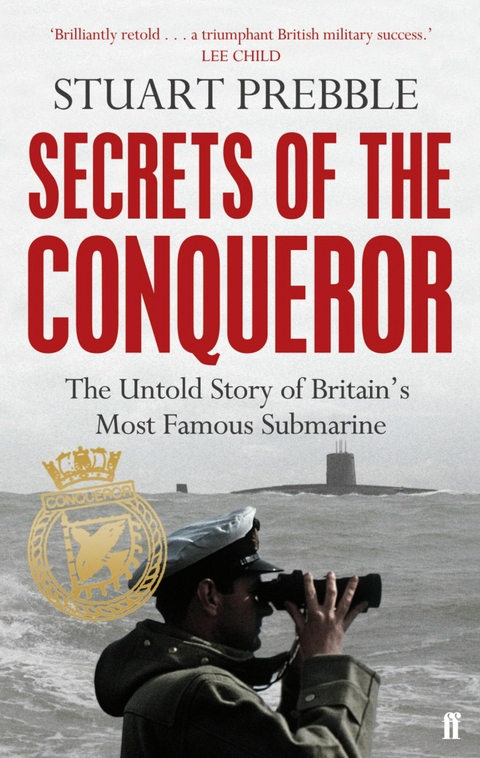
Secrets of the Conqueror (eBook)
288 Seiten
Faber & Faber (Verlag)
978-0-571-29034-5 (ISBN)
Stuart Prebble was for many years a leading television journalist, notably on ITV's World in Action programme, and later became CEO of ITV. He is now a successful producer and writer.
HMS Conqueror is Britain's most famous submarine. It is the only sub since World War Two to have sunk an enemy ship. Conqueror's sinking of the Argentine cruiser Belgrano made inevitable an all-out war over the future of the Falkland Islands, and sparked off one of the most controversial episodes of twentieth century politics. The controversy was fuelled by a war-diary kept by an officer on board HMS Conqueror, and as a young TV producer in the 1980s Stuart Prebble scooped the world by locating the diary's author and getting his story on the record. But in the course of uncovering his Falklands story, Stuart Prebble also learned a military secret which could have come straight out of a Cold War thriller. It involved the Top Secret activities of the Conqueror in the months before and after the Falklands War. Prebble has waited for thirty years to tell his story. It is a story of incredible courage and derring-do, of men who put their lives on the line and were never allowed to tell what they had done. This story, buried under layers of official secrecy for three decades, is one of Britain's great military success stories and can now finally be told.
Stuart Prebble was for many years a leading television journalist, notably on ITV's World in Action programme, and later became a successful producer and writer. He has been obsessed by the secrets of the Conqueror for over three decades.
This is a story I have waited for thirty years to tell. When I first heard it, I was a producer working on ITV’s investigative current affairs series, World in Action. Like most people at the time, I was preoccupied with the conflict between Britain and Argentina over the invasion by the military junta of the Falkland Islands. When the Argentines landed, it had seemed like a relic of a bygone age, an echo of our colonial past – more like 1882 than 1982.
It is fair to say that when Britain woke up to the amazing news that we had lost the Falklands, the reaction of most people was to ask ‘what are they?’ and ‘where?’ On the day of the invasion, ITV’s evening news magazine programme in the north-west of England, Granada Tonight, sent out reporters to ask people in the street where they thought the Falklands were. ‘Just off the coast of Scotland?’ was the most common speculation. ‘Yes of course they are off the coast of Scotland,’ quipped the presenter back in the studio, ‘the trouble is that they are some 8,000 miles off the coast of Scotland, and only about 300 miles off the coast of Argentina.’
Humour quickly turned sour as the television news carried pictures of disarmed Royal Marines lying face down in the street with Argentine soldiers standing over them. Falkland Islanders, we were informed, felt every bit as British as do Cornishmen or the Welsh – probably more so.
Britain and the world watched in amazement as the Royal Navy assembled a Task Force, consisting of ships that most of us had no idea we still possessed, and cheering crowds lined the jetties and coastline as the armada set off to the far end of the world to free our good people from beneath the jackboot of the tyrant. Certainly some jumped-up band of tin-pot generals with too many medals on their chests and too much gold braid on their epaulettes could not be allowed to cock a snook at the British Empire. Just exactly who did they think they were dealing with here?
Three months later, the war was over and our boys were either back or on their way back. Or at least, most of them were. It had been a close-run thing, and far closer than any of us had realised at the time. There was triumph in the popular headlines, there were services of thanksgiving, and Mrs Thatcher (not Her Majesty the Queen) took the salute at the military march-past. But then questions began to be asked. Had the war really been unavoidable? Aside from the fact that it could and should have been anticipated and averted, had it really been necessary to fight at all? Could the matter not have been resolved peacefully through negotiation? Did 649 Argentines and 258 British soldiers, sailors and airmen have to die?
Much of the controversy centred on the sinking of the Argentine cruiser ARA Belgrano with the loss of 323 men. It was widely agreed that this action, by the British hunter-killer submarine HMS Conqueror, had been the act which had made inevitable an all-out war in the South Atlantic. Not only had it sent the Argentine ship to the bottom of the ocean, but with it had gone any prospects of success for the peace negotiations which were being brokered at the time by Peru with the help of the Americans.
On the face of it, the circumstances of the sinking had been straightforward enough. She was an enemy warship, she was at sea, she was escorted by two destroyers, the British had the chance to sink her, and they did. ‘GOTCHA!’ yelled the front-page headline of the Sun, and by jingo we had taught the ‘Argies’ a lesson. But, as often happens in political history, it was not so much the original act which was now causing such disquiet, it was the fact that the government had chosen to lie about it. Week by week, revelations began to emerge showing the differing accounts of the military men who had been there, and the politicians back home who had presented the official version of the sinking. There were discrepancies over just about every aspect of the action, including the first time that the Argentine cruiser had been spotted, its actions in the hours before the attack, its position, its orders, and its course and speed at the moment it was hit by two Mark 8 torpedoes, wracked by explosions and consigned to the sea-bed.
Then, when it already seemed inescapable that the government was covering up something very murky, the Defence Secretary told a stunned House of Commons that a log-book from HMS Conqueror was missing. The control room log-book contained details of the course, depth and speed of the submarine, and its loss was only discovered more than two years after the war, when a civil servant went in search of it in order to try to answer a question from an MP. Immediately it was widely assumed that the log-book contained information that would contradict some aspect of the government’s account of the sinking, and had not been ‘lost’ at all.
An officer serving in the Conqueror, whose personal diary had fuelled much of the controversy about the attack on the Belgrano, was accused of stealing the log-book. If indeed he had misappropriated it, then it could not have been a government cover-up. The mystery deepened. The hunt for the author of the diary, and the thief, was on. By this time I was working on the World in Action programme and I was one of a number of journalists on the trail of the vanishing log-book and all that it implied.
One evening I found myself in company with a small number of submariners from HMS Conqueror, and in the course of several hours a story emerged which, even now as I recall it, I find utterly extraordinary. It is a tale as incredible as the exploits of James Bond, straight out of John le Carré, a story from the wildest part of the front line of the Cold War which was still, at that time, very much liable to go hot at any moment.
My journalistic instincts were aroused and I spent a sleepless night wondering how best I could tell the story I had just heard. In the small hours of the morning, however, I realised that this particular episode could not be made public. I was, and still am, all in favour of freedom of information, and certainly freedom of any information which is kept secret merely because it embarrasses the government. However, this, if anything was, seemed like a genuine military secret: a matter of national security.
At that time I was thirty years old. I thought about the thirty-year rule under which national secrets can be reviewed to see if the passage of time has allowed them to be published. When that came around I would be sixty, and maybe have some time on my hands. In the thirty years since then I have indeed produced three separate World in Action programmes dealing with different aspects of the Falklands War, I have been a documentary maker, a commissioning editor, and Chief Executive of ITV. Eventually I left to start my own TV production company where I executive-produced series such as Grumpy Old Men, Three Men in a Boat, The Alastair Campbell Diaries and various documentaries featuring Michael Portillo.
Today I am sixty. I still do not have time on my hands, but I do have a hankering to tell the story I first heard thirty years ago. So, in November 2010, I asked Alastair Campbell to put me in touch with the right person in the Cabinet Office, and there followed eight months of negotiation. In that time the Ministry of Defence considered my various requests to interview on the record some of the people involved, to be allowed to put aside the Top Secret classification of these events, and to tell the real story of what happened on board HMS Conqueror in 1982.
My arguments were simple and, I believed, compelling. First, the enemy we were confronting at the time – Soviet Communism – no longer exists. It is twenty years since the demise of the USSR and the days of cat and mouse games beneath the oceans of the world are largely over. Secondly, today’s students of the Falklands War and its causes would, without this story, be entirely misled by what is currently the official account of what happened on the submarine Conqueror. Third, and most important of all, the true and until now hidden story reflects extremely well on all those on the British side who took part in it, and we owe it to them and what they did that it should be known and even celebrated.
In the end the men from the Ministry refused. Well, they didn’t refuse completely. They said that while they would not release any present or former Navy personnel from their obligations under the Official Secrets Act, they also would not actively stand in my way or seek to prevent publication.
It has not been easy. While all who were intimately involved with the following story are free to speak quite openly about most aspects of the Falklands War, they have not been free to speak about the other matters. Those are still classified ‘Top Secret’. In many cases talking to them has felt like getting blood out of a stone. In the end, all those who decided to contribute to this narrative took great care not to reveal any information which could genuinely be of use to an enemy. Through a mix of what I learned in that conversation just about thirty years ago, the eyewitness testimony from some of those involved, careful research in the archives, a lot of help from the Naval Historical Branch, patient study of the accounts of the various submariners who have told related stories here and abroad, the Freedom of Information Act and the odd inadvertent slip of the tongue, the real story can at last be told.
Like all good stories, this one begins with a central character of more than average...
| Erscheint lt. Verlag | 12.10.2012 |
|---|---|
| Verlagsort | London |
| Sprache | englisch |
| Themenwelt | Sachbuch/Ratgeber ► Geschichte / Politik ► Allgemeines / Lexika |
| Natur / Technik ► Fahrzeuge / Flugzeuge / Schiffe ► Militärfahrzeuge / -flugzeuge / -schiffe | |
| Geschichte ► Allgemeine Geschichte ► Zeitgeschichte | |
| Geisteswissenschaften ► Geschichte ► Regional- / Ländergeschichte | |
| Geschichte ► Teilgebiete der Geschichte ► Militärgeschichte | |
| Sozialwissenschaften ► Politik / Verwaltung | |
| Schlagworte | Belgrano • Cold War • Espionage • Falklands War • HMS Conqueror • nuclear submarine • Royal Navy |
| ISBN-10 | 0-571-29034-5 / 0571290345 |
| ISBN-13 | 978-0-571-29034-5 / 9780571290345 |
| Informationen gemäß Produktsicherheitsverordnung (GPSR) | |
| Haben Sie eine Frage zum Produkt? |
 EPUB (Adobe DRM)
Kopierschutz: Adobe-DRM
Adobe-DRM ist ein Kopierschutz, der das eBook vor Mißbrauch schützen soll. Dabei wird das eBook bereits beim Download auf Ihre persönliche Adobe-ID autorisiert. Lesen können Sie das eBook dann nur auf den Geräten, welche ebenfalls auf Ihre Adobe-ID registriert sind.
Details zum Adobe-DRM
Dateiformat: EPUB (Electronic Publication)
EPUB ist ein offener Standard für eBooks und eignet sich besonders zur Darstellung von Belletristik und Sachbüchern. Der Fließtext wird dynamisch an die Display- und Schriftgröße angepasst. Auch für mobile Lesegeräte ist EPUB daher gut geeignet.
Systemvoraussetzungen:
PC/Mac: Mit einem PC oder Mac können Sie dieses eBook lesen. Sie benötigen eine
eReader: Dieses eBook kann mit (fast) allen eBook-Readern gelesen werden. Mit dem amazon-Kindle ist es aber nicht kompatibel.
Smartphone/Tablet: Egal ob Apple oder Android, dieses eBook können Sie lesen. Sie benötigen eine
Geräteliste und zusätzliche Hinweise
Buying eBooks from abroad
For tax law reasons we can sell eBooks just within Germany and Switzerland. Regrettably we cannot fulfill eBook-orders from other countries.
aus dem Bereich