Compendium of Partial Differential Equation Models (eBook)
Cambridge University Press (Verlag)
978-0-511-50134-0 (ISBN)
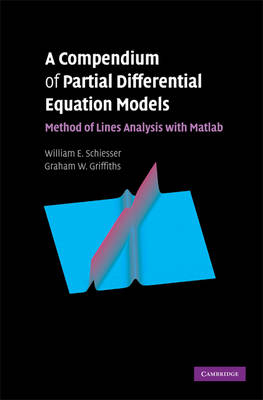
Mathematical modelling of physical and chemical systems is used extensively throughout science, engineering, and applied mathematics. To use mathematical models, one needs solutions to the model equations, this generally requires numerical methods. This book presents numerical methods and associated computer code in Matlab for the solution of a spectrum of models expressed as partial differential equations (PDEs). The authors focus on the method of lines (MOL), a well-established procedure for all major classes of PDEs, where the boundary value partial derivatives are approximated algebraically by finite differences. This reduces the PDEs to ordinary differential equations (ODEs) and makes the computer code easy to understand, implement, and modify. Also, the ODEs (via MOL) can be combined with any other ODEs that are part of the model (so that MOL naturally accommodates ODE/PDE models). This book uniquely includes a detailed line-by-line discussion of computer code related to the associated PDE model.
Mathematical modelling of physical and chemical systems is used extensively throughout science, engineering, and applied mathematics. To use mathematical models, one needs solutions to the model equations; this generally requires numerical methods. This book presents numerical methods and associated computer code in Matlab for the solution of a spectrum of models expressed as partial differential equations (PDEs). The authors focus on the method of lines (MOL), a well-established procedure for all major classes of PDEs, where the boundary value partial derivatives are approximated algebraically by finite differences. This reduces the PDEs to ordinary differential equations (ODEs) and makes the computer code easy to understand, implement, and modify. Also, the ODEs (via MOL) can be combined with any other ODEs that are part of the model (so that MOL naturally accommodates ODE/PDE models). This book uniquely includes a detailed line-by-line discussion of computer code related to the associated PDE model.
| Erscheint lt. Verlag | 10.4.2009 |
|---|---|
| Sprache | englisch |
| Themenwelt | Sachbuch/Ratgeber |
| Mathematik / Informatik ► Mathematik ► Analysis | |
| Mathematik / Informatik ► Mathematik ► Angewandte Mathematik | |
| Technik | |
| ISBN-10 | 0-511-50134-X / 051150134X |
| ISBN-13 | 978-0-511-50134-0 / 9780511501340 |
| Informationen gemäß Produktsicherheitsverordnung (GPSR) | |
| Haben Sie eine Frage zum Produkt? |
 PDF (Adobe DRM)
Kopierschutz: Adobe-DRM
Adobe-DRM ist ein Kopierschutz, der das eBook vor Mißbrauch schützen soll. Dabei wird das eBook bereits beim Download auf Ihre persönliche Adobe-ID autorisiert. Lesen können Sie das eBook dann nur auf den Geräten, welche ebenfalls auf Ihre Adobe-ID registriert sind.
Details zum Adobe-DRM
Dateiformat: PDF (Portable Document Format)
Mit einem festen Seitenlayout eignet sich die PDF besonders für Fachbücher mit Spalten, Tabellen und Abbildungen. Eine PDF kann auf fast allen Geräten angezeigt werden, ist aber für kleine Displays (Smartphone, eReader) nur eingeschränkt geeignet.
Systemvoraussetzungen:
PC/Mac: Mit einem PC oder Mac können Sie dieses eBook lesen. Sie benötigen eine
eReader: Dieses eBook kann mit (fast) allen eBook-Readern gelesen werden. Mit dem amazon-Kindle ist es aber nicht kompatibel.
Smartphone/Tablet: Egal ob Apple oder Android, dieses eBook können Sie lesen. Sie benötigen eine
Geräteliste und zusätzliche Hinweise
Buying eBooks from abroad
For tax law reasons we can sell eBooks just within Germany and Switzerland. Regrettably we cannot fulfill eBook-orders from other countries.
aus dem Bereich