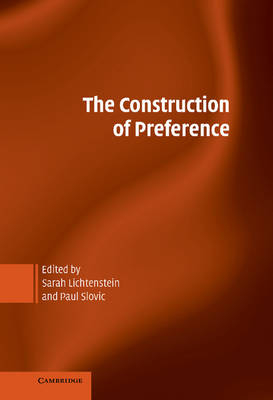
Construction of Preference (eBook)
Cambridge University Press (Verlag)
9780511242885 (ISBN)
One of the main themes that has emerged from behavioral decision research during the past three decades is the view that people's preferences are often constructed in the process of elicitation. This idea is derived from studies demonstrating that normatively equivalent methods of elicitation (e.g., choice and pricing) give rise to systematically different responses. These preference reversals violate the principle of procedure invariance that is fundamental to all theories of rational choice. If different elicitation procedures produce different orderings of options, how can preferences be defined and in what sense do they exist? This book shows not only the historical roots of preference construction but also the blossoming of the concept within psychology, law, marketing, philosophy, environmental policy, and economics. Decision making is now understood to be a highly contingent form of information processing, sensitive to task complexity, time pressure, response mode, framing, reference points, and other contextual factors.
One of the main themes that has emerged from behavioral decision research during the past three decades is the view that people's preferences are often constructed in the process of elicitation. This idea is derived from studies demonstrating that normatively equivalent methods of elicitation (e.g., choice and pricing) give rise to systematically different responses. These preference reversals violate the principle of procedure invariance that is fundamental to all theories of rational choice. If different elicitation procedures produce different orderings of options, how can preferences be defined and in what sense do they exist? This book shows not only the historical roots of preference construction but also the blossoming of the concept within psychology, law, marketing, philosophy, environmental policy, and economics. Decision making is now understood to be a highly contingent form of information processing, sensitive to task complexity, time pressure, response mode, framing, reference points, and other contextual factors.
| Sprache | englisch |
|---|---|
| Themenwelt | Sachbuch/Ratgeber |
| Geisteswissenschaften ► Psychologie ► Allgemeine Psychologie | |
| Geisteswissenschaften ► Psychologie ► Verhaltenstherapie | |
| ISBN-13 | 9780511242885 / 9780511242885 |
| Informationen gemäß Produktsicherheitsverordnung (GPSR) | |
| Haben Sie eine Frage zum Produkt? |
 PDF (Adobe DRM)
Kopierschutz: Adobe-DRM
Adobe-DRM ist ein Kopierschutz, der das eBook vor Mißbrauch schützen soll. Dabei wird das eBook bereits beim Download auf Ihre persönliche Adobe-ID autorisiert. Lesen können Sie das eBook dann nur auf den Geräten, welche ebenfalls auf Ihre Adobe-ID registriert sind.
Details zum Adobe-DRM
Dateiformat: PDF (Portable Document Format)
Mit einem festen Seitenlayout eignet sich die PDF besonders für Fachbücher mit Spalten, Tabellen und Abbildungen. Eine PDF kann auf fast allen Geräten angezeigt werden, ist aber für kleine Displays (Smartphone, eReader) nur eingeschränkt geeignet.
Systemvoraussetzungen:
PC/Mac: Mit einem PC oder Mac können Sie dieses eBook lesen. Sie benötigen eine
eReader: Dieses eBook kann mit (fast) allen eBook-Readern gelesen werden. Mit dem amazon-Kindle ist es aber nicht kompatibel.
Smartphone/Tablet: Egal ob Apple oder Android, dieses eBook können Sie lesen. Sie benötigen eine
Geräteliste und zusätzliche Hinweise
Buying eBooks from abroad
For tax law reasons we can sell eBooks just within Germany and Switzerland. Regrettably we cannot fulfill eBook-orders from other countries.
aus dem Bereich