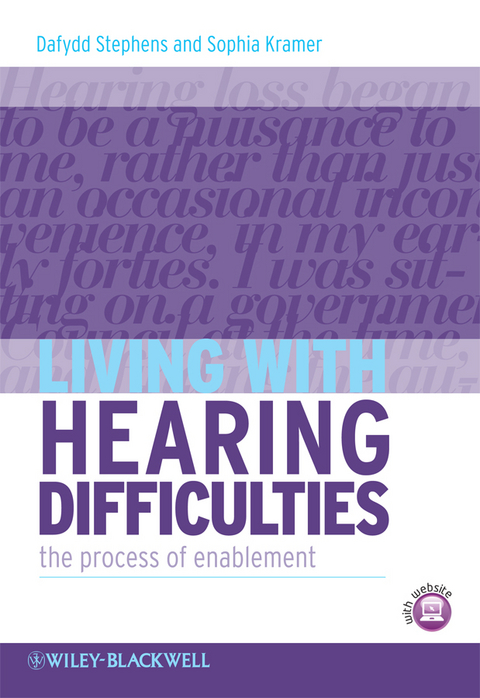
Living with Hearing Difficulties (eBook)
John Wiley & Sons (Verlag)
978-0-470-99612-6 (ISBN)
The thirteen chapters encompass four sections which broadly follow the categories of the World Health Organization's ICF (2001):
- Section 1 addresses types of hearing disorders, the impairments they cause and also the process of help seeking.
- Section 2 deals with the effects of hearing impairment on communication and psychosocial functioning.
- Section 3 considers the individual in their environment; their family, work, and leisure. Section 4 elaborates on the process of enablement in a non-prescriptive manner.
The authors approach the problems and needs from the standpoint of what the patient/client is seeking. Enablement is seen as a team effort between the professionals, the patient and their family in an ever-changing environment. This entails using any relevant techniques to ensure the well-being of the individual with hearing impairment; that end remains very much their goal.
The book also has a companion website www.wiley.com/go/stephens which hosts additional downloadable documents as well as a demonstration of the concept of the signal-to-noise ratio.
Dafydd Stephens FRCP, is Honorary Professor of Audiological Medicine at Cardiff University, Wales, UK.
Sophia E. Kramer, PhD, is Senior Researcher and Psychologist at the Department of E.N.T. / Audiology / EMGO Institute for Health and Care Research at the VU University Medical Centre in Amsterdam, the Netherlands.
Living with Hearing Difficulties is a source-book for professionals who encounter and support individuals with hearing difficulties. It will also be of interest to people with hearing difficulties themselves and those close to them. The book highlights the concept of audiological enablement as being an interactive process requiring the active involvement of both clinician and patient. The thirteen chapters encompass four sections which broadly follow the categories of the World Health Organization's ICF (2001): Section 1 addresses types of hearing disorders, the impairments they cause and also the process of help seeking. Section 2 deals with the effects of hearing impairment on communication and psychosocial functioning. Section 3 considers the individual in their environment; their family, work, and leisure. Section 4 elaborates on the process of enablement in a non-prescriptive manner. The authors approach the problems and needs from the standpoint of what the patient/client is seeking. Enablement is seen as a team effort between the professionals, the patient and their family in an ever-changing environment. This entails using any relevant techniques to ensure the well-being of the individual with hearing impairment; that end remains very much their goal. The book also has a companion website www.wiley.com/go/stephens which hosts additional downloadable documents as well as a demonstration of the concept of the signal-to-noise ratio.
Dafydd Stephens FRCP, is Honorary Professor of Audiological Medicine at Cardiff University, Wales, UK. Sophia E. Kramer, PhD, is Senior Researcher and Psychologist at the Department of E.N.T. / Audiology / EMGO Institute for Health and Care Research at the VU University Medical Centre in Amsterdam, the Netherlands.
Living with Hearing Difficulties: the process of enablement 1
Contents 7
Foreword 10
Preface 12
Acknowledgements 15
1: Introduction 17
The need for this book 17
Terminology 18
Layout of the book 20
The World Health Organization classifications 21
Theoretical/management models in the general rehabilitation literature 24
Models of audiological enablement 27
The Goldstein–Stephens model 29
The role of positive experiences associated with hearing impairment 35
Relevant measures in assessing patients’needs and the outcomes of interventions 37
Development of a preliminary model appropriate to hearing impairment 40
Conclusion 41
2: Seeking help 42
Introduction 42
Becoming aware of hearing difficulties 43
The decision to seek help 47
Referral for hearing help 52
Ethics/philosophy of adult screening 54
Conclusion 58
3: Types of hearing impairment and their consequences 59
Introduction 59
Basic anatomy and physiology and their implications 59
Purposes and process of assessment 63
Types of hearing impairment and their consequences 66
Severity of hearing impairment 70
Unilateral/asymmetrical hearing impairment 71
Age of onset 71
Genetic issues 73
Progressive/sudden onset 74
Conclusion 74
4: The influence of other factors on assessment and goals of enablement 76
Introduction 76
Auditory symptoms 76
General aural symptoms 79
Vision 82
Cognitive and intellectual factors 83
Neuromusculoskeletal problems 84
Conclusion 85
5: Communication 87
Introduction 87
Ecological audiology 87
Ramsdell’s classification 89
Attitudes of the Deaf 97
Conclusion 98
6: Social and emotional aspects of hearing impairment 99
Introduction 99
Participation in life 99
Psychosocial dysfunction 100
Psychosocial consequences of Deafness 106
Demographic factors 107
Conclusion 110
7: Hearing impairment in the family 112
Introduction 112
Impact of hearing impairment on significant others 112
Coping strategies 114
Inclusion of significant others in enablement programmes 116
Hearing impairment arising from genetic causes or with a familial basis 116
Impact of having a family history of hearing impairment 118
Discussion 123
Conclusion 124
8: The process of enablement at work 125
Introduction 125
Statistics 125
Impact of hearing impairment on occupational performance 126
Impact of work-related hearing impairment on significant others 129
Vocational enablement 130
Vocational Enablement Protocol (VEP) 131
Discussion 136
Conclusion 137
9: Leisure and the wider social environment 138
Introduction 138
Prevalence 138
Solitary versus interactive pastimes 139
The role of leisure 139
Opportunities for entertainment and leisure 140
Community life 141
Recreation and leisure 142
Religion and spirituality 147
Human rights, political life and citizenship 148
Conclusion 149
10: The process of enablement 1: Evaluation and decision-making 150
Introduction 150
The evaluation process 150
Integration and decision-making 172
Conclusion 175
11: The process of enablement 2: Short-term remediation 176
Introduction 176
Instrumentation 176
Strategy 190
Ancillary help 194
Conclusion 196
12: Enablement 3: Ongoing remediation and outcome assessment 197
Ongoing remediation 197
Effectiveness of group programmes 210
Outcome assessment 212
Conclusion 217
13: Overall conclusions 218
Appendix: Longitudinal change in enablement needs of older people with hearing impairment 221
References 225
Index 253
| Erscheint lt. Verlag | 28.7.2009 |
|---|---|
| Sprache | englisch |
| Themenwelt | Sachbuch/Ratgeber ► Gesundheit / Leben / Psychologie ► Lebenshilfe / Lebensführung |
| Medizin / Pharmazie ► Gesundheitsfachberufe ► Logopädie | |
| Medizin / Pharmazie ► Medizinische Fachgebiete ► HNO-Heilkunde | |
| Schlagworte | Active • audiological • Audiologie • audiology • Book • Chapters • Clinician • Concept • difficulties • Enablement • Gesundheits- u. Sozialwesen • Health • Health & Social Care • hearing • ICF • Individuals • Interactive • Interest • Involvement • People • Process • Professionals • section • sections • Sourcebook • Themselves • thirteen |
| ISBN-10 | 0-470-99612-9 / 0470996129 |
| ISBN-13 | 978-0-470-99612-6 / 9780470996126 |
| Informationen gemäß Produktsicherheitsverordnung (GPSR) | |
| Haben Sie eine Frage zum Produkt? |
 PDF (Adobe DRM)
Kopierschutz: Adobe-DRM
Adobe-DRM ist ein Kopierschutz, der das eBook vor Mißbrauch schützen soll. Dabei wird das eBook bereits beim Download auf Ihre persönliche Adobe-ID autorisiert. Lesen können Sie das eBook dann nur auf den Geräten, welche ebenfalls auf Ihre Adobe-ID registriert sind.
Details zum Adobe-DRM
Dateiformat: PDF (Portable Document Format)
Mit einem festen Seitenlayout eignet sich die PDF besonders für Fachbücher mit Spalten, Tabellen und Abbildungen. Eine PDF kann auf fast allen Geräten angezeigt werden, ist aber für kleine Displays (Smartphone, eReader) nur eingeschränkt geeignet.
Systemvoraussetzungen:
PC/Mac: Mit einem PC oder Mac können Sie dieses eBook lesen. Sie benötigen eine
eReader: Dieses eBook kann mit (fast) allen eBook-Readern gelesen werden. Mit dem amazon-Kindle ist es aber nicht kompatibel.
Smartphone/Tablet: Egal ob Apple oder Android, dieses eBook können Sie lesen. Sie benötigen eine
Geräteliste und zusätzliche Hinweise
Buying eBooks from abroad
For tax law reasons we can sell eBooks just within Germany and Switzerland. Regrettably we cannot fulfill eBook-orders from other countries.
aus dem Bereich