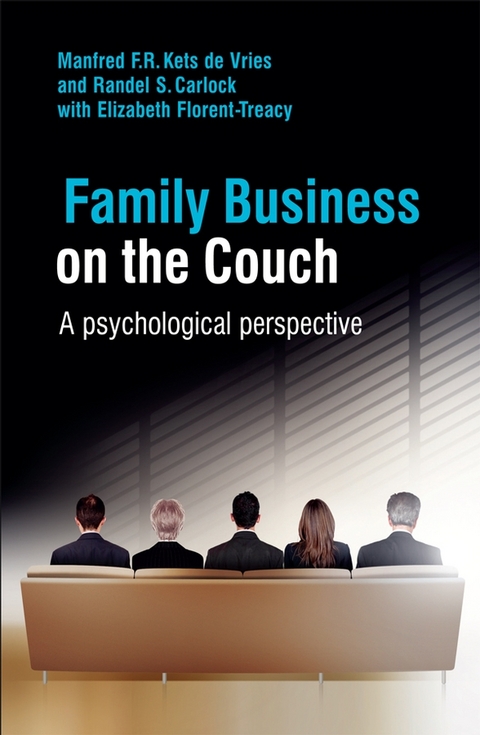
Family Business on the Couch (eBook)
John Wiley & Sons (Verlag)
978-0-470-68747-5 (ISBN)
Here is a new understanding and a broader perspective on the human dynamics of family firms with two complementary frameworks, psychodynamic and family systematic, to help make sense of family-run organisations. Although this book includes a conceptual section, it is first and foremost a practical book about the real world issues faced by business families.
The book begins by demonstrating that many years of achievement through generations can be destroyed by the next, if the family fails to address the psychological issues they face. By exploring cases from famous and less well known family businesses across the world, the authors discuss entrepreneurs, the entrepreneurial family and the lifecycles of the individual and the organisation. They go on to show how companies going through change and transition can avoid the pitfalls that endanger both family and company. The authors then apply tools that will help family businesses in transition and offer their analyses and conclusions.
Readers should draw their own conclusions from careful examination of the cases, identifying the problems or dilemmas faced and the options for improved business performance and family relationships. They should ask what they might have done in the given situation and what new insight into individual or family behaviour each case offers. The goal is to avoid a bitter ending.
MANFRED F.R. KETS DE VRIES brings a unique perspective to the much-studied subjects of leadership and the dynamics of individual and organizational change. He is a clinical professor of leadership development and holds the Raoul de Vitry d’Avaucourt Chair of Leadership Development at INSEAD, France & Singapore. He is also the Director of INSEAD’s Global Leadership Center. He has held professorships at McGill University, the Ecole des Hautes Etudes Commerciales, Montreal, and the Harvard Business School, and he has lectured at management institutions around the world. He is a founding member of the International Society for the Psychoanalytic Study of Organizations. The Financial Times, Le Capital, Wirtschaftswoche, and The Economist have rated Manfred Kets de Vries among the world’s top fifty thinkers on management and among the world’s most influential people in human resource management.
He is the author, co-author, or editor of more than 24 books and over 250 scientific papers as chapters in books and as articles. His books and articles have been translated into more than 25 languages. He was also the first non-American recipient of the International Leadership Award for “his contributions to the classroom and the board room.”
Kets de Vries is a consultant on organizational design/transformation and strategic human resource management to leading US, Canadian, European, African, Australian and Asian companies. As an educator and consultant he has worked in more than forty countries.
DR. RANDEL S. CARLOCK is the first Berghmans Lhoist Chaired Professor in Entrepreneurial Leadership, the founding Director of the Wendel International Centre for Family Enterprise and a founding board member of the Global Leadership Centre at INSEAD. Previously he was the first Opus Professor of Family Enterprise and founder of the family business center at the University of St. Thomas in Minneapolis, MN (USA). Carlock has an MA in education and training (1976), an MBA in strategic management (1983), and a Ph.D. (1991), all from the University of Minnesota. His doctoral dissertation explored the role of organization development in managing high growth entrepreneurial firms. He has also completed a post graduate certification in family and marriage therapy at the Institute of Psychiatry, King’s College, University of London (1998) and a certificate in psychodynamic counseling at Birkbeck College, University of London (1999). He was awarded a Certificate in Family Business Advising with Fellow Status (2001) by The Family Firm Institute, Boston, MA (USA).
He is the author of several books, articles, book chapters, videos and case studies. He has over 25 years of experience serving as an executive with a global family business and as CEO and chairman of his own NASDAQ listed corporation. He currently advises global business families and corporations around the world specializing in Asia, Europe and the Middle East.
ELIZABETH FLORENT-TREACY, Research Project Manager at INSEAD, Fontainebleau, France, and Singapore, She works in the INSEAD Global Leadership Centre, and the Wendel International Centre for Family Enterprise. She has conducted research in the following areas: global leadership; global organizations; corporate culture in European and global organizations; American, French and Russian business practices; family business issues (governance, succession, strategy); entrepreneurial leadership; cross-cultural management; women and global leadership; cultural aspects of mergers and acquisitions; transformational leadership; expatriate executives and families; and the psychodynamics of leadership. She holds degrees in Sociology (BA) and Organization Development (MA).
Elizabeth has written authored or co-authored 4 books, 21 articles, working papers and book chapters and 18 case studies on leadership and family business topics.
The challenge faced by family businesses and their stakeholders, is to recognise the issues that they face, understand how to develop strategies to address them and more importantly, to create narratives, or family stories that explain the emotional dimension of the issues to the family. The most intractable family business issues are not the business problems the organisation faces, but the emotional issues that compound them. Applying psychodynamic concepts will help to explain behaviour and will enable the family to prepare for life cycle transitions and other issues that may arise. Here is a new understanding and a broader perspective on the human dynamics of family firms with two complementary frameworks, psychodynamic and family systematic, to help make sense of family-run organisations. Although this book includes a conceptual section, it is first and foremost a practical book about the real world issues faced by business families. The book begins by demonstrating that many years of achievement through generations can be destroyed by the next, if the family fails to address the psychological issues they face. By exploring cases from famous and less well known family businesses across the world, the authors discuss entrepreneurs, the entrepreneurial family and the lifecycles of the individual and the organisation. They go on to show how companies going through change and transition can avoid the pitfalls that endanger both family and company. The authors then apply tools that will help family businesses in transition and offer their analyses and conclusions. Readers should draw their own conclusions from careful examination of the cases, identifying the problems or dilemmas faced and the options for improved business performance and family relationships. They should ask what they might have done in the given situation and what new insight into individual or family behaviour each case offers. The goal is to avoid a bitter ending.
Preface
Acknowledgements
PART I: QUESTIONS AND OBSERVATIONS
Introduction
Endnote
1 A Psychological Perspective on Business Families
Psychodynamic and family systemic perspectives
Key ideas from the psychodynamic approach
The role of transference and countertransference
The family systemic perspective
A therapeutic alliance
A summing-up
Endnotes
2 The Challenges of Love and Work
Conflicting goals in the family business
The tree-circles model
How conflict can develop
Endnotes
3 Family Business Practices: Assessing Strengths and Weaknesses
The interface of business and family practices
Assessing the health of a family business
Endnotes
PART II: REFLECTION AND LEARNING
4 The Life Cycle as an Organizing Construct
The multiple life cycles of the family business
Key models of human psychological development
The family life cycle
Carter and McGoldrick's family-based life cycle model
Applying the life cycle in family businesses
Endnotes
5 Narcissism, Envy, and Myths in Family Firms
Personality types
Managerial implications of dysfunctional narcissism
The importance of individuation
The family firm as transitional object
The power of envy
Games families play: the role of family myths
The impact of family myths on the family business
Summary
Endnotes
6 The Entrepreneur: Alone at the Top
Common personality characteristics of founder-entrepreneurs
Larry Ellison and Oracle
Deciphering the inner theater of the entrepreneur
Common defensive structures in founder-entrepreneurs
Maintaining the balance
Endnotes
7 Leadership Transition: Replacing a Parent as CEO
Options for tackling the succession problem
The inheritance
Psychological pressures on new leaders
Staying on course
Endnotes
8 A Systemic View of the Business Family
A two-way relationship
The evolution of systems theory
The development of family-systems theory
The family-systems proposition
Family scripts and rules
Family scripts in the family business
A practical example of family systems thinking
Endnotes
9 Diagnosing Family Entanglements
The family genogram
The Circumplex Model of marriage and family systems
Differentiation of self from family of origin
Two family stories
Endnotes
PART III: INTEGRATION AND ACTION
10 Addressing Transitions and Change
Lewin's ideas on change
The Kets de Vries model of individual change
Major themes in the individual journey toward change
The process of change within organizations
The change process in families
Family focus or organization focus?
Endnotes
11 The Vicissitudes of Family Business
The Steinbergs: A study in self-destruction
The immigrant dream
His mother's son
The entrepreneur's vision
Sam as a family business leader
The entrepreneur's dilemma: Passing the baton
The next generation
Irving Ludmer: Play it again, Sam
A family systems perspective on the Steinbergs
The effects of Sam Steinberg's inner world on the family business
The inner theater of Sam's daughters
What if?
Endnotes
12 Putting Family Business Intervention into Practice
The Family Action Research Process
The succession conundrum
The role of the outside adviser
Advice to families seeking help
The benefits pf a psychodynamic systems perspective
Final words
Endnotes
Appendix 1: Developing a Business Family Genogram
Creating the genogram
Therapeutic applications of the genogram
Using the genogram to identify family scripts and themes
How genograms improve communication
Endnotes
Appendix 2: The Clinical Rating Scales and the Circumplex Model
How the CRS work
Endnotes
Index
"...explores the reasons why some family businesses are
dysfunctional - and how to cure them." (The
Guardian, Saturday 15th September 2007)
"fascinating new book" (The Independent, Tuesday 9th
October 2007)
"a unique insight into the subject." (Guardian Unlimited
guardian.co.uk, Thursday 13th December)
"You'll find this book well worth reading" (Edge,
February 2008)
"...an insight into addressing key family buisness issues."
(Gulf Buisness, February 2008)
PSYCHODYNAMIC AND FAMILY SYSTEMIC PERSPECTIVES
KEY IDEAS FROM THE PSYCHODYNAMIC APPROACH
THE ROLE OF TRANSFERENCE AND COUNTERTRANSFERENCE
| Erscheint lt. Verlag | 2.3.2010 |
|---|---|
| Co-Autor | Elizabeth Florent-Treacy |
| Sprache | englisch |
| Themenwelt | Sachbuch/Ratgeber ► Beruf / Finanzen / Recht / Wirtschaft ► Bewerbung / Karriere |
| Wirtschaft ► Betriebswirtschaft / Management ► Planung / Organisation | |
| Schlagworte | business • Business & Management • Businesses • Business Self-Help • effectively • Family • Firm • groundbreaking • holistic • Impact • Individual Personality • interpersonal • Irrationalities • Officer • Powerful • Ratgeber Wirtschaft • Rational • relationships • Singapore • Soul • Surface • topic • View • Way • Wirtschaft /Ratgeber • Wirtschaft u. Management |
| ISBN-10 | 0-470-68747-9 / 0470687479 |
| ISBN-13 | 978-0-470-68747-5 / 9780470687475 |
| Informationen gemäß Produktsicherheitsverordnung (GPSR) | |
| Haben Sie eine Frage zum Produkt? |
 EPUB (Adobe DRM)
Kopierschutz: Adobe-DRM
Adobe-DRM ist ein Kopierschutz, der das eBook vor Mißbrauch schützen soll. Dabei wird das eBook bereits beim Download auf Ihre persönliche Adobe-ID autorisiert. Lesen können Sie das eBook dann nur auf den Geräten, welche ebenfalls auf Ihre Adobe-ID registriert sind.
Details zum Adobe-DRM
Dateiformat: EPUB (Electronic Publication)
EPUB ist ein offener Standard für eBooks und eignet sich besonders zur Darstellung von Belletristik und Sachbüchern. Der Fließtext wird dynamisch an die Display- und Schriftgröße angepasst. Auch für mobile Lesegeräte ist EPUB daher gut geeignet.
Systemvoraussetzungen:
PC/Mac: Mit einem PC oder Mac können Sie dieses eBook lesen. Sie benötigen eine
eReader: Dieses eBook kann mit (fast) allen eBook-Readern gelesen werden. Mit dem amazon-Kindle ist es aber nicht kompatibel.
Smartphone/Tablet: Egal ob Apple oder Android, dieses eBook können Sie lesen. Sie benötigen eine
Geräteliste und zusätzliche Hinweise
Buying eBooks from abroad
For tax law reasons we can sell eBooks just within Germany and Switzerland. Regrettably we cannot fulfill eBook-orders from other countries.
aus dem Bereich