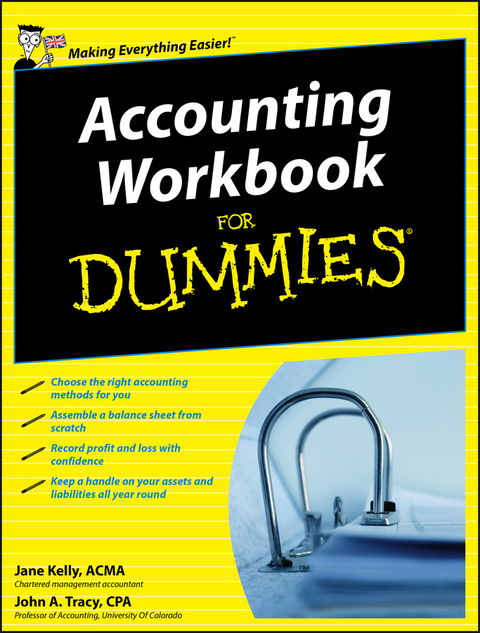
Accounting Workbook For Dummies, UK Edition (eBook)
John Wiley & Sons (Verlag)
978-0-470-66502-2 (ISBN)
This hands-on workbook gets you up to speed with the basics of business accounting, including reading financial reports, establishing budgets, controlling cash flow, and making wise financial decisions. The question and answer sections encourage you to find your own solutions to challenging accounting problems - and there's plenty of space to scribble your workings out! Accounting Workbook For Dummies is the only book that makes truly light work of the financial fundamentals that many businesspeople try to bluff their way through every day.
Accounting Workbook For Dummies, UK Edition covers:
Part I: Business Accounting Basics
Chapter 1: Elements of Business Accounting
Chapter 2: Financial Effects of Transactions
Chapter 3: Getting Started in the Bookkeeping Cycle
Chapter 4: The Bookkeeping Cycle: Adjusting and Closing Entries
Part II: Preparing Financial Statements
Chapter 5: The Effects and Reporting of Profit
Chapter 6: Reporting Financial Condition in the Balance Sheet
Chapter 7: Coupling the Profit & Loss Statement and Balance Sheet
Chapter 8: Reporting Cash Flows and Changes in Owners' Equity
Chapter 9: Choosing Accounting Methods
Part III: Managerial, Manufacturing, and Capital Accounting
Chapter 10: Analysing Profit Behavior
Chapter 11: Manufacturing Cost Accounting
Chapter 12: Figuring Out Interest and Return on Investment
Part IV: The Part of Tens
Chapter 13: Ten Things You Should Know About Business Financial Statements
Chapter 14: A Ten-Point Checklist for Management Accountants
Main changes in the UK edition include:
- UK Accounting practice
- Currency
- UK institutions - Inland Revenue and Customs and Excise etc
- National Insurance, PAYE
- UK taxation and VAT
- Partnerships and Limited company information
- UK legal practice
- UK specific forms
- UK specific case studies
Jane Kelly is a chartered management accountant, bookkeeping teacher and business author.
John A. Tracy is Professor of Accounting at the University of Colorado.
Want to become an accountant? Own a small business but need help balancing your books? Worried about managing your finances under the cloud of the recession? This hands-on workbook gets you up to speed with the basics of business accounting, including reading financial reports, establishing budgets, controlling cash flow, and making wise financial decisions. The question and answer sections encourage you to find your own solutions to challenging accounting problems - and there's plenty of space to scribble your workings out! Accounting Workbook For Dummies is the only book that makes truly light work of the financial fundamentals that many businesspeople try to bluff their way through every day. Accounting Workbook For Dummies, UK Edition covers: Part I: Business Accounting BasicsChapter 1: Elements of Business AccountingChapter 2: Financial Effects of TransactionsChapter 3: Getting Started in the Bookkeeping Cycle Chapter 4: The Bookkeeping Cycle: Adjusting and Closing Entries Part II: Preparing Financial StatementsChapter 5: The Effects and Reporting of ProfitChapter 6: Reporting Financial Condition in the Balance SheetChapter 7: Coupling the Profit & Loss Statement and Balance SheetChapter 8: Reporting Cash Flows and Changes in Owners' EquityChapter 9: Choosing Accounting Methods Part III: Managerial, Manufacturing, and Capital AccountingChapter 10: Analysing Profit BehaviorChapter 11: Manufacturing Cost AccountingChapter 12: Figuring Out Interest and Return on Investment Part IV: The Part of TensChapter 13: Ten Things You Should Know About Business Financial StatementsChapter 14: A Ten-Point Checklist for Management Accountants Main changes in the UK edition include: UK Accounting practice Currency UK institutions - Inland Revenue and Customs and Excise etc National Insurance, PAYE UK taxation and VAT Partnerships and Limited company information UK legal practice UK specific forms UK specific case studies
Jane Kelly is a chartered management accountant, bookkeeping teacher and business author. John A. Tracy is Professor of Accounting at the University of Colorado.
Accounting Workbook For Dummies® 1
About the Authors 5
Dedication 7
Authors’ Acknowledgements 7
Contents at a Glance 9
Table of Contents 11
Introduction 15
About This Book 15
Foolish Assumptions 16
How This Book Is Organised 16
Icons Used in This Book 17
Where to Go from Here 18
Part I: Business Accounting Basics 19
Chapter 1: Elements of Business Accounting 21
Keeping the Accounting Equation in Balance 21
Distinguishing Between Cash-and Accrual-Based Accounting 24
Summarising Profit Activities in the Profit and Loss Statement 27
Assembling a Balance Sheet 28
Partitioning the Cash Flow Statement 31
Tracing How Dishonest Accounting Distorts Financial Statements 33
Answers to Problems on Elements of Business Accounting 35
Chapter 2: Financial Effects of Transactions 39
Relying on Accurate Transaction Records 39
Classifying Business Transactions 41
Seeing Both Sides of Business Transactions 43
Concentrating on Sales 47
Concentrating on Expenses 50
Determining the Composite Effect of Profit 53
Answers to Problems on Financial Effects of Transactions 56
Chapter 3: Getting Started in the Bookkeeping Cycle 63
Constructing the Chart of Accounts 63
Discussing Nominal Accounts 66
Knowing Your Debits from Your Credits 69
Making Original Journal Entries 73
Recording Revenue and Income 75
Recording Expenses and Losses 77
Recording Investing and Financing Transactions 80
Answers to Problems on the Bookkeeping Cycle 82
Chapter 4: The Bookkeeping Cycle: Adjusting and Closing Entries 89
Getting Accurate with Adjusting Entries 89
Breaking Down the End-of-Year Adjusting Entries 92
Closing the Books on the Year 98
Instituting Internal Controls 100
Answers to Problems on the Bookkeeping Cycle 102
Part II: Preparing Financial Statements 107
Chapter 5: Reporting Profit 109
Understanding the Nature of Profit 109
Profit and Loss Statement Format 112
Examining How Sales and Expenses Change Assets and Liabilities 113
Summing Up the Manifold Effects of Profit 117
Answers to Problems on the Effects and Reporting of Profit 120
Chapter 6: Reporting Financial Condition in the Balance Sheet 127
Getting Started on the Balance Sheet 128
Building a Balance Sheet 130
Fleshing Out the Balance Sheet 133
Clarifying the Values of Assets in Balance Sheets 138
Using the Balance Sheet in Business Valuation 139
Answers to Problems on Reporting Financial Condition in the Balance Sheet 142
Chapter 7: Coupling the Profit and Loss Statement and Balance Sheet 149
Rejoining the Profit and Loss Statement and Balance Sheet 149
Filling in Key Pieces of the Balance Sheet from the Profit and Loss Statement 152
Putting Fixed Assets in the Picture 154
Completing the Balance Sheet with Debt and Capital 156
Answers to Problems on Coupling the Profit and Loss Statement and Balance Sheet 159
Chapter 8: Reporting Cash Flows and Changes in Owners’ Capital 163
Figuring Profit from the Balance Sheet 163
Reporting the Statement of Changes in Shareholders’ Capital 166
Determining Cash Effect from Making Profit 167
Presenting the Cash Flow Statement 170
Reporting Cash Flows 170
Connecting Balance Sheet Changes with Cash Flows 172
Answers for Problems on Reporting Cash Flows and Changes in Owners’ Capital 175
Chapter 9: Choosing Accounting Methods 181
Getting Off to a Good Start 181
Cost of Goods Sold Expense Methods 184
Appreciating Depreciation Methods 191
Timing Bad Debts Expense 193
Answers to Problems on Choosing Accounting Methods 196
Part III: Managerial, Manufacturing and Capital Accounting 201
Chapter 10: Analysing Profit Behaviour 203
Mapping Profit for Managers 203
Analysing Operating Profit 206
Analysing Return on Capital 210
Improving Profit Performance 212
Making Trade-Offs Among Profit Factors 217
Answers to Problems on Analysing Profit Behaviour 219
Chapter 11: Manufacturing Cost Accounting 229
Minding Manufacturing Costs 229
Taking a Short Tour of Manufacturing Entries 233
Calculating Product Cost: Basic Methods and Problems 237
Calculating Product Cost in Unusual Situations 243
Answers to Problems on Manufacturing Cost Accounting 247
Chapter 12: Figuring Out Interest and Return on Investment 259
Getting Down to the Basics of Interest 259
Lifting the Veil on Compound Interest 264
Borrowing and Investing in Instalments 266
Measuring Return on Investment (ROI) 268
Answers to Problems on Interest and Return on Investment 270
Part IV: The Part of Tens 275
Chapter 13: Ten Things You Need to Know about Business Financial Statements 277
Rules and Standards Matter 277
Exactitude Would Be Nice, but Estimates Are Key 278
Financial Statements Fit Together Hand in Glove 278
Accrual Basis Is Used to Record Profit, Assets and Liabilities 279
Cash Flow Differs from Accrual Basis Profit 279
Profit and Balance Sheet Values Can Be (and Often Are) Manipulated 280
Financial Statements Are Historical 280
Some Asset Values Are Current, but Others May Be Old 280
Financial Statements Leave Interpretation to Readers 281
Financial Statements Tell the Story of a Business, Not Its Individual Shareholders 281
Chapter 14: A Ten-Point Checklist for Management Accountants 283
Designing Internal Accounting Reports 283
Helping Managers Understand Their Accounting Reports 284
Involving Managers in Choosing Accounting Methods 284
Creating Profit Performance Reports for Managers 285
Formulating Cash Flow Reports for Managers 286
Devising Management Control Reports 286
Developing Models for Management Decision-Making Analysis 286
Working Closely with Managers in Planning 287
Establishing and Enforcing Internal Controls 287
Keeping Up-to-Date on Accounting, Financial Reporting and Tax Changes 288
Index 289
| Erscheint lt. Verlag | 14.1.2010 |
|---|---|
| Sprache | englisch |
| Themenwelt | Sachbuch/Ratgeber ► Beruf / Finanzen / Recht / Wirtschaft ► Wirtschaft |
| Recht / Steuern ► Wirtschaftsrecht | |
| Wirtschaft ► Betriebswirtschaft / Management ► Rechnungswesen / Bilanzen | |
| Schlagworte | Accounting • Balance • Buchhaltung • business • Business School • confidence • Dilemmas • Dummies • everything • Exercises • Home • Jargon • Methods • practical workbook contains • Profit • questions • Rechnungswesen • Record • Sample • Scratch • Sheet • theory • Trouble • Ways • Workbook |
| ISBN-10 | 0-470-66502-5 / 0470665025 |
| ISBN-13 | 978-0-470-66502-2 / 9780470665022 |
| Informationen gemäß Produktsicherheitsverordnung (GPSR) | |
| Haben Sie eine Frage zum Produkt? |
 PDF (Adobe DRM)
Kopierschutz: Adobe-DRM
Adobe-DRM ist ein Kopierschutz, der das eBook vor Mißbrauch schützen soll. Dabei wird das eBook bereits beim Download auf Ihre persönliche Adobe-ID autorisiert. Lesen können Sie das eBook dann nur auf den Geräten, welche ebenfalls auf Ihre Adobe-ID registriert sind.
Details zum Adobe-DRM
Dateiformat: PDF (Portable Document Format)
Mit einem festen Seitenlayout eignet sich die PDF besonders für Fachbücher mit Spalten, Tabellen und Abbildungen. Eine PDF kann auf fast allen Geräten angezeigt werden, ist aber für kleine Displays (Smartphone, eReader) nur eingeschränkt geeignet.
Systemvoraussetzungen:
PC/Mac: Mit einem PC oder Mac können Sie dieses eBook lesen. Sie benötigen eine
eReader: Dieses eBook kann mit (fast) allen eBook-Readern gelesen werden. Mit dem amazon-Kindle ist es aber nicht kompatibel.
Smartphone/Tablet: Egal ob Apple oder Android, dieses eBook können Sie lesen. Sie benötigen eine
Geräteliste und zusätzliche Hinweise
Buying eBooks from abroad
For tax law reasons we can sell eBooks just within Germany and Switzerland. Regrettably we cannot fulfill eBook-orders from other countries.
aus dem Bereich