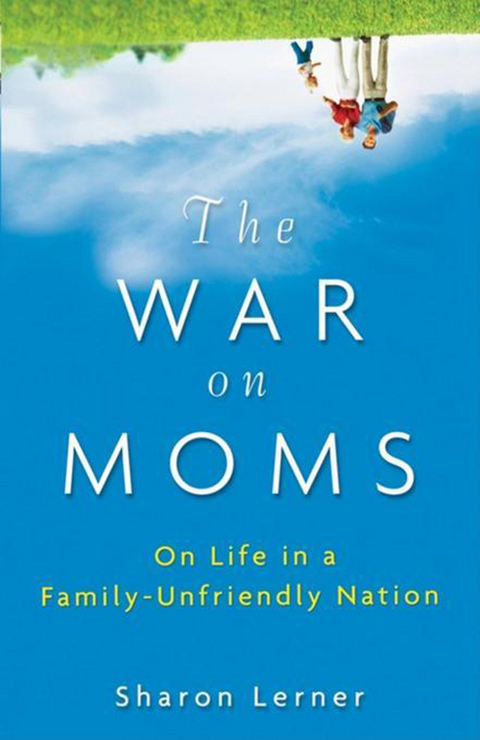
The War on Moms (eBook)
224 Seiten
Turner Publishing Company (Verlag)
978-0-470-58308-1 (ISBN)
SHARON LERNER writes regularly about women and politics for the Nation. A former public-radio producer and Village Voice columnist, her written work has appeared in the New York Times, the American Prospect, and Slate.
Acknowledgments vIntroduction 11 Falling: When Needs Bring Families Down 62 Supermom Returns: Doing It All without Having It All 233 ’Til Dishes Do Us Part: The Problem with Blaming Men 374 The Problems We Wish We Had: A Couple of Choices, None of Them Good 575 Testing the Bootstraps: What Exactly Is Keeping the Women of Mississippi Down? 766 Congratulations, Now Back to Work: Keeping Mothers and Babies Apart 937 Good Day Care Is Hard to Find: The Working Mom Crisis 1218 The Elusive Part-Time Solution: The Stay-at-Home Mom Crisis 1419 Baby Strike: The International Motherhood Experiment 16010 The Blame Game: How and Why We Wound Up in Last Place 172Epilogue 188Notes 197Index 211
How employers make child-rearing an emotional and financial burden for womenThe joy of having a baby quickly morphed into logistical panic when Devorah Gartner learned her newborn had suffered a prenatal stroke and needed daily physical therapy. So the computer software manager asked her employer for a month's leave to care for her daughter. The answer was no, which meant Gartner had to quit her job to care for her child. She lost her health insurance and spiraled into debt.This is not an individual tragedy, writes Sharon Lerner in "The War on Moms: On Life in a Family-Unfriendly Nation," but a national fiasco.The U.S. is failing its mothers. The happy event of a birth often presages disaster for women in this country, the majority of whom get little support in the form of affordable, quality childcare or guaranteed paid maternity leave.Lerner wants to get the revolution started, and her book is a direct appeal for federal intervention to help moms struggling to hold jobs and raise kids at the same time.Dads have challenges too, and increasingly pitch in with housework and childcare, but it's mothers who still, on average, weather the financial and domestic impact of raising children.After becoming parents, most women's incomes go down, while for men, salaries go up. Giving birth, writes Lerner, is "the new financial turning point in many women's lives." She even digs up one study that finds each child a woman has increases her probability of being poor by 5.4 percentage points.The debate of the past decade over whether women should choose to work or stay home with kids is a perverse diversion, argues Lerner persuasively.There is, in fact, no real choice. Women usually neither "opt out" of work, nor do they gamely pump breast milk while typing on BlackBerrys in executive suites, since so few occupy those suites to being with, and so many are pushed out by employers hostile to flex-time or part-time work.One of Lerner's most important contributions here is to remind working parents that the out-of-control feeling is not their fault: It's a policy problem.Women may be working more, but families somehow have less to work with, as the cost of food, gas, housing and healthcare increases. This leads to situations such as that faced by Gartner, who was compelled by a sick child and no flex-time to quit the very job that provided her family's insurance.The recently passed healthcare bill may soon ease the burden, especially for women who will no longer be denied insurance because of the "pre-existing condition" of pregnancy. But getting companies to step up won't do, Lerner writes.There is no widespread economic justification for corporations to initiate flexible workplace provisions for hourly workers, the majority of whom are women. Even the few family-friendly companies that do honor flex-time cover only a small percentage of full-time salaried workers.The solution? Lerner calls for more government intervention, in the form of mandated paid maternity leave, paid sick leave and a national system of affordable, accessible childcare.Without these supports, working parents can face emotional and physical agonies.Take, for example, the issue of maternity leave. It's not just a nicety to allow women to coo in seclusion with their newborns. Often, it's a medical necessity.Women who have had Caesarians are told by doctors to rest for several weeks — but the majority go back to work sooner than that, at risk of losing wages or even their jobs. (Shockingly, only 42% of working mothers stay home for the first 12 weeks of their babies' lives.)What really makes a working mother want to weep, however, is knowing how good it is elsewhere.The United States is one of just a handful of countries that do not offer paid maternity leave. Nations such as Germany or Australia dole out money just for having kids. And after infancy is over, there is free, high-quality childcare in France, Belgium, Denmark and Sweden.In the United States, on the other hand, childcare centers are often costly or dicey, with few regulations and low pay for teachers.Lerner idealizes the Europeans' solutions, without getting into the more controversial economic trade-offs. Nor is she terribly concerned with the gritty details of political solutions at home.For a better primer on getting quality preschool for every 3 and 4-year-old, look at another recent book, "The Promise of Preschool" by Elizabeth Rose, which dissects the push for public preschool in the United States, as well as incremental policy transformations over decades.Instead, Lerner wants change, and she wants it now. "The War on Moms" is an infuriating, galvanizing read — a page-turner for working moms. (Los Angeles Times, May 7, 2010)"An infuriating, galvanizing read — a page-turner for working moms."—The Los Angeles Times
| Erscheint lt. Verlag | 25.3.2010 |
|---|---|
| Sprache | englisch |
| Themenwelt | Sachbuch/Ratgeber ► Beruf / Finanzen / Recht / Wirtschaft ► Wirtschaft |
| Sozialwissenschaften ► Soziologie ► Gender Studies | |
| Sozialwissenschaften ► Soziologie ► Mikrosoziologie | |
| Wirtschaft ► Volkswirtschaftslehre ► Wirtschaftspolitik | |
| Schlagworte | american families • Childbearing • childraising • classisim • Daycare • Economic conditions • familial life • Family • family life • Individualism • marriage • mommy wars • Motherhood • parenthood • Social classes • Social Science • Sociology • sociology of marriage and family • the war on Moms • War on Poverty • Women and business |
| ISBN-10 | 0-470-58308-8 / 0470583088 |
| ISBN-13 | 978-0-470-58308-1 / 9780470583081 |
| Informationen gemäß Produktsicherheitsverordnung (GPSR) | |
| Haben Sie eine Frage zum Produkt? |
 EPUB (Adobe DRM)
Kopierschutz: Adobe-DRM
Adobe-DRM ist ein Kopierschutz, der das eBook vor Mißbrauch schützen soll. Dabei wird das eBook bereits beim Download auf Ihre persönliche Adobe-ID autorisiert. Lesen können Sie das eBook dann nur auf den Geräten, welche ebenfalls auf Ihre Adobe-ID registriert sind.
Details zum Adobe-DRM
Dateiformat: EPUB (Electronic Publication)
EPUB ist ein offener Standard für eBooks und eignet sich besonders zur Darstellung von Belletristik und Sachbüchern. Der Fließtext wird dynamisch an die Display- und Schriftgröße angepasst. Auch für mobile Lesegeräte ist EPUB daher gut geeignet.
Systemvoraussetzungen:
PC/Mac: Mit einem PC oder Mac können Sie dieses eBook lesen. Sie benötigen eine
eReader: Dieses eBook kann mit (fast) allen eBook-Readern gelesen werden. Mit dem amazon-Kindle ist es aber nicht kompatibel.
Smartphone/Tablet: Egal ob Apple oder Android, dieses eBook können Sie lesen. Sie benötigen eine
Geräteliste und zusätzliche Hinweise
Buying eBooks from abroad
For tax law reasons we can sell eBooks just within Germany and Switzerland. Regrettably we cannot fulfill eBook-orders from other countries.
aus dem Bereich