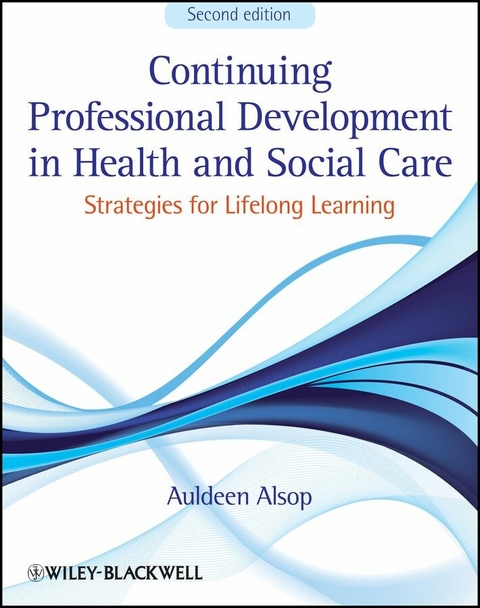
Continuing Professional Development in Health and Social Care (eBook)
John Wiley & Sons (Verlag)
978-1-118-53955-2 (ISBN)
All allied health and social care professionals are required to engage in Continuing Professional
Development (CPD) in order to systematically maintain, improve and broaden their knowledge and skills
and so develop the personal qualities and attributes required in their working lives.
Extensively updated and revised, this second edition now reflects the latest regulatory requirements of
health and social care professionals in the UK, and addresses the needs of health professionals working
worldwide, including social workers who are now regulated in the UK by the Health and Care Professions
Council (HCPC). In addition, new chapters address the specific needs of support workers and students of the relevant professions.
The book discusses the theoretical basis for maintaining competence and offers practical guidance on
how to develop a strategy for professional and career development. Ways of developing and maintaining
a portfolio and of creating a profile to meet regulatory body requirements are addressed, and there is an
emphasis on the development of learning skills, skills of reflection and critical evaluation as central to the
CPD process. Attention is given to the specific needs of those professionals working directly with service
users in practice, those holding managerial positions, employed in education and undertaking research.
The second edition of this practical guide provides invaluable advice for successful continuing
professional development for health and social care professionals at all stages of their career.
• Provides practical guidance on strategies for lifelong learning and continuing professional
development
• Addresses the very latest CPD and regulatory requirements for health and social care professionals
• Includes specific CPD strategies for students and support workers as well as professionals
employed in practice, management, education and research
About the author
Auldeen Alsop is Emeritus Professor and former Professional Lead for Occupational Therapy at Sheffield Hallam University. Throughout her career she has held a number of positions in practice, education
and research in the UK and also as a commissioner of CPD education for health professionals in South
Yorkshire. She holds a Fellowship of the College of Occupational Therapists for her work in developing
the profession. Auldeen has published widely on practice learning and CPD and has presented and
developed her work internationally, notably in Australia, Canada and South Africa.
All allied health and social care professionals are required to engage in Continuing Professional Development (CPD) in order to systematically maintain, improve and broaden their knowledge and skills and so develop the personal qualities and attributes required in their working lives. Extensively updated and revised, this second edition now reflects the latest regulatory requirements of health and social care professionals in the UK, and addresses the needs of health professionals working worldwide, including social workers who are now regulated in the UK by the Health and Care Professions Council (HCPC). In addition, new chapters address the specific needs of support workers and students of the relevant professions. The book discusses the theoretical basis for maintaining competence and offers practical guidance on how to develop a strategy for professional and career development. Ways of developing and maintaining a portfolio and of creating a profile to meet regulatory body requirements are addressed, and there is an emphasis on the development of learning skills, skills of reflection and critical evaluation as central to the CPD process. Attention is given to the specific needs of those professionals working directly with service users in practice, those holding managerial positions, employed in education and undertaking research. The second edition of this practical guide provides invaluable advice for successful continuing professional development for health and social care professionals at all stages of their career. Provides practical guidance on strategies for lifelong learning and continuing professional development Addresses the very latest CPD and regulatory requirements for health and social care professionals Includes specific CPD strategies for students and support workers as well as professionals employed in practice, management, education and research
About the author Auldeen Alsop is Emeritus Professor and former Professional Lead for Occupational Therapy at Sheffield Hallam University. Throughout her career she has held a number of positions in practice, education and research in the UK and also as a commissioner of CPD education for health professionals in South Yorkshire. She holds a Fellowship of the College of Occupational Therapists for her work in developing the profession. Auldeen has published widely on practice learning and CPD and has presented and developed her work internationally, notably in Australia, Canada and South Africa.
Continuing Professional Development in Health and Social Care 3
Contents 7
Preface 8
Acknowledgements 11
Chapter 1 Lifelong learning and continuing professional development 13
Introduction 13
Lifelong learning 14
Employability 15
The professional career 16
Portfolio careers 17
Ethics and quality of care delivery 18
Competence to practise 19
Continuing professional development 21
References 23
Chapter 2 Regulation of allied health and social care professionals 24
Introduction 24
The UK Health and Care Professions Council 25
Specific requirements of registrants regarding their CPD 26
Expectations of the practitioner 26
Initial pre-registration education and continuing professional development 27
Beyond initial professional education 28
CPD and career enhancement 29
Meeting the requirements of the UK HCPC 30
Submissions for CPD audit 31
The experience of audit 32
References 33
Chapter 3 The professional portfolio 34
Introduction 34
Variations of portfolio 35
Manual portfolios 36
E-portfolios 37
Scrapbooking 37
Journaling and creative writing 38
Profiles 38
The student portfolio 39
The new graduate portfolio 39
The practitioner portfolio 40
Portfolios or profiles for interviews and promotion 41
Portfolios for career development 41
Putting a portfolio together 42
Developing a portfolio 43
Taking a break from practice 43
Returning to practice 44
A checklist for your portfolio 44
Professional development and career planning 44
References 45
Chapter 4 The process of continuing professional development 46
Introduction 46
The professional journey 46
Envisioning a career 48
Developing competence for a career 48
The process of continuing professional development 49
Preceptorship 51
Coaching and mentorship 52
Networks 54
Individual performance review 55
References 57
Chapter 5 Learning to learn 59
Introduction 59
The student learner 60
Identifying learning needs 61
Learning as a dimension of competence 62
The autonomous practitioner 63
Learning from experience 64
Reflection 64
Learning as an investment 67
References 68
Chapter 6 Learning with others 70
Introduction 70
Collaborative learning: projects in partnership 71
Learning events 72
Participatory action research 73
Storytelling 73
Mechanisms for supporting learning 74
Social spaces 76
Publication 77
References 79
Chapter 7 Learning in the workplace 80
Introduction 80
Experiential learning 81
Formal and non-formal learning in the workplace 82
Formal learning 83
Informal learning 84
Social workers 85
Accredited learning in the workplace 85
Conflicts of interest 86
How to make the most of workplace learning 87
Transforming ourselves 89
Transforming practice 90
Organisational culture and communities of learning 91
International perspectives on work-based learning 91
References 93
Chapter 8 Scholarly activity and research for the practitioner 96
Introduction 96
Reasons for seeking higher qualifications 97
Typical higher education qualifications 99
Master’s degrees 100
Research degrees 102
Transfer to PhD 103
Taught degrees at Master’s and doctoral level 104
Professional doctorates 104
Advancing a career through research 105
Knowing how you learn best 106
Upgrading a diploma to a degree 106
Returning to learning 107
Experiential learning and independent study 108
Meeting the expectations of different people 109
Accreditation of prior (experiential) learning 110
References 111
Chapter 9 Learning to write and writing to learn 113
Introduction 113
Writing a personal development plan 114
Writing learning outcomes 114
Case studies 115
Project proposals 115
Writing reflectively 116
Reflective journals 116
Reflections on learning events 117
Critical incidents 118
Being critical 118
Writing critically 119
Personal challenge 119
Writing styles 120
Developing writer identity 121
Writing for the public 121
Information leaflets 122
Book reviews 122
Literature reviews 123
Scholarly work 123
Creative writing 124
References 125
Chapter 10 Career development 126
Introduction 126
What is a career? 127
Career development 128
Advancing in a career 129
Career choices 131
Professional isolation 132
Mentoring as an aid to career success 133
Practical steps to career planning and development 134
References 135
Chapter 11 CPD and career development for academics 137
Introduction 137
The early academic career 138
Teaching qualification 139
A continuing career in academia 139
UK Professional Standards Framework 140
Keeping in touch with practice 141
Service learning and community engagement 142
Other CPD opportunities 143
Research 144
References 146
Chapter 12 Leadership and professional development 148
Introduction 148
Management development 149
Leadership 150
Attributes of a leader 150
Leadership development 151
Transition to leader 152
Supporting aspiring leaders 153
Leadership development and action learning 153
Organisational change through leadership 154
Innovation 155
Expert practitioners 156
References 157
Chapter 13 Learning strategies and CPD for support workers 158
Introduction 158
Personal expectations and aspirations 159
Strategies for personal development 160
Keeping a personal portfolio 161
Supervision and reflection on practice 162
Assistant practitioners 162
Working towards a professional qualification 163
Chapter 14 Learning for leisure and pleasure 165
Introduction 165
Leisure 165
Learning for pleasure 166
Technology for learning 167
Retirement 167
References 168
Index 171
| Erscheint lt. Verlag | 7.1.2013 |
|---|---|
| Sprache | englisch |
| Themenwelt | Sachbuch/Ratgeber ► Gesundheit / Leben / Psychologie |
| Medizin / Pharmazie ► Medizinische Fachgebiete ► Medizinethik | |
| Medizin / Pharmazie ► Pflege | |
| Studium ► Querschnittsbereiche ► Prävention / Gesundheitsförderung | |
| Schlagworte | Berufe u. Ausbildung im Gesundheitswesen • Continuing professional development for allied health professionals, CPD for AHPs, resource for CPD for AHPs, latest CPD requirements, CPD for occupational therapists, CPD for physiotherapists, CPD for radiographers, CPD for speech, CPD for language therapists, CPD for podiatrists • Ergotherapie • Gesundheits- u. Sozialwesen • Health & Social Care • Health Care Professional Development & Education |
| ISBN-10 | 1-118-53955-9 / 1118539559 |
| ISBN-13 | 978-1-118-53955-2 / 9781118539552 |
| Informationen gemäß Produktsicherheitsverordnung (GPSR) | |
| Haben Sie eine Frage zum Produkt? |
 PDF (Adobe DRM)
Kopierschutz: Adobe-DRM
Adobe-DRM ist ein Kopierschutz, der das eBook vor Mißbrauch schützen soll. Dabei wird das eBook bereits beim Download auf Ihre persönliche Adobe-ID autorisiert. Lesen können Sie das eBook dann nur auf den Geräten, welche ebenfalls auf Ihre Adobe-ID registriert sind.
Details zum Adobe-DRM
Dateiformat: PDF (Portable Document Format)
Mit einem festen Seitenlayout eignet sich die PDF besonders für Fachbücher mit Spalten, Tabellen und Abbildungen. Eine PDF kann auf fast allen Geräten angezeigt werden, ist aber für kleine Displays (Smartphone, eReader) nur eingeschränkt geeignet.
Systemvoraussetzungen:
PC/Mac: Mit einem PC oder Mac können Sie dieses eBook lesen. Sie benötigen eine
eReader: Dieses eBook kann mit (fast) allen eBook-Readern gelesen werden. Mit dem amazon-Kindle ist es aber nicht kompatibel.
Smartphone/Tablet: Egal ob Apple oder Android, dieses eBook können Sie lesen. Sie benötigen eine
Geräteliste und zusätzliche Hinweise
Buying eBooks from abroad
For tax law reasons we can sell eBooks just within Germany and Switzerland. Regrettably we cannot fulfill eBook-orders from other countries.
aus dem Bereich