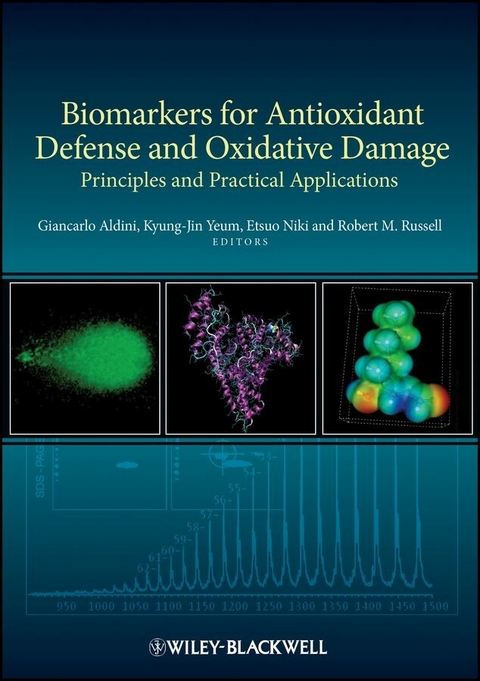
Biomarkers for Antioxidant Defense and Oxidative Damage (eBook)
John Wiley & Sons (Verlag)
978-0-470-96175-9 (ISBN)
Discovering sensitive and specific biomarkers for systemic oxidative damage is essential to understand the role of oxidative stress in human disease. Once these roles are clearly understood, we are able to identify novel drug and nutraceutical targets. This volume goes beyond conventional analytical methods of measuring overall antioxidant activity and provides insight to the discovery of biomarkers that reveal information on specific areas of oxidative stress. Contributed by an international list of experts, Biomarkers for Antioxidant Defense and Oxidative Damage: Principles and Practical Applications describes both conventional biomarkers and recent developments in this area.
Special Features:
- Discusses conventional biomarkers as well as recent advances for measuring antioxidants and oxidative stress
- Biomarkers for lipid peroxidation: isoprostane, hydroxyloctadecaenoic acid, oxysterols, and reactive carbonyl species from lipid peroxidation
- Biomarkers for protein oxidation: carbonylation, tyrosine oxidation, ubiquitin-conjugation
- Biomarkers for DNA oxidative damage: comet assay, hydroxylated nucleotides, and exocylcic DNA adducts
- Recently developed biomarkers from cutting-edge technology
Giancarlo Aldini, Ph.D., Department of Pharmaceutical
Sciences 'Pietro Pratesi', Università degli Studi di Milano, Milan, Italy
Kyung-Jin Yeum, Ph.D., Jean Mayer USDA-Human Nutrition Research Center on Aging, Tufts University, Boston, MA, USA.
Etsuo Niki, Ph.D., , Health Research Institute, National Institute of Advanced Industrial Science & Technology, Osaka, Japan.
Robert M. Russell, M.D., Office of Dietary Supplements, National Institutes of Health, 6100 Executive Blvd., Bethesda, MD 20892-7517, USA
Biomarkers for Antioxidant Defense and Oxidative Damage: Principles and Practical Applications critically evaluates the basic concepts and methodologies of conventional biomarkers as well as current state-of-the-art assays for measuring antioxidant activity/oxidative stress and their practical applications. . Biomarkers for Antioxidant Defense and Oxidative Damage: Principles and Practical Applications will be of a great interest to scientists who are involved in basic research on oxidation, applied scientists evaluating the effects of nutraceuticals or pharmaceutical compounds on antioxidant activity/oxidative stress, and physicians who want to understand the degree of oxidative damage in patients with certain chronic diseases. Discovering sensitive and specific biomarkers for systemic oxidative damage is essential to understand the role of oxidative stress in human disease. Once these roles are clearly understood, we are able to identify novel drug and nutraceutical targets. This volume goes beyond conventional analytical methods of measuring overall antioxidant activity and provides insight to the discovery of biomarkers that reveal information on specific areas of oxidative stress. Contributed by an international list of experts, Biomarkers for Antioxidant Defense and Oxidative Damage: Principles and Practical Applications describes both conventional biomarkers and recent developments in this area. Special Features: Discusses conventional biomarkers as well as recent advances for measuring antioxidants and oxidative stress Biomarkers for lipid peroxidation: isoprostane, hydroxyloctadecaenoic acid, oxysterols, and reactive carbonyl species from lipid peroxidation Biomarkers for protein oxidation: carbonylation, tyrosine oxidation, ubiquitin-conjugation Biomarkers for DNA oxidative damage: comet assay, hydroxylated nucleotides, and exocylcic DNA adducts Recently developed biomarkers from cutting-edge technology
Giancarlo Aldini, Ph.D., Department of Pharmaceutical Sciences "Pietro Pratesi", Università degli Studi di Milano, Milan, Italy Kyung-Jin Yeum, Ph.D., Jean Mayer USDA-Human Nutrition Research Center on Aging, Tufts University, Boston, MA, USA. Etsuo Niki, Ph.D., , Health Research Institute, National Institute of Advanced Industrial Science & Technology, Osaka, Japan. Robert M. Russell, M.D., Office of Dietary Supplements, National Institutes of Health, 6100 Executive Blvd., Bethesda, MD 20892-7517, USA
Biomarkers for Antioxidant Defense and Oxidative Damage: Principles and Practical Applications 1
Contents 7
Preface 9
Contributors 11
Chapter 1: Antioxidant Activity and Oxidative Stress: An Overview 21
Chapter 2: Enzymatic Antioxidant Defenses 39
Chapter 3: Antioxidants as Biomarkers of Oxidative Stress 53
Chapter 4: LDL Oxidation as a Biomarker of Antioxidant Status 69
Chapter 5: The Isoprostanes: Accurate Markers and Potent Mediators of Oxidant Injury in Vivo 83
Chapter 6: Hydroxyoctadecadienoic Acid (HODE) as a Marker of Linoleic Acid Oxidation 103
Chapter 7: Oxysterols: Potential Biomarkers of Oxidative Stress 117
Chapter 8: Lipid Peroxidation Originating ?,?-unsaturated Aldehydes and Their Metabolites as Biomarkers 135
Chapter 9: Oxidative Modification of Proteins: An Overview 155
Chapter 10: Immunochemical Detection of Lipid Peroxidation-specific Epitopes 175
Chapter 11: Mass Spectrometric Strategies for Identification and Characterization of Carbonylated Peptides and Proteins 191
Chapter 12: Nitrotyrosine: Quantitative Analysis, Mapping in Proteins, and Biological Significance 217
Chapter 13: Ubiquitin Conjugates: A Sensitive Marker of Oxidative Stress 237
Chapter 14: Covalent Modifications of Albumin Cys34 as a Biomarker of Mild Oxidative Stress 247
Chapter 15: Protein S-glutathionylation and S-cysteinylation 261
Chapter 16: DNA Oxidation, Antioxidant Effects, and DNA Repair Measured with the Comet Assay 279
Chapter 17: Hydroxylated Nucleotides: Measurement and Utility as Biomarkers for DNA Damage, Oxidative Stress, and Antioxidant Efficacy 301
Chapter 18: Exocyclic DNA Adducts as Biomarkers of Antioxidant Defense and Oxidative Stress 337
Index 351
"Chemists, pharmacologists, and other researchers describe the
principles behind current methods for measuring antioxidant
activity and oxidative stress and their practical applications in
specific health situations." (SciTech Book News, December
2010)
| Erscheint lt. Verlag | 9.6.2011 |
|---|---|
| Sprache | englisch |
| Themenwelt | Sachbuch/Ratgeber ► Gesundheit / Leben / Psychologie |
| Medizin / Pharmazie ► Allgemeines / Lexika | |
| Medizin / Pharmazie ► Gesundheitsfachberufe ► Diätassistenz / Ernährungsberatung | |
| Schlagworte | Antioxidant • Applications • BASIC • Biomarker • Biomarkers • Clinical Nutrition • Concepts • Conventional • Defense • Gesundheits- u. Sozialwesen • Great • Health & Social Care • Interest • Klinische Ernährung • Klinische Ernährung • Medical Science • Medizin • Metabolic disease • Nutraceuticals • Oxidative • Pharmaceutical • Practical • Principles • scientists • Stoffwechselkrankheit • Stoffwechselkrankheiten |
| ISBN-10 | 0-470-96175-9 / 0470961759 |
| ISBN-13 | 978-0-470-96175-9 / 9780470961759 |
| Informationen gemäß Produktsicherheitsverordnung (GPSR) | |
| Haben Sie eine Frage zum Produkt? |
 PDF (Adobe DRM)
Größe: 5,2 MB
Kopierschutz: Adobe-DRM
Adobe-DRM ist ein Kopierschutz, der das eBook vor Mißbrauch schützen soll. Dabei wird das eBook bereits beim Download auf Ihre persönliche Adobe-ID autorisiert. Lesen können Sie das eBook dann nur auf den Geräten, welche ebenfalls auf Ihre Adobe-ID registriert sind.
Details zum Adobe-DRM
Dateiformat: PDF (Portable Document Format)
Mit einem festen Seitenlayout eignet sich die PDF besonders für Fachbücher mit Spalten, Tabellen und Abbildungen. Eine PDF kann auf fast allen Geräten angezeigt werden, ist aber für kleine Displays (Smartphone, eReader) nur eingeschränkt geeignet.
Systemvoraussetzungen:
PC/Mac: Mit einem PC oder Mac können Sie dieses eBook lesen. Sie benötigen eine
eReader: Dieses eBook kann mit (fast) allen eBook-Readern gelesen werden. Mit dem amazon-Kindle ist es aber nicht kompatibel.
Smartphone/Tablet: Egal ob Apple oder Android, dieses eBook können Sie lesen. Sie benötigen eine
Geräteliste und zusätzliche Hinweise
Zusätzliches Feature: Online Lesen
Dieses eBook können Sie zusätzlich zum Download auch online im Webbrowser lesen.
Buying eBooks from abroad
For tax law reasons we can sell eBooks just within Germany and Switzerland. Regrettably we cannot fulfill eBook-orders from other countries.
 EPUB (Adobe DRM)
Kopierschutz: Adobe-DRM
Adobe-DRM ist ein Kopierschutz, der das eBook vor Mißbrauch schützen soll. Dabei wird das eBook bereits beim Download auf Ihre persönliche Adobe-ID autorisiert. Lesen können Sie das eBook dann nur auf den Geräten, welche ebenfalls auf Ihre Adobe-ID registriert sind.
Details zum Adobe-DRM
Dateiformat: EPUB (Electronic Publication)
EPUB ist ein offener Standard für eBooks und eignet sich besonders zur Darstellung von Belletristik und Sachbüchern. Der Fließtext wird dynamisch an die Display- und Schriftgröße angepasst. Auch für mobile Lesegeräte ist EPUB daher gut geeignet.
Systemvoraussetzungen:
PC/Mac: Mit einem PC oder Mac können Sie dieses eBook lesen. Sie benötigen eine
eReader: Dieses eBook kann mit (fast) allen eBook-Readern gelesen werden. Mit dem amazon-Kindle ist es aber nicht kompatibel.
Smartphone/Tablet: Egal ob Apple oder Android, dieses eBook können Sie lesen. Sie benötigen eine
Geräteliste und zusätzliche Hinweise
Buying eBooks from abroad
For tax law reasons we can sell eBooks just within Germany and Switzerland. Regrettably we cannot fulfill eBook-orders from other countries.
aus dem Bereich